Ritual, Protection and the Painted Face
Before beauty was fashion it was chemistry, medicine and religion — and the people who made it knew exactly what they were doing.
HOM · Era3500 BCE – 500 CERitual & Divine Beauty
All of The Ancient World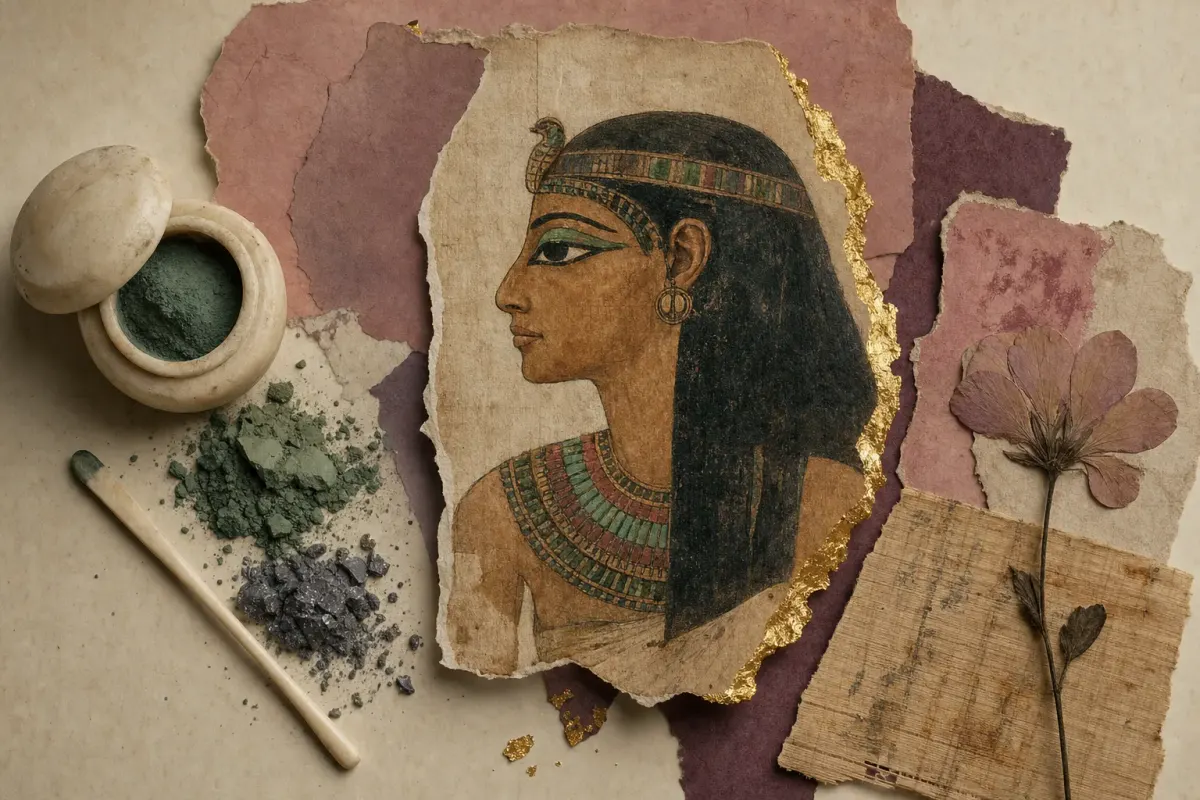
In short
Ancient cosmetics were deliberately manufactured, not merely gathered: analysis of Egyptian kohl shows two of its four compounds were synthesised by a wet-chemistry process that takes weeks, which makes the painted eye of the Nile a piece of technology as much as an ornament.
- 9min read
- 5chapters
- 5sources

Vivien
Your guide through time
Listen to this essay
7 min listenVivien reads our essays aloud, word for word — every date and every name in its place — so you can listen the way you would be walked through a gallery.
An AI voice, designed for History of Makeup
The oldest makeup in the world is not a curiosity. It is a manufactured product, made to a specification, in quantity, by people who understood what they were doing well enough to repeat it for three thousand years.
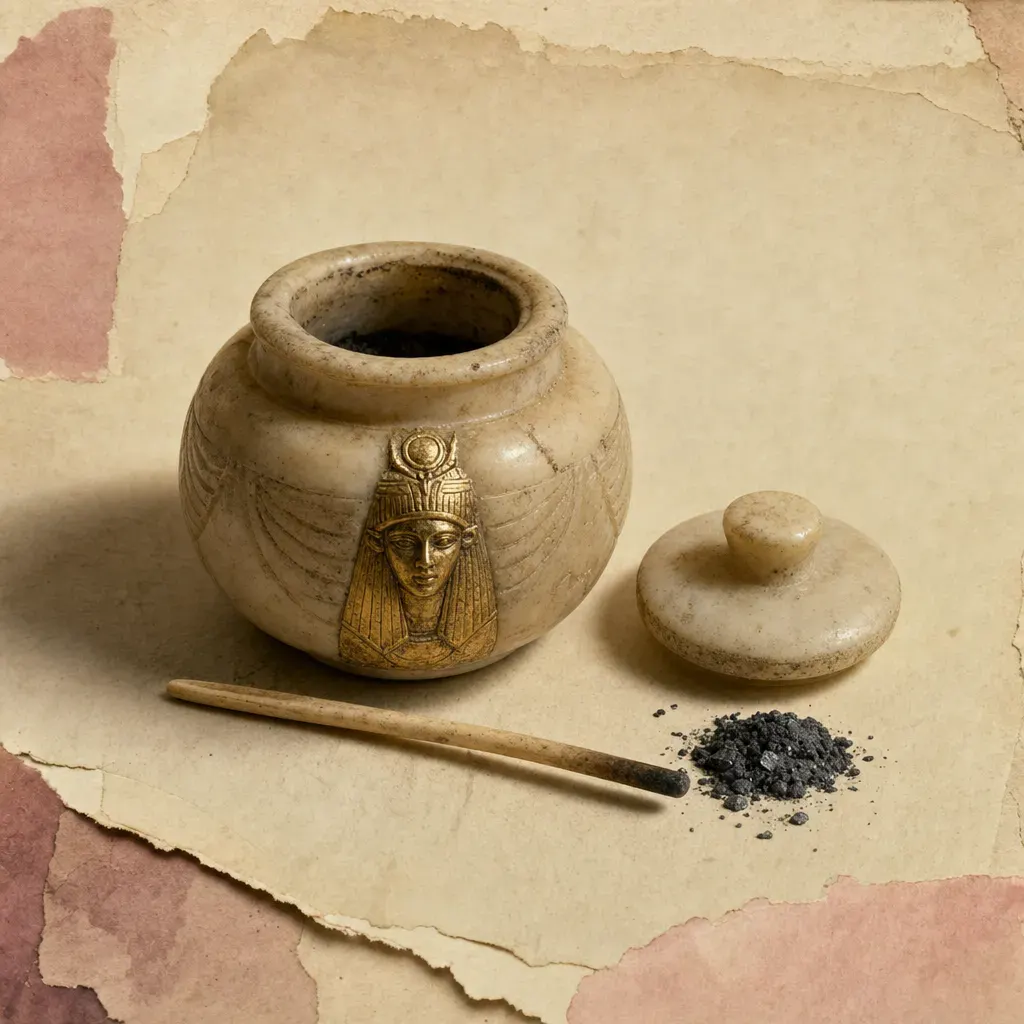
Ground mineral pigment appears in Egyptian graves before the pyramids: malachite for green, galena for grey-black, red ochre for the mouth and cheek. The palettes they were ground on survive in their thousands. So do the pots, the tubes, the applicator sticks and the little spoons — a complete toolkit, buried with its owner because it would be needed again.
Kohl Was Chemistry
For most of the twentieth century, Egyptian kohl was described as ground galena — lead sulfide, dug up and crushed. In 1999 a team working on samples from the Louvre's collection published an analysis that changed the picture. The kohl contained four lead compounds, and two of them — laurionite and phosgenite — are not found in Egypt in any quantity that would supply a cosmetics trade.[2]
They had been made. The process is a wet synthesis, mixing lead oxide with rock salt and natron in water and leaving it to react, with the solution replaced repeatedly over something like a month. Nobody undertakes that by accident. The same research noted the classical sources' claim that these preparations were used against eye disease, and later work has suggested a plausible mechanism, though the balance of benefit against lead exposure remains an open question rather than a settled finding.[2]
What is not in question is the intent. Somebody was running a repeatable chemical process, on purpose, to make an eye cosmetic to a particular formula. That is the oldest documented manufacturing recipe in beauty, and it predates almost everything else in this archive by millennia.
Who Wore It, and Why
Egyptian eye paint was worn by men and women, by the living and the dead, by the wealthy and — in simpler preparations — by a great many people who were not. It was not a gendered signal and it was not principally a seduction. Lined eyes appear on temple walls, on coffins, on workmen and on gods.[3]
Several purposes ran together without competing. The eye was protective: kohl was associated with the restored Eye of Horus, which made wearing it an act with meaning and not only an appearance. It was practical: a dark band around the eye reduces glare, which is not a trivial benefit under that sun. It was medical, or believed to be. And it was, plainly, beautiful — the graves are full of finely made containers, and nobody commissions an alabaster pot for a purely utilitarian substance.[4]
Green came first. Malachite, a copper carbonate, dominates the earliest material; the grey-black galena preparations become general later, and for a long period both were in use, sometimes on the same face.[3]
Greece, Rome and the Pursuit of Pallor
Further north the ideal inverted. Where Egypt drew the eye, Greece and Rome whitened the face, and the whitening agent was lead. Psimythion to the Greeks, cerussa to the Romans, it was white lead carbonate, made by suspending lead over vinegar in a sealed vessel until a crust formed — a process Pliny describes in the Naturalis Historia around 77 CE with no apparent alarm.[5]
Pallor meant leisure. A woman who did not work outdoors was pale, so paleness advertised a household that did not need her to. Red came from ochre, from plant sources, and at the expensive end from cinnabar — mercury sulfide — which was known to be dangerous to the people who mined and processed it.[6]
Roman writing about cosmetics needs handling with care, because most of it is satire. Ovid, Juvenal and Martial are our fullest sources and all three are mocking: the painted woman is a stock figure of the genre, and a joke about a face that melts is a joke, not a measurement. Ovid is the interesting exception — his Medicamina Faciei Femineae sets out actual formulations, in verse, and reads as a genuine technical text wearing a poem's clothes.[6]
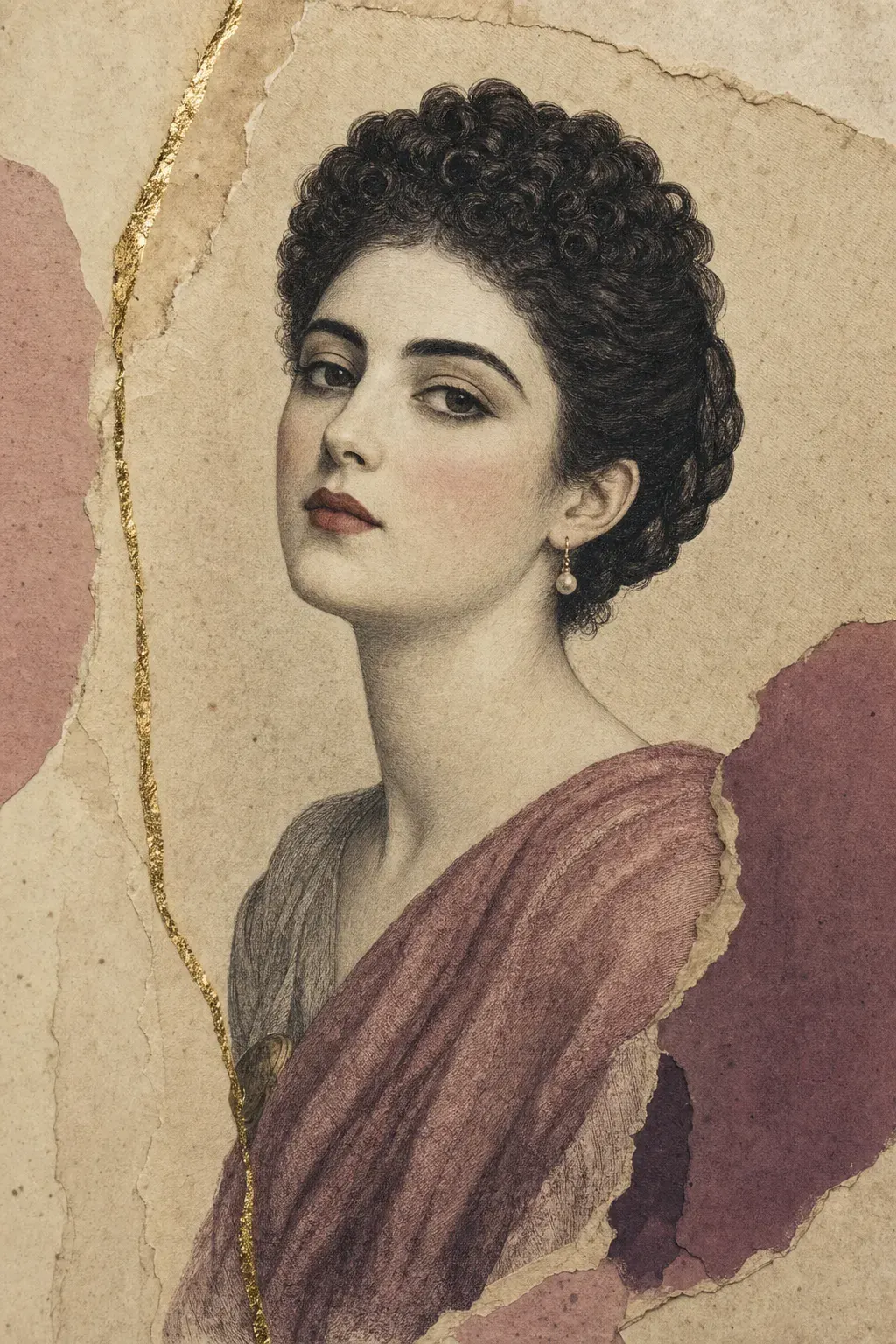
It is made from very fine shavings of lead, placed over a vessel filled with the strongest vinegar; by which means the shavings become dissolved… it is also used by females to whiten the complexion.
What We Do Not Know About Cleopatra
Cleopatra VII is the most-described face in ancient cosmetics and one of the least documented. There is no contemporary account of what she wore. The confident modern descriptions — crushed carmine beetles on the lips, lapis lazuli on the lids, a specific blue above and black below — are reconstructions built backwards from general Ptolemaic practice, and then repeated until they acquired the texture of fact.[8]
What can be said is duller and truer: she was a Ptolemaic ruler in a Hellenised Egyptian court, and the cosmetic materials available to such a court are well attested. Beyond that, the honest answer is that we do not know, and an archive that invents the detail loses the right to be believed about the parts it can actually source.
What the Ancient World Established
Three things begin here and never really stop.
The first is that cosmetics are manufactured. From the Egyptian kohl workshops onward, the interesting question about a cosmetic is not where it was found but how it was made, and by whom, to what standard.
The second is that beauty materials are frequently hazardous, that this is frequently known, and that it frequently changes nothing. Lead carbonate was a complexion standard in Greece, in Rome, in Renaissance Italy and in Georgian England — a run of roughly two thousand years, through repeated documentation of its harm.
The third is that a painted face always means something beyond itself. In Egypt it meant protection and divinity; in Rome it meant leisure, and to the satirists deceit. The materials change constantly. The habit of reading a face as a statement does not.
Sources
- [1, 3]Sacred Luxuries: Fragrance, Aromatherapy, and Cosmetics in Ancient Egypt Cornell University Press, 1999.
- [2]Making make-up in Ancient Egypt Nature 397, 483–484, 1999.
- [4]Egyptian kohl pots and applicators, Department of Egypt and SudanView source (opens in a new tab) Accessed 2026-09-22.
- [5, 7]Naturalis Historia, Books XXXIII–XXXV 77.
- [6, 8]Cosmetics in Roman Antiquity: Substance, Remedy, Poison The Classical World 102.3, 2009.
Continue in The Ancient World
Ritual & Divine Beauty
Browse all 32 articles