The Cosmetic Spoon: A Swimmer Holding Out a Dish
Among the most admired objects in the Egyptian cosmetic record are spoons carved as swimming women. What they held is harder to say than their name suggests.
In short
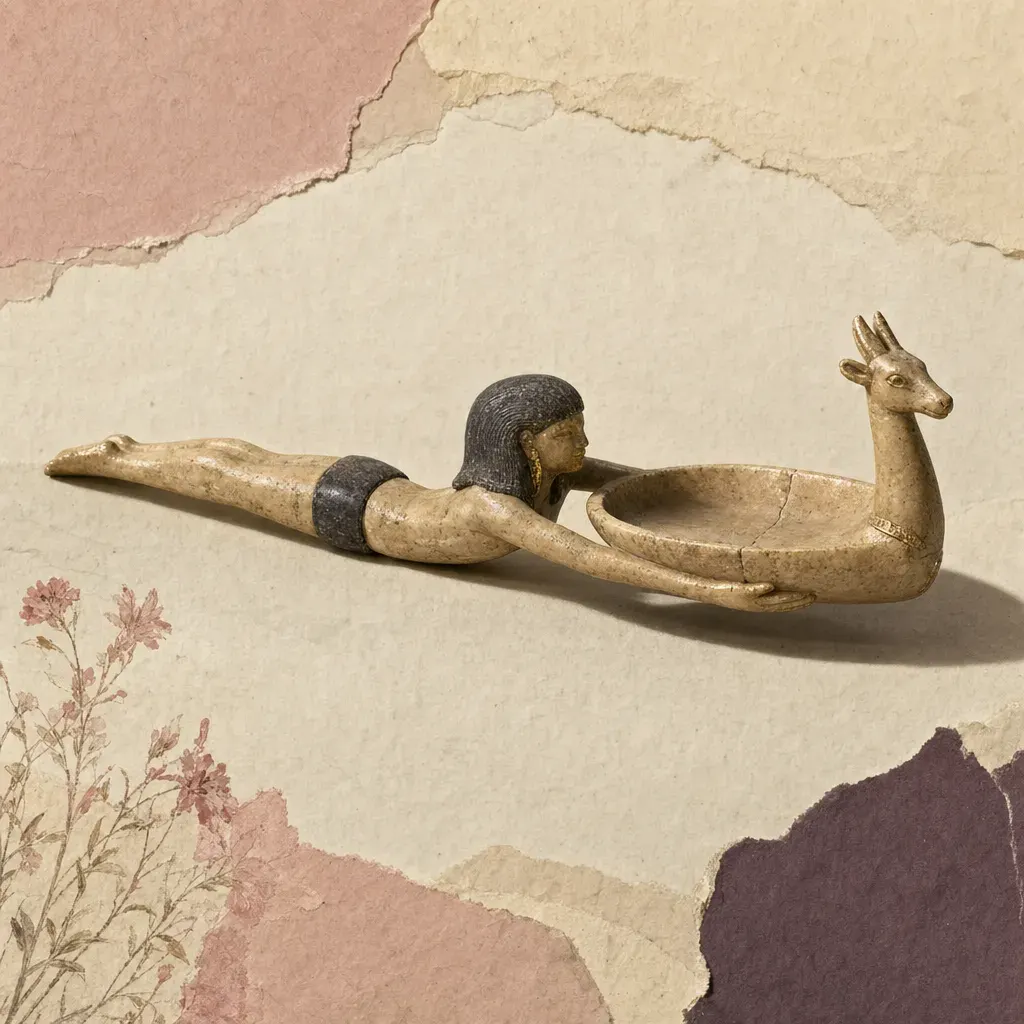
A spoon in the Metropolitan Museum, carved in travertine and steatite in the reign of Amenhotep III, shows a swimming woman pushing a dish shaped like a gazelle ahead of her; museums call such objects cosmetic spoons, a name inferred from their form.
- 3min read
- 4chapters
- 4sources

Vivien
Your guide through time
Listen to this essay
4 min listenVivien reads our essays aloud, word for word — every date and every name in its place — so you can listen the way you would be walked through a gallery.
An AI voice, designed for History of Makeup
Among the objects the Metropolitan Museum catalogues as cosmetic spoons is one carved from travertine and steatite in the reign of Amenhotep III, around 1386 to 1347 BCE. It is twenty-two and a half centimetres long. A young woman swims, her legs stretched out behind her and a dark wig on her head, and holds out in front of her a dish carved as a gazelle, its head raised. The museum's name for the object lists all three: cosmetic spoon, swimming woman, gazelle.[1]
A version in faience made several centuries later, turquoise-blue with black hair, repeats the idea at fifteen and a half centimetres, the swimmer holding an open bowl.[2] They are among the most admired objects in Egyptian art, and their name makes a claim. Cosmetic spoon says what the bowl was for. The objects themselves are quieter on that point than the label.
Where the Name Comes From
A shallow bowl on a handle is a form for holding a small quantity of something precious, and Egyptian practice supplied plenty of candidates: the unguents, oils and pigments that the survey literature places inside a whole culture of fragrance, cosmetics and ritual.[3]
The name is therefore a reasonable inference from the form and from what else Egyptian households kept. But it is an inference. A spoon whose bowl had been analysed and found to hold kohl or unguent would say more than a hundred that have not, and the museum records cited here report no such analysis.[4]
Beside the Working Kit
The everyday equipment of Egyptian cosmetics survives in sets. A group excavated at Thebes in 1911 holds a kohl tube and its applicator with a razor, tweezers, a whetstone and a mirror, made of bronze or copper alloy, stone, ivory and wood.[5] Next to that working kit, the carved spoons look like something else: objects of display as much as of use, worked with a care that ordinary tools rarely received.
That difference is part of the evidence. A spoon carved as a swimming woman was made to be looked at, and whatever it held, it held it in a form that turned an act of preparation into an image.
The name says what the bowl was for. The object is quieter on that point than the label.
The Swimmer
The motif is specific: a young woman swimming, her body at full stretch, the dish held out ahead of her as if she were pushing it across the water. It recurs across centuries. The travertine spoon belongs to the Eighteenth Dynasty,[6] and the faience one to the long span of the Twenty-first to Twenty-fifth,[7] which makes the swimmer a convention rather than one craftsman's idea.
What she meant to the people who owned her is not recorded on the objects, and any reading of her as a symbol has to be argued from somewhere else. What the spoons establish is narrower: the form was prized, repeated and made in fine materials over several hundred years.
What Is Not Known
What any particular spoon held, whether it was used at all, and whether it was made for a living owner or for a burial. The museum records give material, date and dimensions; they do not give contents.[8]
The most accurate name for these objects might be carved spoons of a kind associated with cosmetics. It is longer and less elegant than the one they carry, and it says exactly as much as the evidence does.
Sources
- [1, 4, 6, 8]Cosmetic Spoon in the Shape of Swimming Woman Holding a Dish, accession number 26.2.47 Department of Egyptian Art, The Metropolitan Museum of Art.View source (opens in a new tab) Accessed 2026-09-25.
- [2, 7]Cosmetic Spoon in the Form of a Swimming Girl, accession number 44.4.14 Department of Egyptian Art, The Metropolitan Museum of Art.View source (opens in a new tab) Accessed 2026-09-25.
- [3]Sacred Luxuries: Fragrance, Aromatherapy, and Cosmetics in Ancient Egypt Cornell University Press, 1999.
- [5]Cosmetic set of Kohl Tube and Applicator, Razor, Tweezers, Whetstone, and Mirror, accession numbers 26.7.837a-d and 26.7.1447 Department of Egyptian Art, The Metropolitan Museum of Art.View source (opens in a new tab) Accessed 2026-09-22.
Filed under