A Sealed Jar: What One Container Can and Cannot Prove
A lid that held for twenty-seven centuries produced the best-analysed cosmetic of the ancient world — and a single data point.
In short
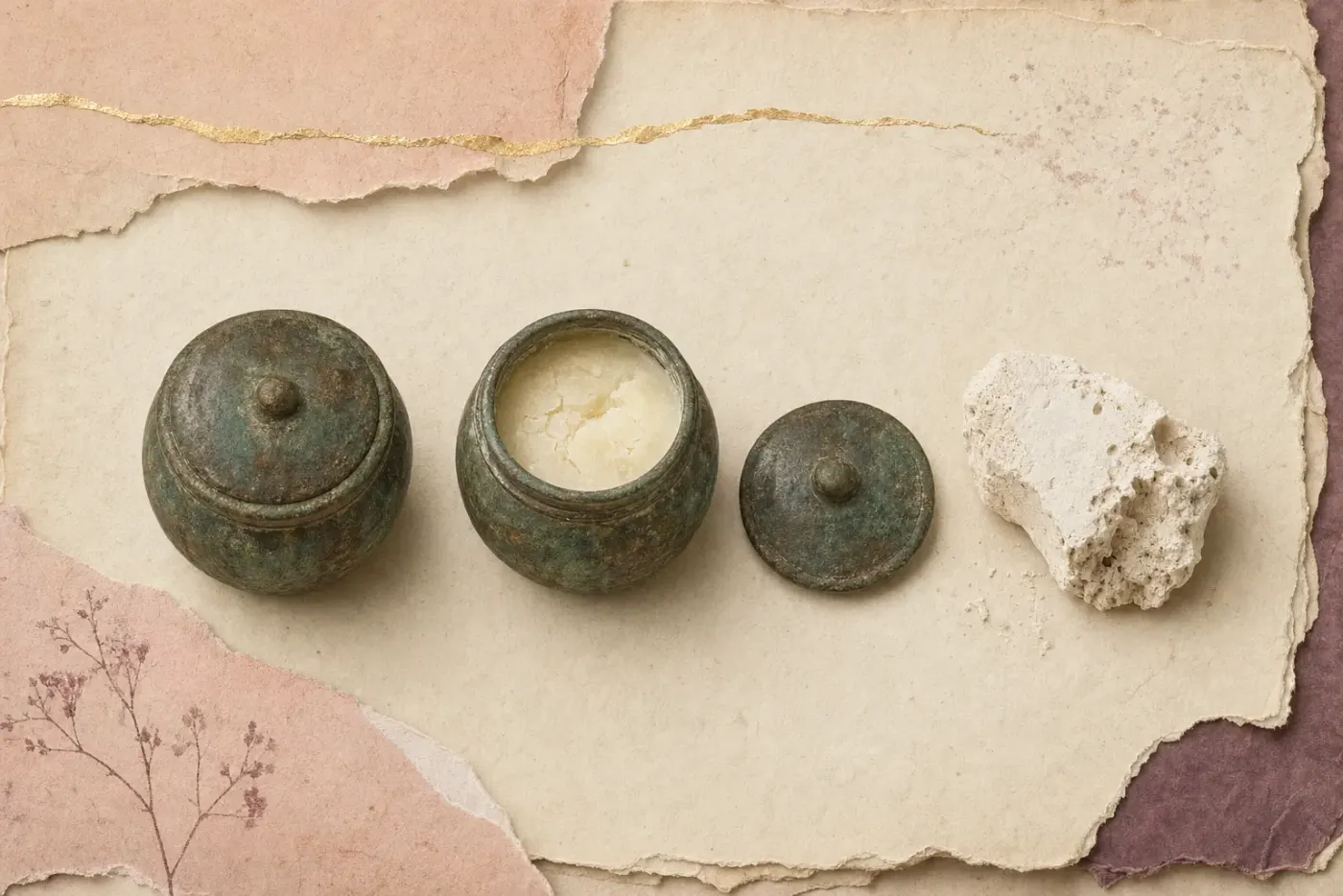
Residue from a sealed container in tomb M49 at the Liujiawa site, a Rui state cemetery of the Spring and Autumn period, was identified as ruminant adipose fat mixed with monohydrocalcite from cave moonmilk; the tomb occupant was male.
- 12min read
- 6chapters
- 1source

Vivien
Your guide through time
Listen to this essay
5 min listenVivien reads our essays aloud, word for word — every date and every name in its place — so you can listen the way you would be walked through a gallery.
An AI voice, designed for History of Makeup
Almost everything known about ancient cosmetics comes from a stain. A stain tells you which elements were present and leaves the recipe to be guessed at.
The container from tomb M49 at Liujiawa, a Rui state cemetery of the Spring and Autumn period, is different: it was sealed, and its contents survived as contents. The residue was identified as ruminant adipose fat mixed with monohydrocalcite from cave moonmilk — a fat and a mineral, in a jar, with a date.[1]
What Those Two Ingredients Are
Ruminant adipose fat is animal fat, the ordinary base of most pre-industrial cosmetics: it carries a powder, spreads on skin and stays where it is put. Nothing about it is exotic, which is part of why the identification is convincing.[2]
Monohydrocalcite from cave moonmilk is the unusual half. Moonmilk is a soft white deposit that forms inside caves, and the mineral in it is a calcium carbonate — so the white in this jar is chalk-family, obtained from a specific and not especially convenient place.[2]
The inconvenience is informative. A whitener could be had from more accessible carbonates, so choosing a cave deposit implies that something about this one — its fineness, its colour, its softness or its associations — was worth the journey, and that somebody knew where to go.[2]
It Is Not Lead
That matters, because the expected answer would have been lead. A great deal of the history of face whitening in every tradition is a history of lead compounds, and here, early, is a calcium carbonate instead.[3]
So the Chinese record does not begin with lead and then find alternatives. It begins with at least one non-lead white already in use, and lead enters a field that was already occupied — which changes the shape of the story from a discovery to a substitution.[3]
The lid is the finding. Everything else follows from a seal that held for twenty-seven centuries.
The Occupant Was Male
The tomb occupant was male, and the detail is worth leaving in rather than quietly passing over, because the default assumption about a buried cosmetic is that it belonged to a woman.[4]
What it establishes is narrower than it looks. A jar in a man’s tomb shows that such a jar could be buried with a man; it does not show that he used it, that men generally did, or that the object was his rather than a gift, an heirloom or a provision for an afterlife. A grave good is a statement by the living.[4]
One Vessel Is One Vessel
The authors draw a wider inference about an emerging cosmetic industry, and that inference rests on a single vessel. The caution is theirs as much as ours, and it should travel with the finding wherever the finding goes.[5]
The distinction is between a recipe and a practice. This jar establishes that somebody, once, combined these two materials and that the result was worth burying; it cannot establish how common the combination was, how it was made, who made it, or whether anyone outside this cemetery would have recognised it.[5]
Why It Still Matters
Because a single well-dated recipe is a fixed point, and the subject has very few. Most statements about ancient cosmetics are reconstructions from texts written centuries later or from residues too degraded to resolve into a formula.[6]
A fixed point also disciplines the guessing around it. Any account of early Chinese cosmetics now has to accommodate a fat-based preparation with a cave-mineral white at this date, and accounts that cannot are wrong about something.[6]
And it is a recipe rather than an inventory. Most analyses recover the elements present and leave the proportions, the preparation and the order of mixing unknowable; intact contents preserve a decision somebody made about how much of what went in, which is the part a formula actually consists of.[6]
What Is Not Known
What the preparation was for is not established. A fat-and-carbonate mixture is consistent with a face white, with a skin dressing, with a medicinal salve and with a ritual preparation, and the jar does not adjudicate between them.[7]
Nor is the supply chain known. Cave moonmilk comes from caves, so somebody went to one, but whether that was the owner, a specialist or a trader is not recoverable from a residue.[7]
Sources
- [1, 2, 3, 4, 5, 6, 7]The Rise of the Cosmetic Industry in Ancient China: Insights from a 2700-Year-Old Face Cream Archaeometry 63 (5), 1042-1058, 2021.View source (opens in a new tab) Accessed 2026-09-22.
Filed under