Malachite
Identity
Obsoleteas of 22 Sep 2026
- INCI name
- MALACHITE
- CAS
- 1319-53-512069-69-1
- EC
- 235-113-6
- Origin
- Mineral
- First attested
- 4,400 BCE
- Also known as
- basic copper carbonate · copper carbonate hydroxide · mountain green
How it is dated
Malachite is the pigment most frequently identified on Predynastic Egyptian cosmetic palettes, from the Badarian period onwards, conventionally about 4400 to 4000 BCE, and green staining survives around the eyes of some bodies of the period.
No regulatory dataset is loaded. The status above is this archive's editorial summary of the documented record, not a statement of any substance's legal position in your jurisdiction, and nothing here is advice on whether to use it.
In short
Malachite is a green copper carbonate mineral, ground on stone palettes into the green eye paint of Predynastic and Old Kingdom Egypt, and one of the earliest cosmetic colours that can be named as a specific substance.
- 3min read
- 4chapters
- 5sources

Vivien
Your guide through time
Listen to this entry
4 min listenVivien reads our essays aloud, word for word — every date and every name in its place — so you can listen the way you would be walked through a gallery.
An AI voice, designed for History of Makeup
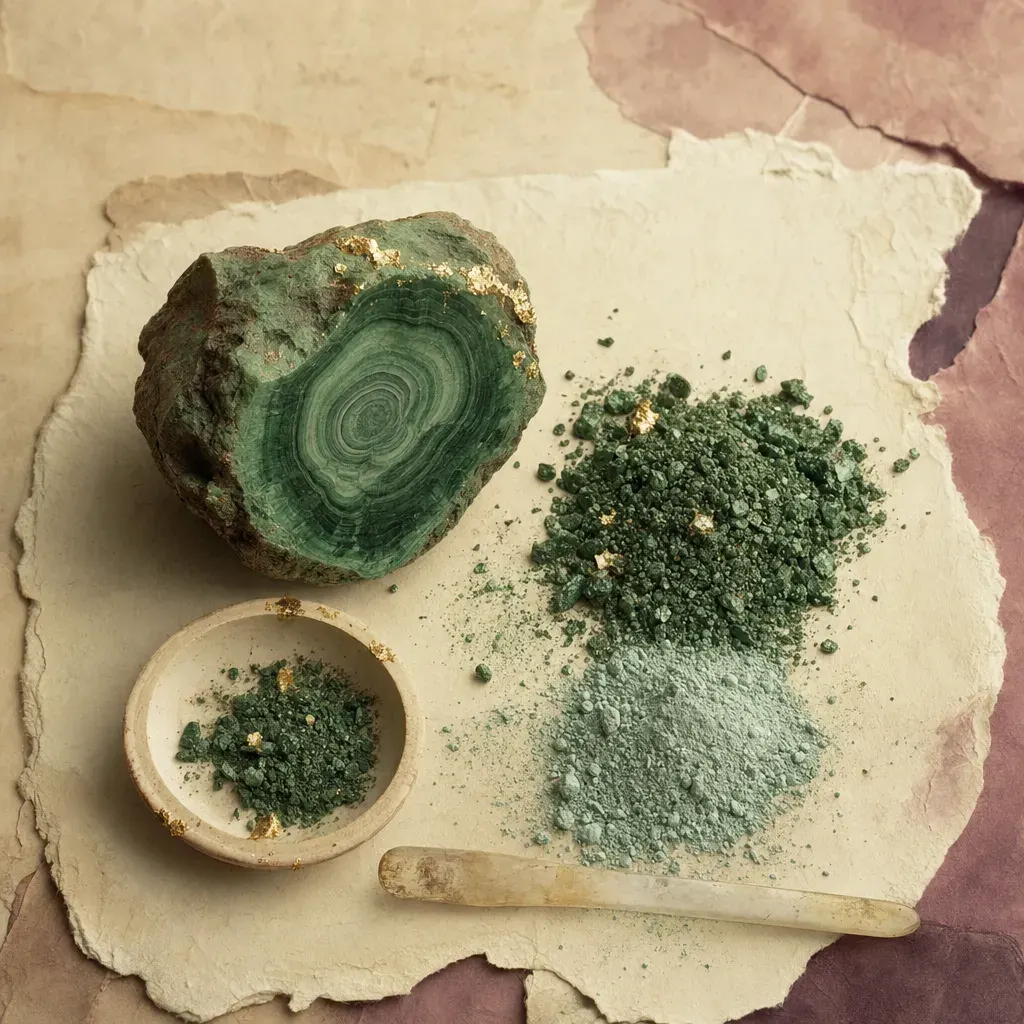
Malachite is a copper carbonate mineral, opaque and banded in bright green, that forms where copper ore weathers near the surface. Crushed and washed it gives a green pigment, and the coarser the grind, the deeper the green.
In Egypt it was the green half of a two-colour convention: malachite below the eye, black galena above.[1] Its recorded use on a face is older than its recorded use on a wall, which is unusual for a pigment and makes it one of the earliest cosmetic colours identifiable as a specific mineral.
What It Is
The compound is a basic copper carbonate, Cu2(CO3)(OH)2, carried under two registry numbers: one for the mineral as mined, one for the salt as prepared industrially.[2] It is soft, around 3.5 to 4 on the Mohs scale, which is why it could be reduced to powder on a siltstone palette with a hand-held pebble rather than a mill. The colour comes from the copper ion.
Particle size governs the shade more than purity does. Ground fine, malachite pales towards a chalky mint; left coarse it holds a saturated green but handles like grit. Hand-prepared malachite is therefore coarse by modern standards, and the residues on surviving palettes look it.
In History
Malachite is the pigment most often identified on the siltstone palettes buried with the Egyptian dead from the Badarian period onwards, through the fifth and fourth millennia BCE.[3] Green staining survives around the eyes of some Predynastic bodies, which is direct evidence that the powder went onto the face and not only into the grave.[4]
Its dominance did not last. By the Old Kingdom the lead-based blacks had taken the upper lid, malachite was confined to the lower one, and green eye paint then leaves the Egyptian cosmetic record altogether.[3] The ore itself came from the Sinai and the Eastern Desert, the regions that also supplied copper metal.[3]
What It Does
Malachite functions as a pigment: an insoluble solid that colours by covering rather than staining. It has moderate opacity and no gloss, so a malachite line reads as flat matte green. Bound with fat or gum it stays where it is put; unbound it dusts away.
Copper compounds are mildly antibacterial, and this is often offered as the reason Egyptians ringed the eye in green. The chemistry is real; the motive is inference. What the Egyptian sources record is the practice and its ritual and protective associations, not a rationale of this kind,[5] and the same claim is made, with the same absence of support, for the black paints.
Safety and Status
Malachite is no longer used as a cosmetic eye pigment, and the obsolescence is specific: what ended was the application, not the mineral. The green line below the eye has no modern successor. Colorants permitted in cosmetic products in the European Union are listed in Annex IV of Regulation (EC) No 1223/2009, adopted on 30 November 2009 and applied in full from 11 July 2013;[7] malachite is not among them, and it is not a listed colour additive in the United States either.
The name nevertheless survives on ingredient lists. MALACHITE is a recognised INCI name, carrying the mineral's own registry number, CAS 1319-53-5, and the Commission's ingredient database records it with a skin-conditioning function rather than as a colorant.[6] That is a different product in a different role, sold for reasons that have nothing to do with covering an eyelid in green. Nothing here is a determination about the safety of any particular preparation, ancient or modern.
Sources
- [1, 3, 5]Sacred Luxuries: Fragrance, Aromatherapy, and Cosmetics in Ancient Egypt Cornell University Press, 1999.
- [2]Substance Infocards, ECHA database of registered substancesView source (opens in a new tab) Accessed 2026-09-22.
- [4]Pigment Stories: Eternal Green in Predynastic Egypt University College London, 2020.View source (opens in a new tab) Accessed 2026-09-22.
- [6]CosIng: Cosmetic Ingredient DatabaseView source (opens in a new tab) Accessed 2026-09-22.
- [7]Regulation (EC) No 1223/2009 on cosmetic products 2009.View source (opens in a new tab) Accessed 2026-09-22.