Blackened Teeth: The Cosmetic That Left a Skeleton
Almost every cosmetic vanishes with the body that wore it. This one stained the part that survives.
In short
Ohaguro is attested from at least the fourth century, with Kofun-period remains, haniwa figures and the Book of Wei’s reference to a land of black teeth; a Grand Council proclamation of 1870 discontinued it among kazoku who had undergone genpuku.
- 12min read
- 6chapters
- 3sources
Vivien
Your guide through time
Listen to this essay
5 min listenVivien reads our essays aloud, word for word — every date and every name in its place — so you can listen the way you would be walked through a gallery.
An AI voice, designed for History of Makeup
The evidential problem running through this whole history is that cosmetics are applied to soft tissue and soft tissue does not survive. Almost everything we know about ancient faces is inferred from containers.
Tooth blackening is the exception. It was applied to enamel, enamel outlasts everything else in a body, and the practice is attested from at least the fourth century, with Kofun-period remains and haniwa figures, and a reference in the Book of Wei to a land of black teeth.[1]
How It Was Done
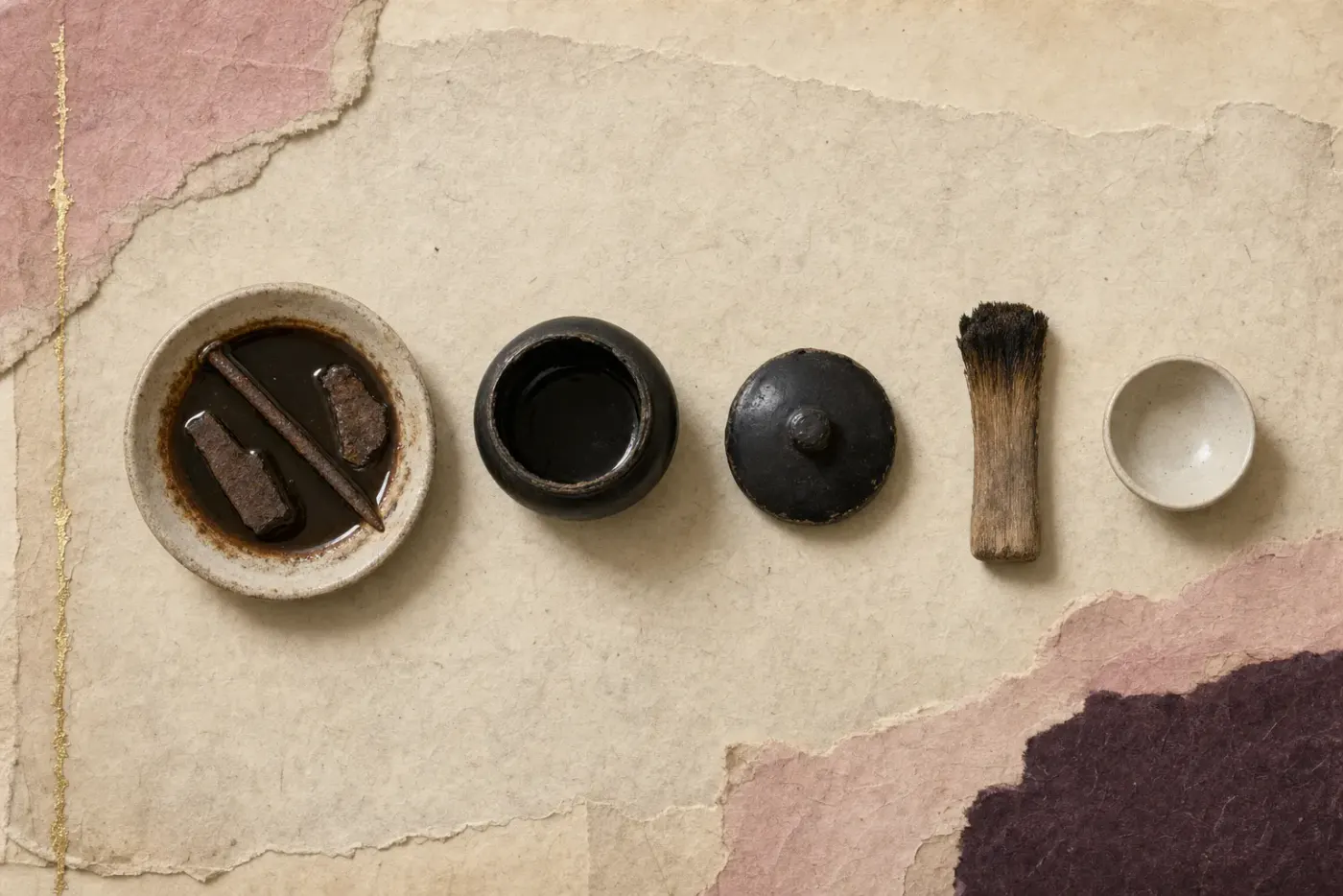
By iron in acid. The recorded method uses vinegar, sake and rice-rinsing water, which together dissolve iron into a solution that stains the tooth surface.[2]
Everything in that list is a kitchen material. It is one of the clearest cases in this history of a cosmetic assembled out of what a household already had, which is also why the practice could be general rather than confined to people who could buy a preparation.[2]
It does have a cost of its own, which is time. A stain has to be maintained as the enamel wears and new surface is exposed, so the practice commits the wearer to a repeated task rather than to a purchase — an inversion of how most cosmetics are paid for.[2]
What It Signified
Status, and stage of life. Blackened teeth and the redrawn brow both carried status meanings rather than being simply decorative, which puts them closer to a wedding ring than to a lipstick.[3]
The brow convention was tied to the same life-stage logic: eyebrows were removed at the birth of a first child.[4] A cosmetic that marks a transition is worn as information, and information of that kind is not a matter of taste.
Two markers used together also encode more than either alone. Blackened teeth and an absent or redrawn brow can be read as a pair, which lets a small vocabulary express several states — the same economy the three-colour palette works by.[3]
Enamel outlasts everything else in a body. This is the one cosmetic that left a skeleton behind.
A Practice Semi-Permanent by Design
A stain on enamel does not come off at the end of a day, which makes ohaguro categorically different from a powder or a paint: it is closer to a tattoo than to a cosmetic, and it commits the wearer.
That is consistent with what it signified. A mark that announces a permanent change of status ought to be permanent itself, and a status marker that washed off every night would be doing its job badly.[5]
It follows that adopting it was a decision of a different order. A powder can be tried and abandoned in an afternoon; a stain on the teeth is entered into, and the practice therefore says something about a society’s confidence that the status it marked would last.[5]
The Government Moves First
A Grand Council proclamation of 1870 — the fifth day of the second month of Meiji 3 — discontinued tooth blackening and eyebrow shaving among kazoku who had undergone genpuku.[6]
The addressees matter and are usually widened in retelling. The instrument names kazoku who had undergone that coming-of-age ceremony, not nobles and officials generally, and a proclamation aimed at a defined group is a different thing from a national ban.[6]
Why a State Legislates a Cosmetic
Because a practice legible as traditional becomes a liability when a government is presenting itself as modern to foreign observers, and the most visible practices go first.
An imperial announcement followed in 1873, and powdered ohaguro persisted into mid-Meiji regardless — which is the ordinary fate of such measures.[7] A proclamation records an intention; the powder on sale afterwards records the practice.
What Is Not Known
How the practice began, and whether the fourth-century attestation marks its start or the start of the surviving evidence for it, is not established. The two are routinely confused and the difference is large.[8]
How widely it was observed outside the groups the records describe is also unclear. Excavated remains, figurines and a foreign chronicle each sample a different and unrepresentative slice of a population.[8]
The Book of Wei reference carries its own caution. A foreign chronicle describing a neighbouring people records what struck an outside observer as remarkable, which is evidence that the practice existed and poor evidence of how ordinary it was.[8]
Sources
- [1, 2, 4, 8]Beauty Secrets in Japanese Prints Asian Art Newspaper, 27 October 2020, 2020.View source (opens in a new tab) Accessed 2026-09-22.
- [3, 5, 7]Kaleidoscope of Books No. 29: Make-up Then and Now — Cosmetic Culture from Edo to Showa National Diet Library, Tokyo, 2021.View source (opens in a new tab) Accessed 2026-09-22.
- [6]Dajōkan Proclamation No. 88 of Meiji 3 (1870): Kazoku genpuku no tomogara, senshi sōbi wo teishi su — tooth-blackening and eyebrow-shaving discontinued among nobles who have undergone genpuku Dajōkan, Empire of Japan; printed in Hōrei Zensho, Meiji 3 (Naikaku Kanpōkyoku), 1870.
Filed under