Galena (Kohl)
Identity
Bannedas of 22 Sep 2026
- CAS
- 1314-87-0
- EC
- 215-246-6
- Origin
- Mineral
- First attested
- 4,400 BCE
- Also known as
- lead sulphide · lead sulfide · lead(II) sulfide · PbS
No INCI name: this material predates the nomenclature and is not a listed cosmetic ingredient.
How it is dated
Galena survives as a residue on Egyptian cosmetic palettes from the Badarian period, conventionally about 4400 to 4000 BCE, alongside green malachite.
No regulatory dataset is loaded. The status above is this archive's editorial summary of the documented record, not a statement of any substance's legal position in your jurisdiction, and nothing here is advice on whether to use it.
In short
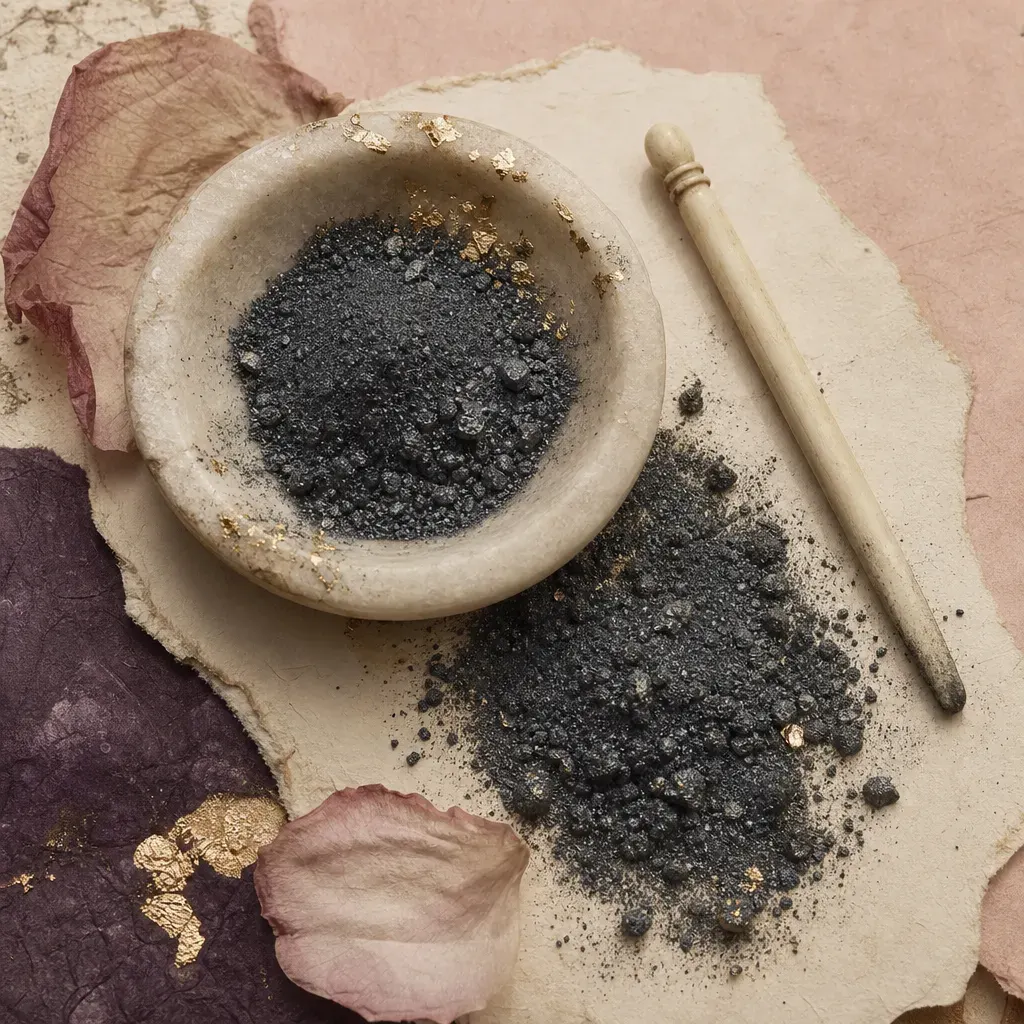
Galena is the natural ore of lead sulphide, ground on a stone palette and bound with fat to make the black eye paint of dynastic Egypt. It is the material behind the oldest sense of the word kohl.
- 3min read
- 4chapters
- 8sources

Vivien
Your guide through time
Listen to this entry
5 min listenVivien reads our essays aloud, word for word — every date and every name in its place — so you can listen the way you would be walked through a gallery.
An AI voice, designed for History of Makeup
Galena is lead sulphide in its natural ore form: a heavy, brittle, metallic-grey mineral that cleaves into cubes and crushes to a soft black powder. Worked into fat or resin, it becomes the black eye paint applied to the upper lid and the brow across three thousand years of Egyptian practice.[1]
It is the material behind the oldest sense of kohl, though the word has since attached itself to a range of powders with little in common but the colour. Galena is also the reason kohl is now handled by regulators as a lead hazard rather than as a cosmetic.
What It Is
The compound is lead(II) sulphide, PbS.[2] In the ore it forms dense cubic crystals with a bright metallic lustre; reduced to powder it loses the shine and goes matte black. It is insoluble in water, which is why a galena paint does not run, and soft enough to grind on a flat stone without specialist equipment.
Analysis of eye-paint residues in the Louvre's Egyptian collection found galena and cerussite, both natural ores, accompanied by laurionite and phosgenite. Those two lead chlorides are not plausible weathering products and do not occur usefully in the local deposits; they appear to have been made deliberately by wet chemical preparation.[3] The finding reframes Egyptian eye paint as a manufactured product rather than a ground mineral.
In History
Galena appears on Egyptian cosmetic palettes from the fourth millennium BCE alongside green malachite, and becomes the dominant eye-paint mineral from the Old Kingdom onwards.[4] Kohl tubes, pots and applicator sticks survive in quantity and are a standing category in Egyptian museum collections.[5]
The ore had to be brought in. Lead isotope analysis of eleven kohl samples from Bronze Age burials in Sudanese Lower Nubia, published in 2024, divided them into two isotopic groups and matched some of them to the pharaonic mining site of Gebel el-Zeit on the Red Sea coast; the second group points to a source not yet identified, and the study does not say which group is the larger.[6] On that evidence at least part of the eye-paint supply travelled the same routes as metal.
What It Does
Galena works as a pigment and an opacifier. It colours by covering, not by staining, and it sits on the surface of the skin. Particle size does most of the work: coarsely ground it reads as grey, milled fine and bound in fat it gives the dense, slightly greasy black recorded in residues and painted on coffin portraits.
Claims that Egyptian eye paint was worn chiefly to repel flies, cut glare from the sun or treat eye disease circulate confidently and rest on thin evidence. Medical and protective associations are genuinely present in the Egyptian textual record.[7] The specific mechanisms now attributed to galena belong to a modern literature laid over that record rather than to the record itself, and this entry treats them as unsettled.
Safety and Status
Lead and its compounds are listed in Annex II of Regulation (EC) No 1223/2009 on cosmetic products, the European Union's register of substances prohibited in cosmetics. The regulation was adopted on 30 November 2009 and applied in full from 11 July 2013, and its annexes have been amended repeatedly since; the listing described here is the consolidated text as at the status date given above.[8] In the United States the Food and Drug Administration states that kohl, kajal, surma and equivalent products are not approved colour additives, and maintains an import alert against eye cosmetics that declare them.[9]
Powders sold under the name remain in wide circulation. A survey of forty-seven kohl samples collected in Oman found galena as the principal component of some, with amorphous carbon, haematite, magnetite, zincite, calcite, minium and sassolite accounting for others.[10] The name says nothing reliable about the contents.
Sources
- [1, 4, 7]Sacred Luxuries: Fragrance, Aromatherapy, and Cosmetics in Ancient Egypt Cornell University Press, 1999.
- [2]Substance Infocards, ECHA database of registered substancesView source (opens in a new tab) Accessed 2026-09-22.
- [3]Making make-up in Ancient Egypt Nature 397, 483–484, 1999.
- [5]Egyptian kohl pots and applicators, Department of Egypt and SudanView source (opens in a new tab) Accessed 2026-09-22.
- [6]Bronze age supply chains between ancient Egypt and Nubia revealed by lead isotope analysis of kohl samples Scientific Reports 14, article 27488, 2024.View source (opens in a new tab)
- [8]Regulation (EC) No 1223/2009 on cosmetic products 2009.View source (opens in a new tab) Accessed 2026-09-22.
- [9]Kohl, Kajal, Al-Kahal, Surma, Tiro, Tozali, or Kwalli: By Any Name, Beware of Lead PoisoningView source (opens in a new tab) Accessed 2026-09-22.
- [10]Composition of eye cosmetics (kohls) used in Oman Journal of Ethnopharmacology 60(3), 223-234, 1998.View source (opens in a new tab)