The Eyeshadow Palette: A Format That Sells a Relationship
The grid of pressed pans is a recent invention, and it argues something a single colour cannot.
In short
By the mid-1930s the Kurlash company's Shadette range ran to twelve eyeshadow shades and Elizabeth Arden's Eye Sha-Do Paste to around fourteen, each bought one at a time, which is what makes the grid of pans in a single case a distinctly later idea.
- 8min read
- 6chapters
- 9sources
Vivien
Your guide through time
Listen to this essay
8 min listenVivien reads our essays aloud, word for word — every date and every name in its place — so you can listen the way you would be walked through a gallery.
An AI voice, designed for History of Makeup
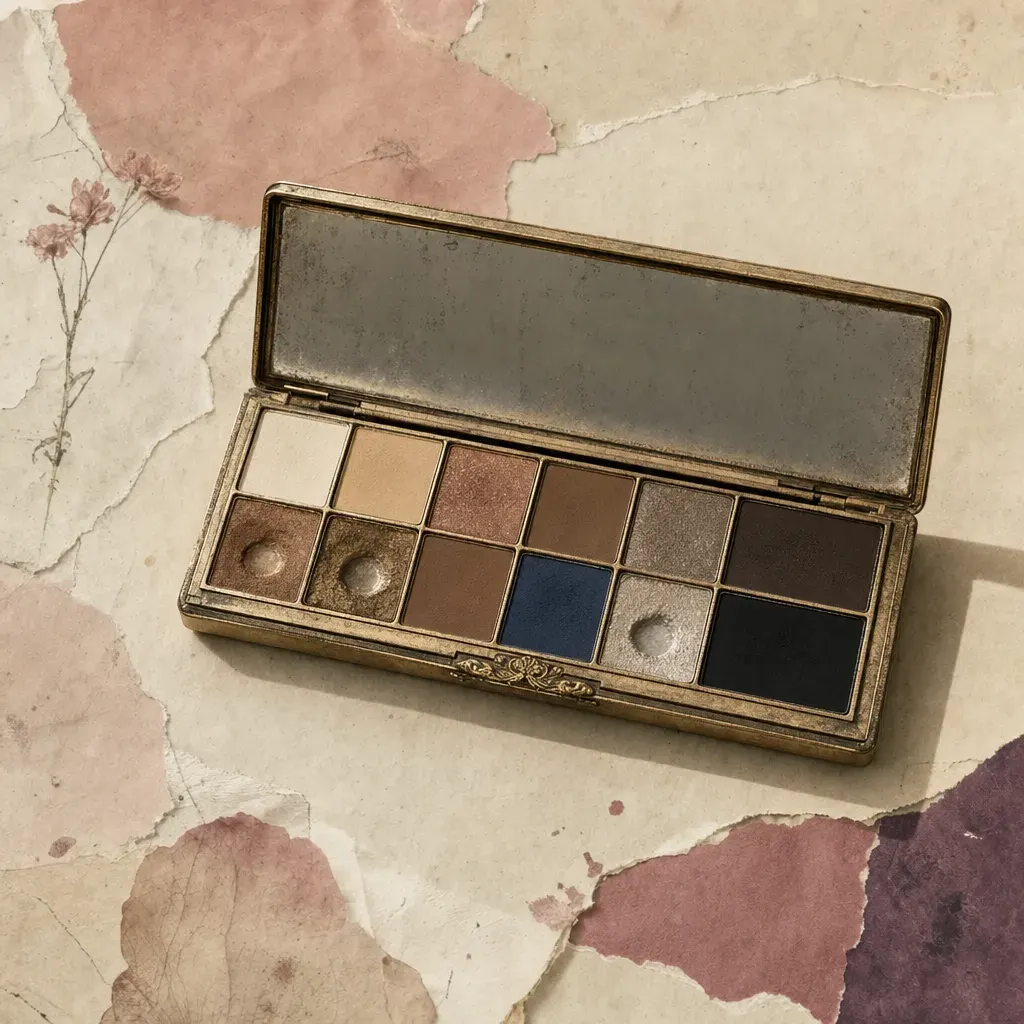
A modern eyeshadow palette is a tray of pressed pans in a case with a mirror. It holds anywhere between four and forty colours, arranged in rows, commonly with the pale shades at one end and the dark ones at the other, and it is sold as a unit under a single name.
That format is not old. For most of the twentieth century eyeshadow was bought the way paint is bought: one colour, chosen for a purpose. The palette is an argument that particular colours belong together, and the argument is the product.
A Borrowed Word
Palette carries three meanings in this subject and they are not the same. In Egyptology it is a flat greywacke slab of the kind found in Predynastic burials, shaped as fish, boats and animals; a boat-shaped example in the Metropolitan Museum is twenty-five centimetres long and dated to roughly 3900 to 3500 BCE.[1]
Malachite was prepared on these, but not by grinding in the way nineteenth-century accounts describe. Experimental work indicates the ore was crushed against a large anvil stone with a handheld hammer stone, and the resulting shards then worked to a fine powder on the palette's polished surface. Green staining survives on palettes recovered from graves and malachite residue survives around the eyes of human remains of the period, while palettes from settlement contexts more often carry red ochre, which is why the objects are taken to have held more than one role.[2]
In painting, a palette is a mixing board: a surface for combining colours chosen elsewhere. In cosmetics the word means neither of those. It means a set of colours already selected, pressed, and fixed in position.
One Shade at a Time
The commercial record is clear about how eyeshadow was sold. The Kurlash company introduced Shadette, a compact eyeshadow, in 1930, in brown, blue, green and violet. Gold and mahogany were added in 1936, taking the range to twelve, and iridescent versions followed in 1938.[3] Elizabeth Arden's eye range in 1930 included Venetian Eye Sha-Do, a compact eyeshadow, alongside cake and liquid mascaras and an eyebrow pencil; by 1935 the paste version ran to roughly fourteen shades and the compact to seven.[4]
Every one of those was a separate purchase. A woman assembling a combination did the assembling herself, and any relationship between two shades was her own work.
A single shade sells a colour. A palette sells an opinion about which colours go next to which.
Selling the Relationship
Colour harmony is the merchandising idea usually reached for at this point, and it is worth being exact about what it was. In the trade of the 1920s it meant complexion typing: matching a product's shade to the colouring of the person wearing it. Max Factor's Society Make-up of 1927 divided customers into four groups, blondes, brunettes, redheads and brownettes, and neither the practice nor the idea of sorting customers into types was new or peculiar to one firm — colour typing was in use across numerous cosmetic companies through the decade. James Bennett reports that Fred Basten's biography of Max Factor credits him with first developing Color Harmony in 1918, and describes that attribution as an unverified claim.[5]
That is a proposition about the relation between a product and a face. The palette makes a different one, about the relation between a shade and the shade next to it in the tray, and nothing in the trade record of the 1920s advances it. The reading offered here — that the tray does to a set of colours what a counter assistant once did to a customer's complexion — is this entry's own, and is offered as a reading rather than as a documented continuity.
The Pan Made It Possible
The enabling technology is the godet: a shallow metal cup holding pressed powder, set into a case. Patents for inserting godets into compacts appear from 1917, developed for pressed face powder rather than for eye colour.[6] A godet can be made small, several can sit side by side in one tray, and each can be replaced without disturbing its neighbours.
The format was therefore available for decades before it was used to sell a set of eyeshadows, and it was not idle in the meantime. Cases with more than one well were patented and sold for other products from the start of the 1920s: Antoine Vericel's vanity box, granted in 1921, holds two powder receptacles and two puffs alongside a compartment for a lipstick, in a case built to be carried in a handbag.[7]
So a tray with several wells in it is not the thing that had to be invented. What has to be shown is when that arrangement was first used to sell a set of eye colours as a set, and that needs a dated object with a record behind it, which this entry does not yet have.
One Case, Several Colours
Mary Quant's cosmetics range, launched in London on 28 March 1966, is the case usually pointed to. The Victoria and Albert Museum records Quant's own account of experimenting with artists' materials — paint brushes, watercolour paint boxes and crayons — and her aim of streamlining cosmetics, so that products worked well together, women spent less time applying them and had fewer items to carry around.[8] That is an argument for a coordinated set, made by the person selling one.
What survives as an object is later and is not a tray of pans. The museum holds a Mary Quant Overnighter cosmetics case of about 1970, in orange PVC with a stud closure and the silver daisy logo on the front flap, twenty centimetres tall, containing two lift-out trays of Quant-branded cosmetics and skincare.[9] The distinction matters for this entry. Assembling several products under one lid is an old idea, and a fitted carrying case is one form of it. Pressing several eye colours into a single tray and selling the arrangement itself is the later and narrower one, and it is the one that still wants a dated first example.
What the Grid Argues
A palette is laid out to be read. Position implies function: a pale shade for the lid, a mid tone through the socket, a dark one at the lash line. Nothing enforces that reading. The layout is a suggestion rather than an instruction, but it is a suggestion made in metal and pressed powder instead of in a leaflet.
What a palette does not say is worth noting too. A tray of twelve rarely sees twelve colours used. It is bought for two or three, and the remainder are the argument for buying it. That is the difference between selling a colour and selling a relationship.
Sources
- [1]Boat-shaped palette, accession number 07.228.156 Department of Egyptian Art, The Metropolitan Museum of Art.View source (opens in a new tab) Accessed 2026-09-22.
- [2]Pigment Stories: Eternal Green in Predynastic Egypt University College London, 2020.View source (opens in a new tab) Accessed 2026-09-22.
- [3]Kurlash Cosmetics and Skin.View source (opens in a new tab) Accessed 2026-09-25.
- [4]Elizabeth Arden (1930-1945) Cosmetics and Skin.View source (opens in a new tab) Accessed 2026-09-22.
- [5]Max Factor Cosmetics and Skin.View source (opens in a new tab) Accessed 2026-09-22.
- [6]Compressed Face Powders Cosmetics and Skin.View source (opens in a new tab) Accessed 2026-09-22.
- [7]US Patent 1,381,036 - Vanity-box United States Patent Office, 1921.View source (opens in a new tab) Accessed 2026-09-22.
- [8]The story of Mary Quant make-upView source (opens in a new tab) Accessed 2026-09-22.
- [9]'Overnighter' cosmetics case, Mary Quant, accession number T.107-2021 Victoria and Albert Museum, London.View source (opens in a new tab) Accessed 2026-09-22.
Filed under