The Hand Mirror: The Technology of Seeing Your Own Face
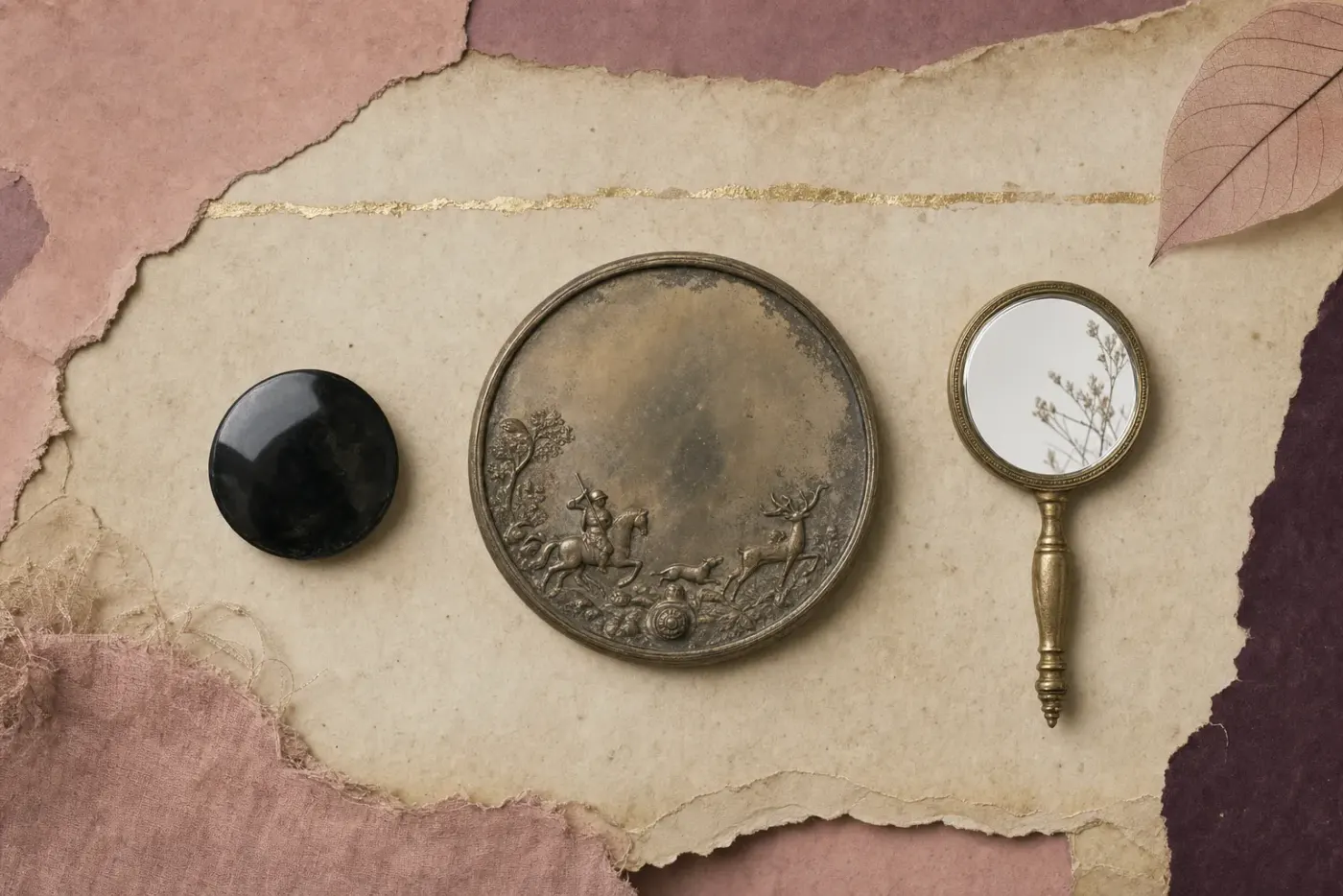
Obsidian, polished bronze, silvered glass. Every cosmetic technique that demands precision demands a mirror first.
In short
Fifty-six Neolithic obsidian mirrors are known from six sites in central Anatolia, with one further example from Tel Kabri in the Levant; a 2025 study of the mirrors and preforms at Tepecik Çiftlik identifies it as a potential manufacturing site and proposes, as a hypothesis, that mirrors were distributed from there in the seventh millennium BCE.
- 9min read
- 6chapters
- 10sources

Vivien
Your guide through time
Listen to this essay
8 min listenVivien reads our essays aloud, word for word — every date and every name in its place — so you can listen the way you would be walked through a gallery.
An AI voice, designed for History of Makeup
A mirror in the Metropolitan Museum, from a tomb in the Wadi Gabbanat el-Qurud west of Thebes, has a disc of silver fourteen centimetres across. The handle is a Hathor emblem, its ancient gold sheathing now carried on a modern wooden core. The object stands twenty-nine centimetres tall and dates to the reign of Thutmose III, about 1479 to 1425 BCE.[1]
It is an expensive object and, by modern standards, a poor mirror. That combination is most of the history of the thing. Until the nineteenth century a clear reflection was difficult to make, and a clear reflection of a whole face was a mark of wealth.
Obsidian First
The oldest objects that are unambiguously mirrors are discs of obsidian, slightly convex, with a highly reflective polished face. Fifty-six are known from the Near East, spread across six sites in central Anatolia — Tepecik Çiftlik, Çatalhöyük East, Sırçalıtepe, Güvercinkayası, Domuztepe and Akarçay Tepe — occupied between the eighth and the beginning of the fifth millennium BCE, with one further example from Tel Kabri in the Levant. They turn up in graves, in middens, in the infill of buildings after abandonment, in caches and on the surface.[2]
A study published in 2025 applied an interdisciplinary approach, combining typology, technology and use-wear analysis, to the mirrors and preforms found at Tepecik Çiftlik. It identifies the site as a potential mirror manufacturing centre and advances, as a hypothesis, the distribution of mirrors during the seventh millennium BCE in central Anatolia. Its author describes the work as a preliminary step, contributing to the identification of that site and to the reconstruction of the complete chaîne opératoire.[2] A settled account of where these objects were made, and how far they travelled, does not yet exist.
Metal, and Its Limits
In Egypt and the Mediterranean, from the Bronze Age the standard mirror is a cast metal disc, polished, usually with a handle. Copper alloy is the common material; silver, as in the Hathor mirror, is the expensive one. Egyptian examples are often found as part of a grooming set rather than alone. One excavated for Lord Carnarvon by Howard Carter in 1911, from tomb CC 37 at Thebes, sits with a kohl tube and applicator, a razor, tweezers and a whetstone.[3]
That mirror measures nine centimetres by seven. It shows an eye, a mouth, a part of a face. A polished metal surface also dulls and must be repolished, and what it returns is dimmer and warmer than glass. It is a working tool for lining an eye, not an instrument for examining a head.
The Largest Body of Evidence Is Chinese
The longest and largest run of pre-modern mirror evidence is not Mediterranean but Chinese, and a history of the object that stops at Egypt and Europe has left out most of it. The Chinese mirror is a cast disc, decorated on the back and polished on the face; the Metropolitan Museum's Tang example of the eighth century, worked with a hunting scene, is bronze and twenty-one and a half centimetres across.[4]
The alloy is distinctive. A Western Han mirror examined in 2025 is described as a high-tin bronze; it carried only basic polishing marks and no coating of any kind, and its silver-grey lustre belongs to an oxidised tin-rich phase of the metal itself, left at the surface after copper was lost from it.[5] Reflection here is a property of the alloy and the polish, not of anything applied.
The scale is distinctive too. A study published in 2024 characterised forty-seven Han bronze mirrors from Zhejiang, Anhui and Fujian by typo-chronology, lead isotope analysis, compositional analysis and metallography, and set them against comparative data from China, Japan, Central Asia and Southeast Asia. It found that mirror production shifted towards a more standardised industry in the middle to late Western Han, and that mirrors of that period turn up well outside Han China — in Japan, Thailand, Afghanistan, and in Xiongnu and Dian contexts.[6] That is a manufacturing and distribution network of its own, running alongside everything described above and documented by the same isotopic methods used on Egyptian kohl.
A mirror cheap enough to lose is a nineteenth-century object. The compact in a handbag depends on it.
Glass, Tin and Mercury
A glass mirror needs two things: glass flat and clear enough to see through without distortion, and a reflective backing that will hold to it. The European answer, standard for roughly three hundred years, was an amalgam of tin and mercury. A sheet of tin foil was laid flat, mercury poured over it, and the glass plate lowered onto the liquid surface and weighted while the amalgam set.[7]
The process was slow and hazardous to the people who carried it out, the plates were costly, and the product was a fitting for rooms rather than a personal possession. For most of its European history the mirror belongs to the study of furniture.[8]
Silvering
The change that made mirrors ordinary was chemical. Silver can be deposited onto glass from solution, giving a bright, even, thin reflective layer with no mercury and none of the waiting an amalgam plate required. Justus von Liebig is the name attached to the method, and the date usually given for the discovery is earlier than any publication of it: his own account of the silvering and gilding of glass appeared in German in the Annalen der Chemie und Pharmacie in 1856, and in English in the Journal of the Franklin Institute the same year.[9]
What followed was volume. A silvered glass mirror could be made small, backed, framed and sold cheaply, and within a generation a mirror was an ordinary possession rather than an installed luxury.[10]
What It Made Possible
Cosmetic technique tracks the mirror closely. A line drawn along a lash root, a matched pair of brows, a mouth shaped to an edge: each requires seeing the work while doing it, at close range, in adequate light. The Egyptian grooming set carries a mirror for exactly that reason, at nine centimetres by seven.
The compact completed the sequence. Antoine Vericel's vanity-box patent of 1921 describes a mirror that could be raised into position for use and retained in the case when it was shut.[11] Once a bright reflective surface could be made cheaply and hinged into a metal case, it stopped being household furniture and became something carried in a bag, and the work it supported could be done anywhere. The mirror is the quiet precondition for most of what the rest of this site describes.
Sources
- [1]Mirror with Handle in the Form of a Hathor Emblem, accession number 26.8.97 Department of Egyptian Art, The Metropolitan Museum of Art.View source (opens in a new tab) Accessed 2026-09-22.
- [2]Neolithic obsidian mirrors from Southwest Asia: A reflection on their diffusion and manufacture Journal of Archaeological Science: Reports, volume 62, article 105047, 2025.View source (opens in a new tab)
- [3]Cosmetic set of Kohl Tube and Applicator, Razor, Tweezers, Whetstone, and Mirror, accession numbers 26.7.837a-d and 26.7.1447 Department of Egyptian Art, The Metropolitan Museum of Art.View source (opens in a new tab) Accessed 2026-09-22.
- [4]Mirror with hunting scene, accession number 25.20.3 Department of Asian Art, The Metropolitan Museum of Art.View source (opens in a new tab) Accessed 2026-09-22.
- [5]Microstructures and electrochemical corrosion behaviors of bronze mirror npj Heritage Science, volume 13, issue 1, 2025.View source (opens in a new tab)
- [6]Reconstructing the trade history: provenance study of Han bronze mirrors in and out of Han China Archaeological and Anthropological Sciences, volume 16, issue 7, 2024.View source (opens in a new tab)
- [7]The tin-mercury mirror: its manufacturing technique and deterioration processes Studies in Conservation 38(1), 3-16, 1993.View source (opens in a new tab)
- [8, 10]The Mirror: A History Routledge (English edition; first published in French as Histoire du miroir), 2001.
- [9]On the silvering and gilding of glass Journal of the Franklin Institute, volume 62, 318-321, 1856.View source (opens in a new tab)
- [11]US Patent 1,381,036 - Vanity-box United States Patent Office, 1921.View source (opens in a new tab) Accessed 2026-09-22.
Filed under