The Bath: Where the Body Was Made Ready
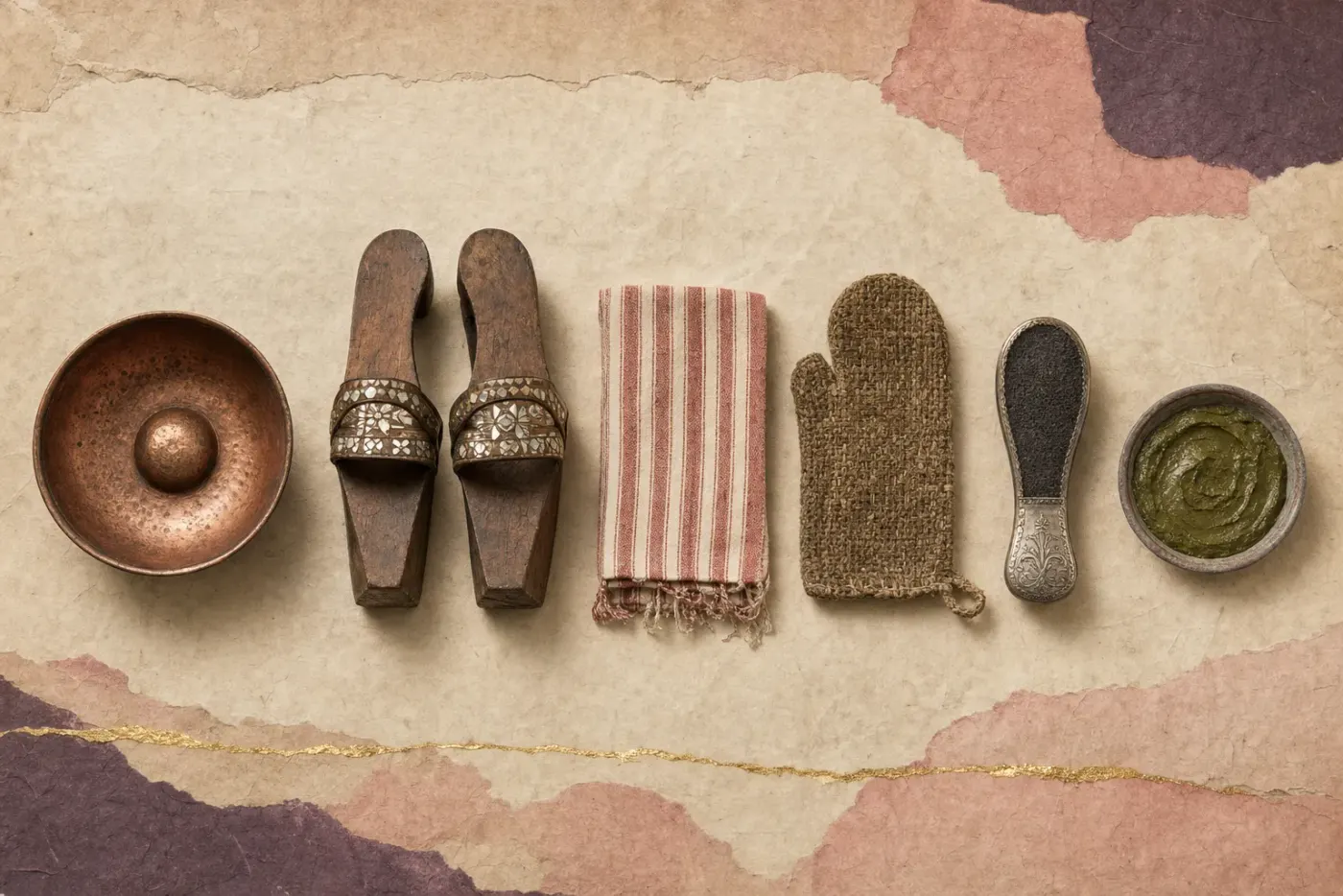
For most of history the public bath was not where make-up came off. It was where hair was removed, skin was scrubbed and hair was braided, in company, for hours.
In short
Lady Mary Wortley Montagu visited the women's baths at Sofia in 1717 and counted about two hundred women there, who stayed four or five hours while their attendants braided their hair: "'tis the women's coffee-house".
- 4min read
- 5chapters
- 5sources
Vivien
Your guide through time
Listen to this essay
5 min listenVivien reads our essays aloud, word for word — every date and every name in its place — so you can listen the way you would be walked through a gallery.
An AI voice, designed for History of Makeup
The philosopher Seneca once took lodgings directly over a public bath, and wrote to a friend listing the noise. There was the man exercising with lead weights, the slap of the masseur's hand, the swimmer, the cake-seller and the sausage-man. And there was the hair-plucker, shouting in a shrill voice to advertise himself, quiet only when he was plucking someone's armpits and making his customer yell instead.[1]
The joke is a record. Removing body hair was a service sold at the Roman bath, done in the open among the crowd. For most of history the bath was not where make-up came off. It was where the body was made ready for it.
The Women's Coffee-House
In April 1717 Lady Mary Wortley Montagu, travelling to Constantinople with her husband, the English ambassador, stopped at Sofia to see its hot baths. She arrived at about ten in the morning and found the bath already full: about two hundred women on two tiers of marble sofas, the ladies above and their slaves behind them, drinking coffee or sherbet, talking or working, while the slaves braided their hair "in several pretty fancies".[2]
Her summary is the line everyone quotes: "'tis the women's coffee-house, where all the news of the town is told, scandal invented, &c." They went, she was told, about once a week, and stayed four or five hours. The women tried to undress her for the bath, and when she showed them her stays they concluded that her husband had locked her into them.[2]
The Tire-Woman
A century later Edward William Lane described the same institution in Cairo, where between sixty and seventy public baths served the city. When a bath was given over to women, a cloth hung over the door to warn men away. A lady of wealth brought her own attendant, the belláneh, whom Lane calls "the washer and tire-woman": she rubbed and washed her clients, plaited their hair and applied the depilatory, and the women spent an hour or more under her hands before resting, eating and talking.[3]
Lane records the depilatory too. The usual one was a resin applied melted; the one often preferred in the bath, called noorah, was quicklime with about an eighth part of orpiment, made into a paste that loosened the hair in about two minutes and was washed off.[3] The bath was also, he notes, where a mother might choose a bride for her son from among the girls she saw there.[3]
The bath was not where the face came off. It was where the body was made ready for it, in company.
A Bride at the Bath
The bath had its own ceremonies. In Constantinople Montagu watched a bride of about seventeen received at one of the finest baths by some two hundred women, relations and friends of the two families. Undressed like everyone else, she was led round the three largest rooms in procession, with perfume carried before her in silver-gilt pots and a wedding song sung in chorus, and then presented to each married woman in turn, who gave her a gift.[4]
In Cairo the bride also went to the bath in state, in a procession Lane calls Zeffet el-Hammám, and on her return her hands and feet were dyed on the Night of the Henna.[5] In both cities the bath was the first stage of the bridal toilette, a preparation of the body before any colour was put on it.
The Bath Comes to London
The hammam reached Victorian Britain as a cure. The historian of the Victorian Turkish bath has identified more than six hundred opened in the British Isles after 1856, the first London ones used largely as a remedy for illness.[6] The grandest, the Hammam at 76 Jermyn Street, opened to the public on 28 July 1862, with David Urquhart, its inspiration, as first manager and the dermatologist Erasmus Wilson among its larger shareholders.[7]
Urquhart's own plan shows what changed in the crossing. The women were to have a separate street entrance, kept from intruding on the central hall, and room for seventy bathers at once, against three hundred on the men's side.[7] In Sofia and Cairo the women's bath had been a world of its own. In London it was a side door.
What Is Not Known
What the women in these baths said about themselves. Every account here is an outsider's: a Roman philosopher complaining about the noise, an English ambassador's wife who was herself the curiosity, an English scholar describing a women's world partly, by his own account, from what he was told.[8] The ritual is well described from its edges, and almost never from inside.
Sources
- [1]Moral Letters to Lucilius, Letter 56: On Quiet and Study Loeb Classical Library (Ad Lucilium Epistulae Morales, volume 1); Wikisource transcription, 1917.View source (opens in a new tab) Accessed 2026-09-25.
- [2, 4]Letters of the Right Honourable Lady M—y W—y M—e, written during her travels in Europe, Asia, and Africa Thomas Martin, London (a new edition, complete in one volume); Project Gutenberg eBook #17520, 1790.View source (opens in a new tab) Accessed 2026-09-25.
- [3, 5, 8]An Account of the Manners and Customs of the Modern Egyptians, written in Egypt during the years 1833-1835 Ward, Lock and Co., London (reprint of the third edition of 1842); Project Gutenberg eBook #70796, 1890.View source (opens in a new tab) Accessed 2026-09-25.
- [6]The Victorian Turkish bath arrives in 19th century London Victorian Turkish Baths (victorianturkishbath.org).View source (opens in a new tab) Accessed 2026-09-25.
- [7]England: London: Jermyn Street (76). 1: the Hammam opens Victorian Turkish Baths (victorianturkishbath.org).View source (opens in a new tab) Accessed 2026-09-25.
Filed under