Five Ointments, Named: A Monastic Rule as a Product List
A rule about what monks may use turns out to be one of the most specific early inventories of eye preparations anywhere.
In short
The Pali Vinaya’s Mahavagga lists five eye ointments permitted to monks, beginning with black collyrium; several of the identifications attached to that list are Buddhaghosa’s later glosses rather than the text’s own words.
- 12min read
- 6chapters
- 1source

Vivien
Your guide through time
Listen to this essay
5 min listenVivien reads our essays aloud, word for word — every date and every name in its place — so you can listen the way you would be walked through a gallery.
An AI voice, designed for History of Makeup
The most specific evidence about ordinary materials usually comes from rules, because a rule has to say exactly what it covers and a description does not.
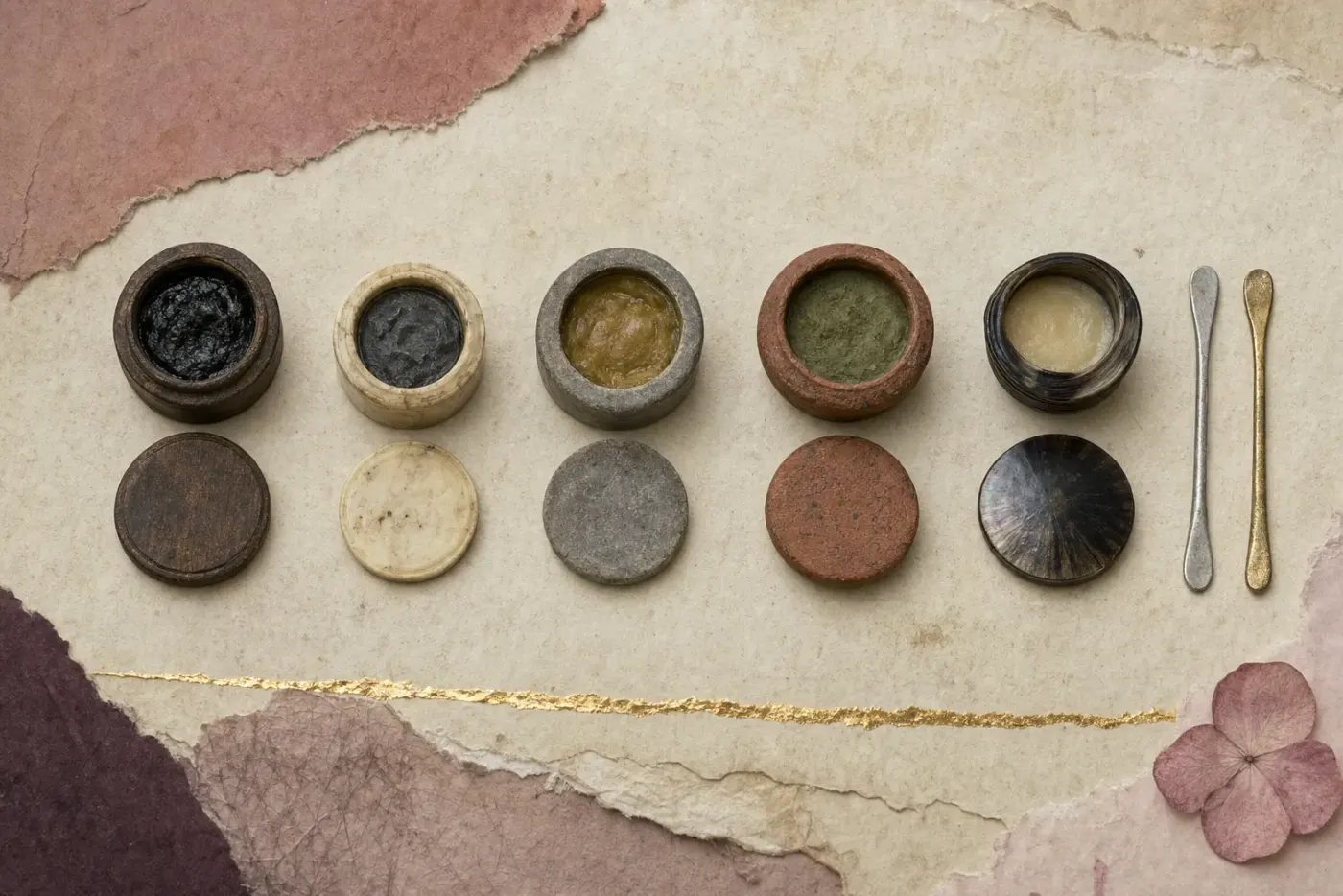
The Mahavagga, part of the Pali Vinaya, lists five eye ointments permitted to monks, beginning with black collyrium — an enumeration unusually precise for the period.[1]
Why a Monastic Rule Names Cosmetics at All
Because renunciation has to be specified. A community that gives up adornment must decide what counts, and the obvious hard case is a preparation that is medical for one wearer and decorative for another.[2]
Permitting five and naming them is how that is settled. The permission implies a medical or practical justification, the enumeration prevents the permission from being stretched, and the result is a list somebody had to make exhaustive.[2]
Exhaustive lists are rare and valuable. Most ancient references to cosmetics are incidental — a thing mentioned because it happened to be in a scene — whereas a list drawn up to be complete tells you about the whole category rather than about one item in it.[2]
What a Rule Proves That a Poem Cannot
That the things named were available. A rule regulating five preparations is meaningless unless monks could actually obtain five preparations, so the list is indirect evidence of a supply.[3]
It also implies they were distinguishable. Naming five separate items assumes a community that could tell them apart and a vocabulary stable enough for the rule to be applied by people who had not met its author.[3]
That is a real constraint on how far the terms could drift. A rule is enforced by people at a distance from whoever wrote it, so its words have to mean the same thing across a community — which is precisely the stability that later commentary shows had eventually broken down.[3]
A rule has to say exactly what it covers. That is why the strictest text is often the most informative one.
The Commentary Is Not the Text
Identifications of the individual ointments circulate confidently, and several of them come from Buddhaghosa’s glosses rather than from the Mahavagga’s own words — the sota and kapalla identifications among them.[4]
Buddhaghosa is a major commentator and his readings carry real weight; they are also centuries later than the rule and represent one authoritative interpretation of words whose referents had by then become unclear. Attributing them to the Vinaya collapses that distance.[4]
The Containers, and a Detail Usually Garbled
The same passage regulates the equipment as well as the substances, and the list of permitted materials there applies to the boxes. The sticks in that passage are gold and silver.[5]
It is a small correction with a large moral. A materials list attached to the wrong object produces a confident sentence about what ancient applicators were made of, sourced to a real text that says something else — and the error is invisible to anyone who has not read the passage.[5]
Medicine and Adornment, Again
The permission almost certainly rests on the eye preparations being understood as remedies. That is the same boundary al-Zahrawi’s compendium sits on, the same one the Trotula texts sit on, and the same one Victorian advertising later exploited on purpose.[6]
What is unusual here is that the boundary is being drawn deliberately rather than blurred. Somebody had to decide where a remedy stopped and an ornament began, and wrote down the answer.[6]
The answer they reached is also recognisably the one modern regulation reaches. A substance is classified by its claimed purpose rather than by what it is, so the same preparation can be permitted or forbidden depending on what it is for — a rule the Vinaya arrived at some two thousand years earlier.[6]
What Is Not Known
What four of the five were, in material terms, is not settled by the text itself. The identifications available are commentarial, and a commentary written centuries later is evidence about its own period as much as about the rule’s.[7]
How far the rule was observed is also unknown, as it is for every rule. A prohibition is evidence that somebody thought the thing needed prohibiting, which is not quite the same as evidence about what people did.[7]
Nor is it clear how the five were obtained. A community that does not trade still has to get its permitted ointments from somewhere, and the rule regulates possession without recording the arrangement behind it.[7]
Sources
- [1, 2, 3, 4, 5, 6, 7]Cosmetics and Coiffure in Ancient India Journal of the Indian Society of Oriental Art 8, 62-145, 1940.View source (opens in a new tab) Accessed 2026-09-22.
Filed under