White Lead (Ceruse)
Identity
Bannedas of 22 Sep 2026
- CAS
- 1319-46-6
- EC
- 215-290-6
- Colour Index
- CI 77597
- Origin
- Synthetic
- First attested
- 450 BCE
- Also known as
- ceruse · cerussa · psimythion · basic lead carbonate · lead white · Venetian ceruse · flake white
No INCI name: this material predates the nomenclature and is not a listed cosmetic ingredient.
How it is dated
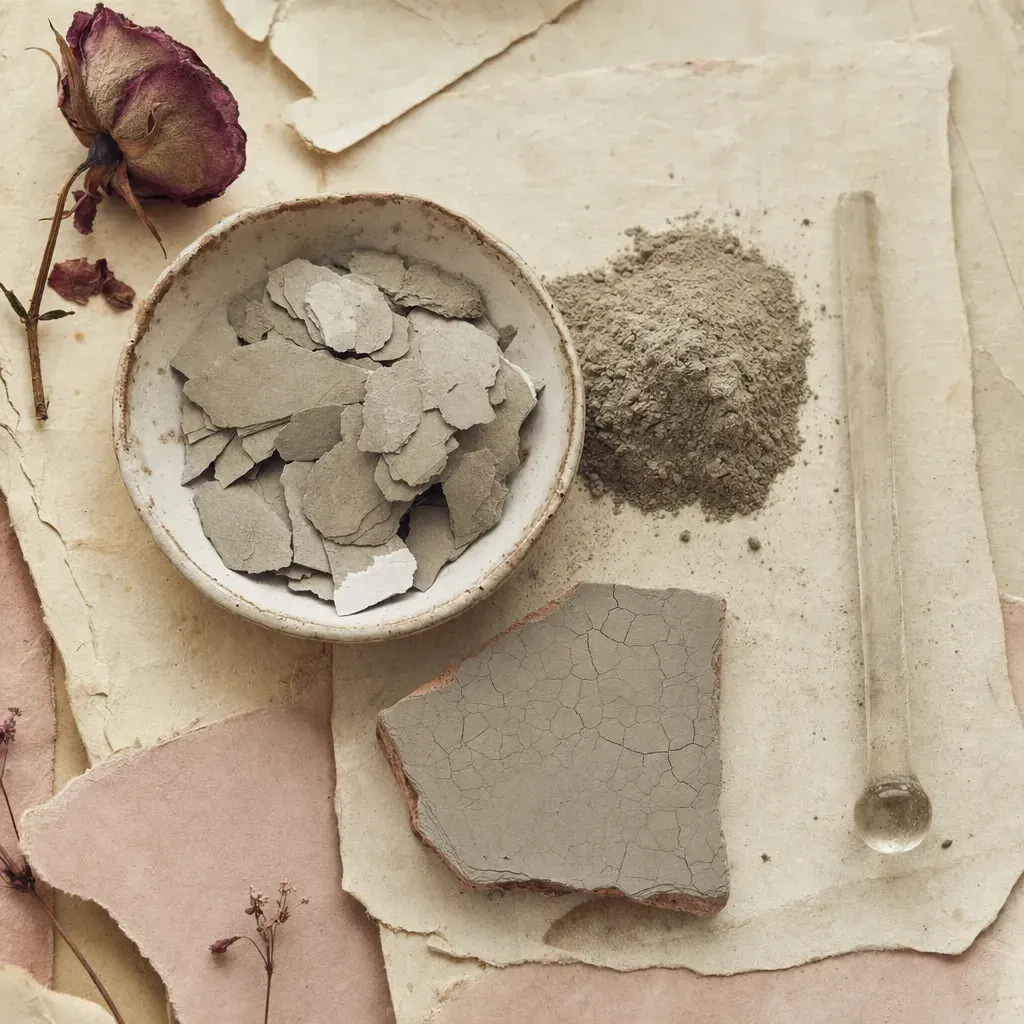
Pellets of psimythion recovered from Greek burials of the fifth to third centuries BCE, analysed and published in 2020, are the earliest secure physical evidence of the cosmetic material rather than of the pigment in general.
No regulatory dataset is loaded. The status above is this archive's editorial summary of the documented record, not a statement of any substance's legal position in your jurisdiction, and nothing here is advice on whether to use it.
In short
A synthetic basic lead carbonate, made since antiquity by corroding metallic lead over vinegar, which gave the face a dense opaque white and is the most consequential poisonous cosmetic in the European record.
- 3min read
- 4chapters
- 8sources

Vivien
Your guide through time
Listen to this entry
5 min listenVivien reads our essays aloud, word for word — every date and every name in its place — so you can listen the way you would be walked through a gallery.
An AI voice, designed for History of Makeup
White lead was the best white pigment available in Europe for something like two thousand years, and it was made by deliberately corroding metal. In the Greek method, strips of lead were sealed in pots above fermenting vinegar until a white crust formed on the surface; the crust was then scraped off, washed, dried and ground.[1] The packing of the pots in dung or spent tanbark for warmth belongs to the Dutch stack process, an industrial scaling-up of the same chemistry from the seventeenth century onward.[2]
Applied to the face as ceruse, it did what no other white of the period could do. It covered. Skin became a flat, even, faintly luminous surface that held its colour all evening. That capacity is the reason the material outlived every warning ever issued about it.
What It Is
The pigment is a basic lead carbonate, conventionally written 2PbCO₃·Pb(OH)₂ — a combination of lead carbonate and lead hydroxide rather than a single simple salt. It occurs in nature as the rare mineral hydrocerussite, but the natural mineral was never the working source. White lead is a synthetic material, and has been since antiquity.[3]
Analysis of surviving cosmetic pellets has complicated the textbook account. Material recovered from Greek burials proved to be almost entirely cerussite, the simple carbonate, with hydrocerussite present at only a few per cent — close to the reverse of what the standard description of lead white would predict.[4]
In History
Theophrastus described the vinegar method in On Stones in the late fourth century BCE, and Pliny the Elder described a version of it some three centuries later.[5] The archaeology runs alongside the texts. Pellets of psimythion have been recovered from burials of the fifth to third centuries BCE at Athens and at Tanagra in Boeotia, one of them from the stone sarcophagus of an actor in the Kerameikos cemetery — a man who would have used it to play women.[6]
In the sixteenth century the refined Venetian grade became the prestige cosmetic of the European courts. The claim that ceruse killed Elizabeth I is repeated in popular accounts of the period, Gunn's among them.[7] No contemporary source attributes her death to cosmetics; the story is a later reconstruction, assembled from her portraits and from what was by then known about lead, and the confidence with which it is repeated is not matched by the evidence for it.
What It Does
Lead white works by refraction. Its particles bend light strongly enough to hide what lies beneath them, so a thin film obscures redness, texture and uneven pigment in a single pass. It also has weight and a soapy drag that lets it be spread thin and stay where it is put, which is why it was applied as a paint rather than dusted on as a powder.
Ceruse was that pigment carried in a medium — vinegar, egg white, or a fat. The finish was matte and slightly chalky, and it cracked. Later accounts describe reapplication over an unwashed face, and if that was the practice it is also the mechanism by which exposure accumulated.[8] The claim is repeated far more often than it is evidenced, and no contemporary document has been produced for it here.
Safety and Status
Lead is absorbed through broken skin and, far more efficiently, by ingestion and by inhalation of the powder. The occupational harm was documented long before the cosmetic harm was regulated. The International Labour Organization adopted the White Lead (Painting) Convention in 1921, prohibiting white lead in the internal painting of buildings, with exceptions for railway stations, industrial premises and artistic work.[9]
In the European Union the prohibition is categorical: lead and its compounds stand at entry 289 of Annex II to Regulation (EC) No 1223/2009, the list of substances prohibited in cosmetic products.[10] That position was reached in stages rather than at once, and elsewhere by other routes — lead acetate remained a permitted hair-dye ingredient in the EU until Commission Regulation (EU) 2021/1099 removed it, and in the United States the Food and Drug Administration repealed the corresponding colour-additive listing at 21 CFR 73.2396 by final rule in October 2018.[11] The position in any particular country should be checked against that country's own law rather than inferred from this one. White lead carries no INCI name, because it was never in use under the system that assigns them.
Sources
- [1, 4, 6]On metal and 'spoiled' wine: analysing psimythion (synthetic cerussite) pellets (5th–3rd centuries BCE) and hypothesising gas-metal reactions over a fermenting liquid within a Greek pot Archaeological and Anthropological Sciences 12.10, article 243, 2020.View source (opens in a new tab) Accessed 2026-09-22.
- [2, 3]Lead whiteView source (opens in a new tab) Accessed 2026-09-22.
- [5]Naturalis Historia, Books XXXIII–XXXV 77.
- [7]The Artificial Face: A History of Cosmetics David & Charles, 1973.
- [8]Fashions in Makeup: From Ancient to Modern Times Peter Owen, 1972.
- [9]White Lead (Painting) Convention, 1921 (No. 13) International Labour Organization, NORMLEX, 1921.View source (opens in a new tab) Accessed 2026-09-22.
- [10]Regulation (EC) No 1223/2009 on cosmetic products 2009.View source (opens in a new tab) Accessed 2026-09-22.
- [11]Listing of Color Additives Subject to Certification; Lead Acetate; Final Rule (83 FR 53297) 2018.View source (opens in a new tab) Accessed 2026-09-22.