Palettes Before Pyramids: The Oldest Cosmetic Object in Quantity
Before Egypt had monumental architecture it had grinding slabs, and it had them in numbers that make cosmetic preparation ordinary.
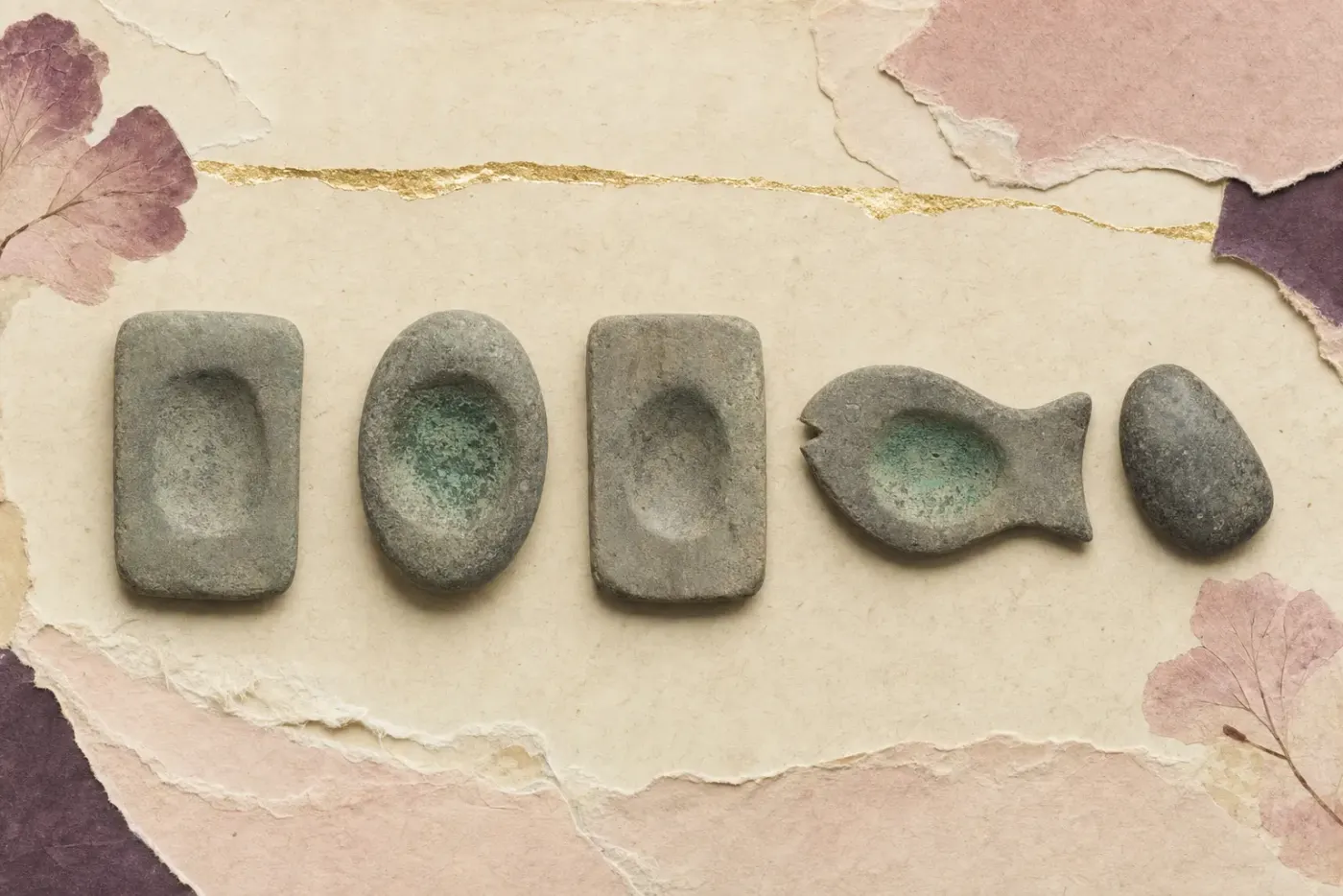
In short
Flat grinding palettes appear in Predynastic Egyptian graves in numbers large enough to indicate that cosmetic preparation was an ordinary household activity rather than an exceptional or exclusively ritual one.
- 12min read
- 6chapters
- 2sources

Vivien
Your guide through time
Listen to this essay
6 min listenVivien reads our essays aloud, word for word — every date and every name in its place — so you can listen the way you would be walked through a gallery.
An AI voice, designed for History of Makeup
The oldest sustained evidence for cosmetics anywhere is not a pigment or a container. It is a flat slab of stone, worn into a shallow hollow at the centre by grinding, buried with its owner, and found in Predynastic Egyptian graves in numbers that rule out its being unusual.[1]
That quantity is the whole argument. A single elaborate object tells you an elite existed. Thousands of plain ones, distributed across ordinary burials, tell you something was being done routinely — and the palette is the earliest artefact in this history that can carry a claim of that kind.[1]
What a Palette Is
Mechanically it is the simplest possible tool: a hard flat surface against which a mineral is reduced to powder with a smaller stone. The wear pattern is the evidence of use, and it is unambiguous — a depression worn into the centre of a slab is not a decorative feature.[2]
Many are shaped: rhomboids, fish, birds, shields. Others are entirely plain. The elaborate ones have attracted almost all of the scholarly and popular attention, which is a distortion worth naming, because it is the plain ones in quantity that establish the practice.[2]
The material is consistent enough to be diagnostic. Most are a fine grey-green siltstone from a known quarry region, which means the stone itself travelled before the palette did, and that even the plainest example represents an organised supply rather than a slab picked up nearby.[2]
What Was Ground On Them
Green first, and green predominantly. Malachite — a copper carbonate — is the pigment found most often in association with Predynastic palettes, and the residues on the stone are the direct physical link between the tool and the material.[3]
The pigment did not stay on the palette. Human remains carry malachite around the eyes, which closes the chain from mineral to tool to face and removes the need to infer cosmetic use from the object alone. That is an unusually complete evidential sequence for a period this early.[4]
Thousands of plain ones, distributed across ordinary burials, tell you something was being done routinely.
Grave Goods Are Not Daily Life
Everything above comes from burials, and that fact deserves more attention than it usually gets. A grave is a deliberate deposit, assembled by the living according to conventions about what the dead require, and it is not a photograph of a household.[5]
An object placed in a grave may have been used daily, made specially for the burial, or valued precisely because it was not ordinary. The inference from grave goods to daily practice is reasonable here because of the sheer volume and plainness of the material — but it is an inference, and the alternative readings are not absurd.[5]
Why Green, and Why We Cannot Say
Explanations are abundant and evidence is not. Green eye paint is routinely explained by protection from sun glare, by repelling insects, by treating eye disease, or by association with fertility and with specific deities.[6]
Each of those is plausible and none is established for the Predynastic period, which predates the textual record that later explanations are read back from. The honest position is that a widespread practice is attested and its purpose is not recorded, and any confident account of what a Predynastic Egyptian believed about malachite is reconstruction.[6]
Who Used Them
The distribution does not respect the categories a modern reader arrives with. Palettes appear in the graves of men and of women, and across a wide range of apparent status, which is consistent with the pattern that holds through the whole dynastic period: Egyptian eye paint was not a women’s product.[7]
That single fact does more to disturb the standard story of cosmetics than any chemical finding. The assumption that painting a face is a female practice is a convention of particular societies, and the oldest large body of evidence available does not share it.[8]
What Is Not Known
Dates in this period are conventional ranges rather than points, resting on ceramic sequences and on a smaller body of radiocarbon work than the confidence of published date ranges suggests. The −3500 marker here is a convention, not a measurement.[9]
Nor can the frequency of use be recovered. A palette records that grinding happened, not how often, by whom, or for what occasion — and no technique available to archaeology converts wear into a schedule.[9]
Sources
- [1, 2, 3, 5, 6, 7, 9]Sacred Luxuries: Fragrance, Aromatherapy, and Cosmetics in Ancient Egypt Cornell University Press, 1999.
- [4, 8]Egyptian kohl pots and applicators, Department of Egypt and SudanView source (opens in a new tab) Accessed 2026-09-22.
Filed under