The Kohl Pot: What the Container Tells Us About the Cosmetic
Egyptian kohl jars and tubes survive in quantity. Their shape is the best evidence there is for how the powder inside was handled.
In short
A kohl jar in the Metropolitan Museum, cut from serpentinite and buried below Theban tomb 71 around 1480 BCE, still holds its galena: the container and its contents survived together, which is why the technique can be reconstructed at all.
- 7min read
- 5chapters
- 11sources

Vivien
Your guide through time
Listen to this essay
7 min listenVivien reads our essays aloud, word for word — every date and every name in its place — so you can listen the way you would be walked through a gallery.
An AI voice, designed for History of Makeup
During the Metropolitan Museum's 1935 to 1936 season at Thebes, excavators opened the burial of a woman named Hatnefer and a man named Ramose, below the tomb catalogued as Theban Tomb 71. Among the goods was a squat jar of serpentinite, five and a half centimetres tall. It still contained galena.[1]
That is the ordinary condition of the Egyptian kohl container. Containers survive in quantity and across a wide range of materials, in stone, faience, glass, wood and reed,[2] and some, like Hatnefer's, still hold what was put in them. The pots are not merely packaging for a lost cosmetic. They are the best surviving evidence for how that cosmetic was handled.
What the Shape Is For
Two container types dominate. The first is a jar: wide-mouthed, heavy for its size, with a flat everted rim. The second is a tube: narrow, deep, with an opening barely wider than a pencil. The tube is the more informative of the two, because it comes with a rod attached.
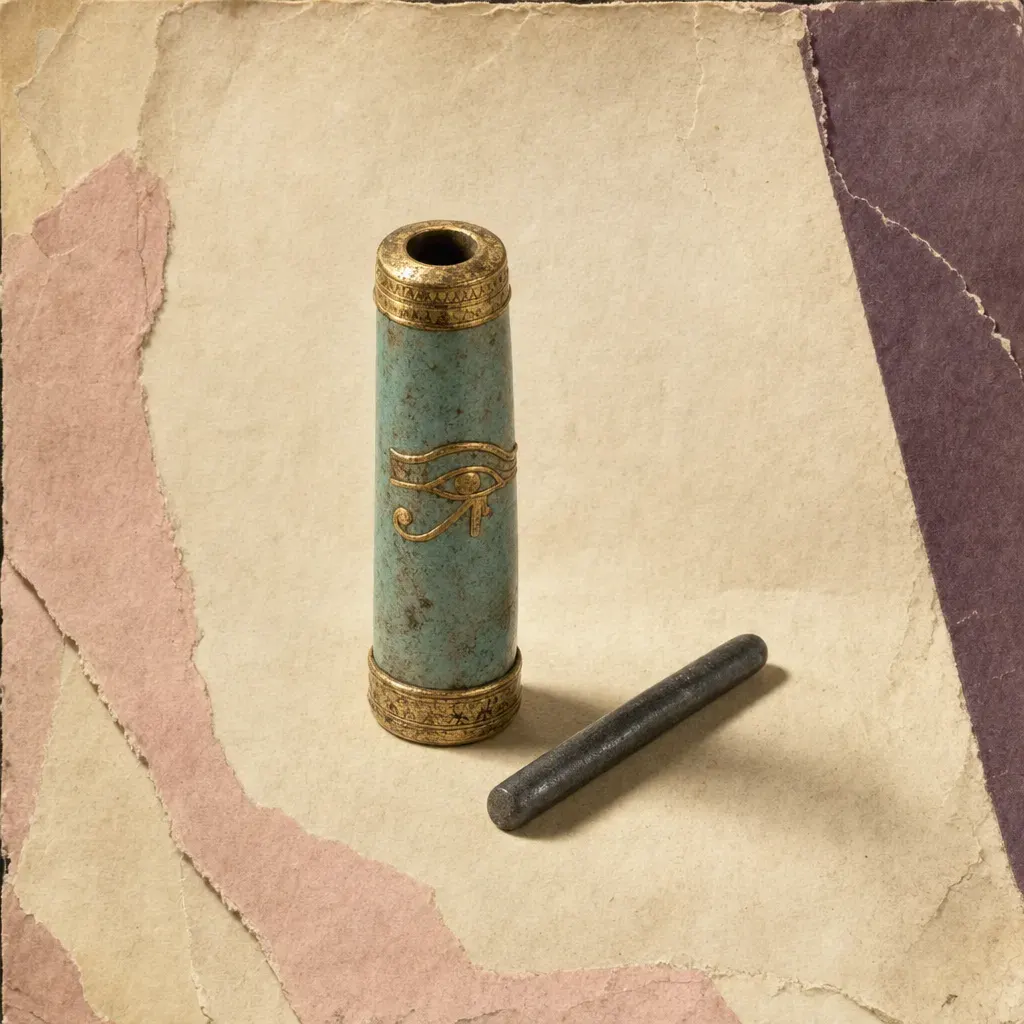
A kohl tube in the Metropolitan Museum, made of faience and mounted in gold, stands five and a half centimetres high and is catalogued with a stick of haematite four and a half centimetres long.[3] What the record establishes is that the two were kept together and that a tube of those proportions cannot be reached into with a finger: it is built around a rod, and the powder was drawn out on the rod rather than scooped. That the same stick also stoppered the tube is a reading of the form. The museum does not say so, and no Egyptian source does either.
The jar form suggests a different method: a wide mouth and a broad rim suit a paste, or a powder worked on the rim before use. That too is inference from shape rather than testimony. Both forms were in use across dynastic Egypt.[4]
Before the Tube, a Slab
The container has a predecessor that is not a container at all. Predynastic burials in Egypt contain flat slabs of greywacke, a fine dark siltstone from the Eastern Desert, shaped as fish, birds, turtles and boats. A boat-shaped example in the Metropolitan Museum is twenty-five centimetres long and dated to roughly 3900 to 3500 BCE.[5]
These are working surfaces for mineral pigment, though not quite in the way the standard description has it. Nineteenth-century statements that malachite was ground on palettes are still widely repeated by scholars; experimental work has shown that the ore was in fact crushed, first against a large anvil stone with a handheld hammer stone, and the resulting crystal shards then worked to a fine powder on the palette's polished surface.[6]
What the palettes were for is not settled by that sequence alone. Green staining survives on palettes recovered from graves, and malachite residue survives around the eyes of human remains of the period, while palettes from settlement contexts more often carry red ochre: the difference between the two contexts is one reason the objects are taken to have held more than one role, in daily life as well as in funerary ritual.[6] The slab is a workbench. The pot is what the work goes into. The move from one to the other is a move from making a cosmetic at the moment of use to keeping it made.
A container built around a rod held a powder that was drawn on, not dabbed.
The Contents Were Not One Thing
Kohl names a colour and a use, not a compound. X-ray diffraction of forty-seven kohl samples collected in Oman found several quite different mineral bases in products sold under the same word.[7] A 2022 study of Egyptian material reached a comparable conclusion for the ancient period, identifying manganese-based, silicon-based and carbon-based preparations alongside the lead-based ones that dominate the popular account.[8]
Where lead was used it was not always crushed ore. Analysis of samples in the Louvre identified laurionite and phosgenite, lead compounds that appear to have been synthesised deliberately rather than mined.[9] Lead isotope analysis of eleven kohl samples from Bronze Age Sudanese Lower Nubia split them into two groups. Some of the galena matches the pharaonic mining site at Gebel el-Zeit on the Red Sea coast; the second group points to a source not yet identified.[10] The pot sat at the end of a supply chain, and not always the same one.
A Kit, Not a Single Object
Kohl containers are frequently found with other equipment. A set excavated for Lord Carnarvon by Howard Carter in 1911, from tomb CC 37 in the Asasif at Thebes, holds a kohl tube and its stick together with a mirror, a razor, a pair of tweezers and a whetstone.[11] The mirror measures nine centimetres by seven. The whetstone is for the razor. The group describes a routine rather than a product.
Some containers are compound. Double tubes hold two wells and one stick; the Science Museum Group catalogues a carved wooden example as probably Egyptian, dated between 100 BCE and 400 CE, twenty-eight by sixty-nine by thirty-six millimetres.[12] What the second well held is not established, and the object does not say.
Why They Survive
The survival rate has a plain cause. Cosmetic equipment went into graves, and stone, faience and glass do not rot. Wood and reed survive in Egypt because the ground is dry. The result is evidence that is unusually good for the container and unusually poor for everything around it: the hands, the light, the mirror held at arm's length, the reason for doing it at all.
Claims about kohl's medical effects circulate widely and are not settled by the objects. What the pots support is narrower and firmer. A powder was kept, a rod was dipped, a line was drawn, and the equipment mattered enough to be placed in the grave with its owner.[13]
Sources
- [1]Kohl Jar, accession number 36.3.62 Department of Egyptian Art, The Metropolitan Museum of Art.View source (opens in a new tab) Accessed 2026-09-22.
- [2, 4, 13]Sacred Luxuries: Fragrance, Aromatherapy, and Cosmetics in Ancient Egypt Cornell University Press, 1999.
- [3]Kohl Tube and Applicator, accession number 30.8.150 Department of Egyptian Art, The Metropolitan Museum of Art.View source (opens in a new tab) Accessed 2026-09-22.
- [5]Boat-shaped palette, accession number 07.228.156 Department of Egyptian Art, The Metropolitan Museum of Art.View source (opens in a new tab) Accessed 2026-09-22.
- [6]Pigment Stories: Eternal Green in Predynastic Egypt University College London, 2020.View source (opens in a new tab) Accessed 2026-09-22.
- [7]Composition of eye cosmetics (kohls) used in Oman Journal of Ethnopharmacology 60(3), 223-234, 1998.View source (opens in a new tab)
- [8]Recipes of Ancient Egyptian kohls more diverse than previously thought Scientific Reports, volume 12, 2022.View source (opens in a new tab)
- [9]Making make-up in Ancient Egypt Nature 397, 483–484, 1999.
- [10]Bronze age supply chains between ancient Egypt and Nubia revealed by lead isotope analysis of kohl samples Scientific Reports 14, article 27488, 2024.View source (opens in a new tab)
- [11]Cosmetic set of Kohl Tube and Applicator, Razor, Tweezers, Whetstone, and Mirror, accession numbers 26.7.837a-d and 26.7.1447 Department of Egyptian Art, The Metropolitan Museum of Art.View source (opens in a new tab) Accessed 2026-09-22.
- [12]Double wooden kohl tube, Egypt (?), 100 BCE-400 CE, object number A634876 Science Museum Group Collection.View source (opens in a new tab) Accessed 2026-09-22.
Filed under