Lining the Eye: From Synthesised Kohl to the Drawn Wing
From manufactured Egyptian kohl to the drawn wing: the one cosmetic gesture that has never been out of use somewhere.
In short
The line around the eye has the longest continuous documented history of any cosmetic: analysis of Egyptian kohl found two lead compounds that had to be synthesised deliberately, and carbon black was only listed as a US cosmetic colour additive in 2004.
- 8min read
- 6chapters
- 20sources

Vivien
Your guide through time
Listen to this essay
9 min listenVivien reads our essays aloud, word for word — every date and every name in its place — so you can listen the way you would be walked through a gallery.
An AI voice, designed for History of Makeup
Of everything in this archive, the line around the eye has the longest documented history. It is drawn on predynastic Egyptian faces,[1] on Roman ones,[2] in medieval Arabic medical writing,[3] in Hollywood publicity stills,[4] and on a phone screen this morning.
The materials have been replaced several times over. The gesture — a dark line following the lash line, extended or not at the outer corner — is the one cosmetic act that is being performed somewhere at any given point in the record. It also has the best claim of any cosmetic to having been a technology before it was an ornament: the pots, sticks and spoons that survive in their thousands are the kit of a product with a specification.[5]
Four Compounds
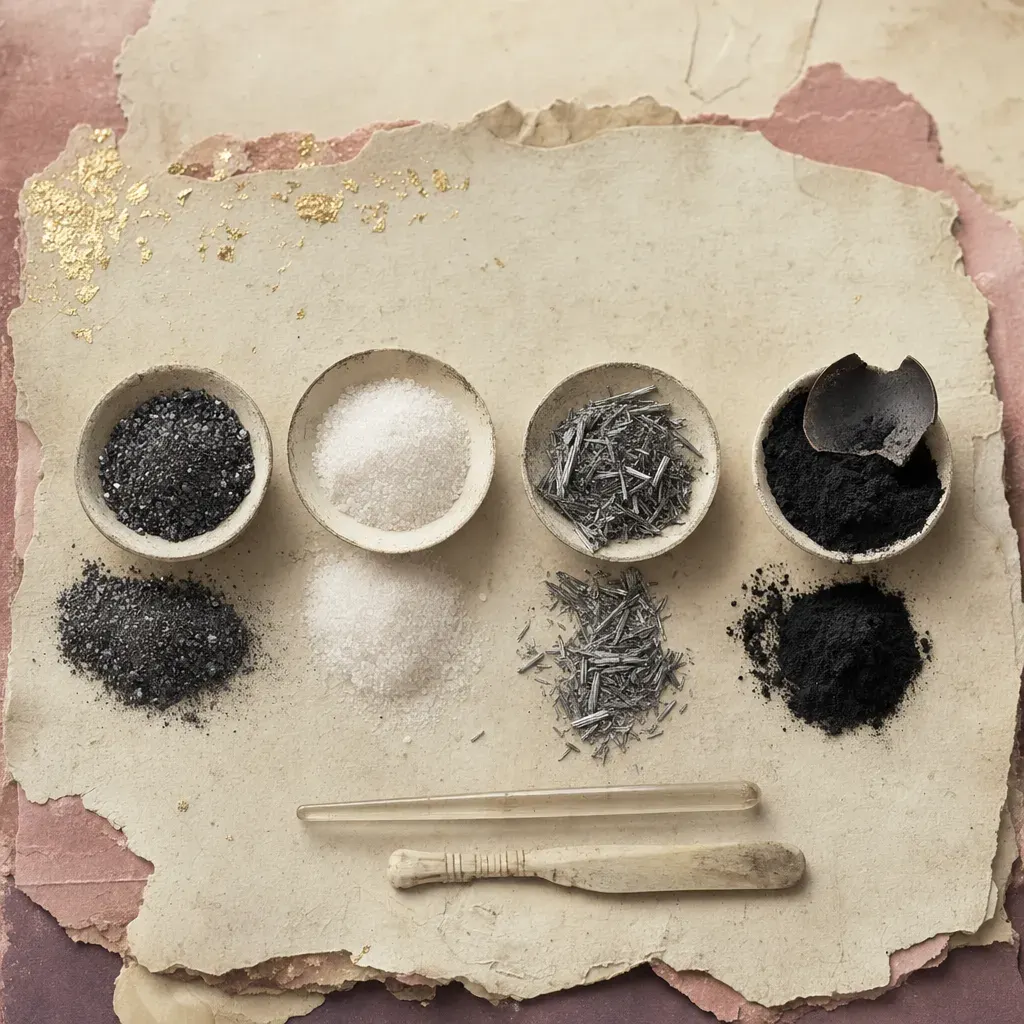
Egyptian kohl was described for most of the twentieth century as crushed galena. Analysis of samples from the Louvre's collection, published in 1999, found four lead compounds, and two of them — laurionite and phosgenite — are rare as natural minerals. Finding them in quantity in a cosmetic is the argument for deliberate synthesis: they were made by a wet chemical process rather than gathered and ground.[6]
Later work has widened the picture rather than overturning it. A study published in 2022 found a greater range of Egyptian kohl recipes than a single-formula model implies — manganese-based, silicon-based and carbon-based preparations alongside the lead ones, with haematite among the minerals identified, varying by period and by site.[7] The consistent finding across both is deliberateness. These were products made to a specification, not minerals picked up and crushed.
Kohl Is Not One Thing
The word travels further than the substance. Kohl, kuhl, surma, kajal and ithmid name preparations that overlap without being identical. An X-ray diffraction survey of forty-seven samples collected in Oman is the clearest demonstration of it: there, kohl names a colour rather than a composition, with ithmid reserved for stibnite, antimony sulfide, and reckoned the best of them.[8] Lead isotope analysis of eleven kohl samples from Bronze Age Lower Nubia sorted them into two groups — one matching galena ores from Gebel el-Zeit on the Egyptian Red Sea coast, the other pointing to a source that has not been identified.[9] That is how a cosmetic becomes evidence for a trade route, and also how it stays, in part, an open question.
The medical literature followed the practice rather than leading it. Al-Zahrawi's Kitab al-Tasrif, compiled in al-Andalus around the turn of the eleventh century, treats cosmetic preparation as a branch of medicine and includes eye preparations within it.[10] In South Asia the named preparations diverge again, and the chemistry separates them. Analysis of Indian kajal and surma found a median of 851 micrograms per gram of polycyclic aromatic hydrocarbons in kajal, against 243, 231 and 45 micrograms per gram in black, whitish-black and white surma respectively.[11] Those numbers are the signature of a combustion product. A household kajal is lamp soot, collected from a wick burning under a plate, and soot is carbon rather than mineral.
The materials have been replaced several times over. The gesture has never gone out of use everywhere at once.
Where the Line Goes Missing
In western Europe the drawn eye thins out of the record for several centuries. Early modern European sources are far more interested in the complexion and the mouth, and eye paint is comparatively scarce in both the recipes and the portraits.[12] The ecclesiastical writing on cosmetics, of which there is a great deal, concentrates almost entirely on whitening and reddening.[13]
That is a gap in one region's record, not a gap in the practice. Eye preparations are set down as a branch of medicine in al-Andalus around the turn of the eleventh century,[14] and kohl was still being made, named and graded in Oman in the 1990s, in enough variety for a chemist to collect forty-seven distinct samples of it.[15] Those are two fixed points, not a continuity anyone has traced end to end, and the honest claim is the smaller one: the practice is documented outside Europe in periods when the European record has nothing to say. A history that treats the European silence as the history of eye makeup has the shape of the subject badly wrong.
Bara Before Tutankhamun
The heavily lined eye returns to western faces through film, and the usual explanation gets the order wrong. Howard Carter opened Tutankhamun's tomb in 1922, and the Egyptian revival that followed is real and well documented.[16] But Theda Bara had already played Cleopatra in 1917, in black eye makeup heavy enough to register on the film stock of the period — five years before the tomb was found.[17]
Early cinema drove the drawn eye for a technical reason. Orthochromatic stock rendered faces flat and washed out, and heavy dark definition around the eye was the correction for it. What audiences went home and copied was a solution to a photographic problem.[17]
Cake, Liquid, Wing
The commercial eye cosmetic arrives in the United States in the 1910s. Thomas Lyle Williams sold a brow and lash preparation called Lash-Brow-Ine from 1915, and the cake mascara that became Maybelline shortly afterwards. The company's founding story, in which he named the product for his sister, is corporate biography rather than documented history.[18]
Regulation came through injury. Lash Lure, a permanent lash and brow dye containing para-phenylenediamine, caused ulceration and blindness in cases reported from 1933, and the episode was used in the American campaign that produced the Federal Food, Drug, and Cosmetic Act of 1938.[19]
The winged line as most people now draw it is a mid-century form, built on liquid liners in fine-tipped applicators and carried through the 1950s and 1960s by film and television.[20]
The Oldest Pigment, Recently Approved
Carbon black is the oldest colourant on the human face and one of the most recently authorised for it. In the United States, D&C Black No. 2 — a high-purity furnace black — was added to the list of colour additives subject to certification by a rule published on 28 July 2004, permitting use in eyeliner, brush-on-brow, eye shadow, mascara and other cosmetics.[21] The listing is codified at 21 CFR 74.2052.[22]
The European position is older and has one condition worth reading carefully. Carbon Black (CI 77266) is a permitted cosmetic colourant at entry 126 of Annex IV to Regulation (EC) No 1223/2009.[23] What Commission Regulation (EU) 2016/1120 of 11 July 2016 added was a separate entry, 126a, for the nano form: permitted at up to 10 per cent by weight, with a primary particle size of 20 nanometres or greater and purity above 97 per cent, and not to be used in any application that may lead to exposure of the end user's lungs by inhalation.[24] That last condition is the consequential one in a paragraph about powders for the eye and the brow, and it is easily lost when the nano entry is described as though it authorised carbon black in general.
Traditional kohl sits in a different position entirely. The US Food and Drug Administration has not approved kohl as a colour additive and has warned about imported kohl products found to contain lead.[25] A material can be five thousand years old and have no legal standing whatever in a given jurisdiction. The two facts are unrelated, and confusing them is how heritage gets mistaken for permission.
Sources
- [1]Sacred Luxuries: Fragrance, Aromatherapy, and Cosmetics in Ancient Egypt Cornell University Press, 1999.
- [2]Cosmetics in Roman Antiquity: Substance, Remedy, Poison The Classical World 102.3, 2009.
- [3, 10, 14]Kitab al-Tasrif, Book 19: on adwiyat al-zinah (the medicines of adornment) 1000.
- [4, 17]Hollywood Before Glamour: Fashion in American Silent Film Palgrave Macmillan, 2013.
- [5]Egyptian kohl pots and applicators, Department of Egypt and SudanView source (opens in a new tab) Accessed 2026-09-22.
- [6]Making make-up in Ancient Egypt Nature 397, 483–484, 1999.
- [7]Recipes of Ancient Egyptian kohls more diverse than previously thought Scientific Reports, volume 12, 2022.View source (opens in a new tab)
- [8, 15]Composition of eye cosmetics (kohls) used in Oman Journal of Ethnopharmacology 60(3), 223-234, 1998.View source (opens in a new tab)
- [9]Bronze age supply chains between ancient Egypt and Nubia revealed by lead isotope analysis of kohl samples Scientific Reports 14, article 27488, 2024.View source (opens in a new tab)
- [11]Polycyclic aromatic hydrocarbons in kajal and surma eye cosmetic preparations Human Toxicology, volume 7, pages 195-197, 1988.View source (opens in a new tab) Accessed 2026-09-22.
- [12]Beauty and Cosmetics 1550–1950 Shire Publications, 2012.
- [13, 20]Fashions in Makeup: From Ancient to Modern Times Peter Owen, 1972.
- [16]Tutankhamun and the discovery of the tomb, 1922View source (opens in a new tab) Accessed 2026-09-22.
- [18]Hope in a Jar: The Making of America’s Beauty Culture Metropolitan Books, 1998.
- [19]Lash Lure and Paraphenylenediamine: Toxic Beauty Past and Present American Academy of Ophthalmology.View source (opens in a new tab) Accessed 2026-09-22.
- [21]Listing of Color Additives Subject to Certification; D and C Black No. 2 (final rule) Federal Register, 28 July 2004, 2004.View source (opens in a new tab) Accessed 2026-09-22.
- [22]21 CFR 74.2052 - D and C Black No. 2 Code of Federal Regulations, title 21, part 74, subpart C, 2026.View source (opens in a new tab) Accessed 2026-09-22.
- [23]Regulation (EC) No 1223/2009 of the European Parliament and of the Council of 30 November 2009 on cosmetic products Official Journal of the European Union, 2009.View source (opens in a new tab) Accessed 2026-09-22.
- [24]Commission Regulation (EU) 2016/1120 of 11 July 2016 amending Annex IV to Regulation (EC) No 1223/2009 on cosmetic products Official Journal of the European Union, 2016.View source (opens in a new tab) Accessed 2026-09-22.
- [25]Kohl, Kajal, Al-Kahal, Surma, Tiro, Tozali, or Kwalli: By Any Name, Beware of Lead PoisoningView source (opens in a new tab) Accessed 2026-09-22.
Filed under