Psimythion in the Ground: The Pellets That Survived Athens
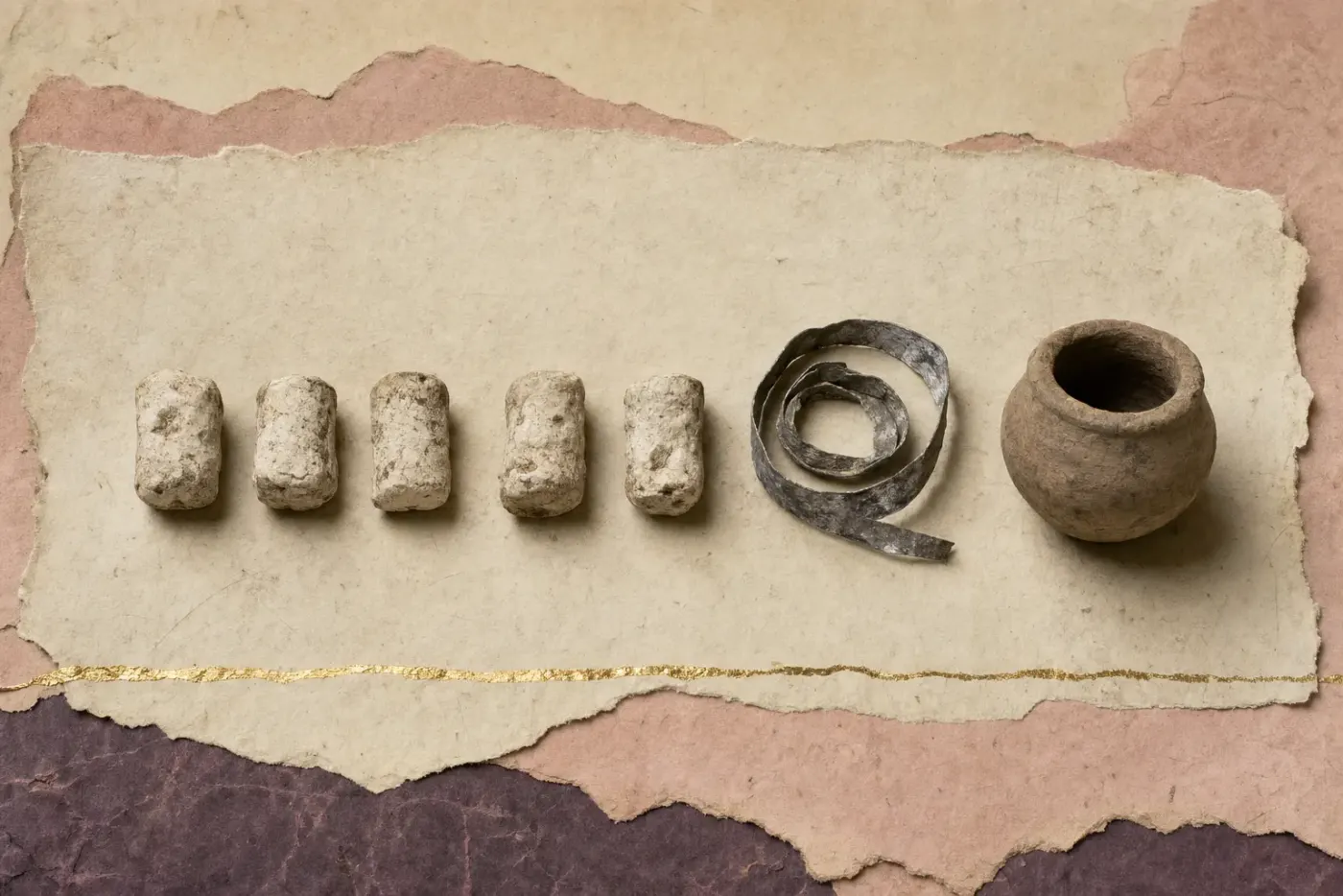
The Greek face white is usually known from insults in comedy. It is also known from pellets that came out of graves.
In short
Pellets of psimythion, a synthetic cerussite, survive from fifth- to third-century BCE burials at Athens and Tanagra, including Tomb 24 in the Kerameikos, and analysis finds them cerussite-dominant.
- 12min read
- 6chapters
- 3sources

Vivien
Your guide through time
Listen to this essay
5 min listenVivien reads our essays aloud, word for word — every date and every name in its place — so you can listen the way you would be walked through a gallery.
An AI voice, designed for History of Makeup
Most of what is said about Greek cosmetics comes from men complaining about them in plays, which is a source with a known bias and no chemistry.
Psimythion is better served than that. Pellets survive from fifth- to third-century BCE burials at Athens and Tanagra, including Tomb 24 in the Kerameikos, and analysis finds them cerussite-dominant — a synthetic lead carbonate.[1]
Synthetic, Not Mined
Cerussite occurs naturally, but a cerussite-dominant pellet in a grave is a manufactured object: somebody made the compound, formed it into a pellet and put it into circulation.[2]
That places Greece alongside Egypt and China in the same finding. Three traditions, independently, went past what could be dug up and manufactured their cosmetic materials, which is a much stronger statement about ancient chemistry than any one of them alone.[2]
It also reframes what these societies were doing. Producing a compound that does not occur usefully in nature requires knowing that a reaction will happen, controlling the conditions for it and repeating the result, and three traditions doing that independently for a cosmetic is a serious claim about how much practical chemistry was in circulation.[2]
How It Was Probably Made
The analysis proposes gas–metal reactions over a fermenting liquid inside a Greek pot — lead exposed to the vapours rising off souring wine, in a closed vessel, with the white forming on the metal.[3]
It is worth noting that this is a hypothesis presented as one, arrived at from the composition of the surviving material rather than from a recipe. The pellets are the evidence; the process is the reconstruction that best accounts for them.[3]
Lead, a sealed pot, and wine going bad. That is a cosmetics industry.
Why a Pellet
Because a formed solid is a unit. A pellet can be counted, weighed, priced, wrapped and carried in a way loose powder cannot, and a scraped crust has to be worked into something before it can be sold.[4]
So the form is evidence of a trade rather than of domestic manufacture. Somebody was producing these in quantity and to a consistent size, which is a workshop rather than a household.[4]
A grave is also a distribution record of sorts. Objects reach burials through the hands of the living, so a formed pellet in a tomb at Tanagra is evidence that whatever was made somewhere got as far as there.[4]
And burial with the dead is a judgement about worth. Whatever else psimythion was, it was something the living thought a person should not go into the ground without — which puts it among the possessions that mattered rather than among the incidentals.[4]
The Same Compound, Two Thousand Years On
Lead white kept its identity all the way into the modern pigment catalogue, where it is Pigment White 1, Colour Index 77597 — the same material, finally given a number.[5]
And it was displaced not by regulation alone but by substitutes: zinc white and then titanium white, which is the pattern the Japanese case shows explicitly. A dangerous material leaves when something else can do its job.[5]
Which is the uncomfortable general lesson of this whole history. The materials that persisted longest were the ones that worked best, and the moral arguments against them were consistently less effective than a competitor with comparable coverage.[5]
What the Pellets Do Not Say
Who wore it. A pellet in a burial establishes that the material existed, was valued enough to accompany the dead, and was made to a form — and says nothing about how generally it was used or by whom.[6]
The literary sources that do discuss wearers are satirical and hostile, and reconciling a hostile text with a physical object is not something either can do alone.[7]
What Is Not Known
Whether the proposed gas–metal process is the one actually used is not settled. It accounts for the composition of the surviving pellets, which is the strongest kind of argument available, and it is not a recipe anybody recorded.[8]
How the Greek process relates to the later European one is also not established here. Both corrode lead in the presence of acid vapour, and whether that reflects transmission or convergence is a separate question.[8]
The scale of production is likewise unknown. Formed pellets imply a workshop, and the surviving quantity is far too small to indicate whether that workshop supplied a street, a city or a region.[8]
Sources
- [1, 2, 3, 4, 6, 8]On metal and 'spoiled' wine: analysing psimythion (synthetic cerussite) pellets (5th–3rd centuries BCE) and hypothesising gas-metal reactions over a fermenting liquid within a Greek pot Archaeological and Anthropological Sciences 12.10, article 243, 2020.View source (opens in a new tab) Accessed 2026-09-22.
- [5]Lead whiteView source (opens in a new tab) Accessed 2026-09-22.
- [7]Fashions in Makeup: From Ancient to Modern Times Peter Owen, 1972.
Filed under