Worn by Everyone: The Cosmetic That Marked Nobody Out
Almost every cosmetic in history divides the people who wear it from the people who do not. Egyptian eye paint did the opposite.
In short
Egyptian eye paint appears across the whole society — men and women, living and dead, gods and labourers — so unlike almost every later cosmetic it did not function primarily as a marker of rank.
- 12min read
- 6chapters
- 6sources

Vivien
Your guide through time
Listen to this essay
5 min listenVivien reads our essays aloud, word for word — every date and every name in its place — so you can listen the way you would be walked through a gallery.
An AI voice, designed for History of Makeup
Ask what a cosmetic is for and the usual answer is difference. It separates the adorned from the plain, the leisured from the working, the adult from the child, one rank from the next.
Egyptian eye paint is the large exception. It is on men and on women, on the living and on the dead, on gods and on labourers, across the whole span of dynastic Egypt — which means it cannot have been doing the work of distinguishing them.[1]
What a Universal Cosmetic Implies
If everyone wears it, the interesting question moves from who to why. A practice with no exclusion to enforce is not competing for status, so it has to be supplying something else: a function, a protection, a religious requirement, or simply the normal appearance of a face.
Distinction in Egypt therefore has to live in the grade of the material and the quality of the container rather than in the fact of wearing, which is a familiar arrangement — the difference is not whether you have the thing but which version of it you have.[2]
It is worth noticing how rare that arrangement is. Sumptuary rules, church prohibitions and the nineteenth-century rule against visible paint all work by deciding who may wear something; a cosmetic that everyone wears has no such lever, and the societies in this history that had one almost always pulled it.[2]
The Materials Were Ordinary and the Sourcing Was Not
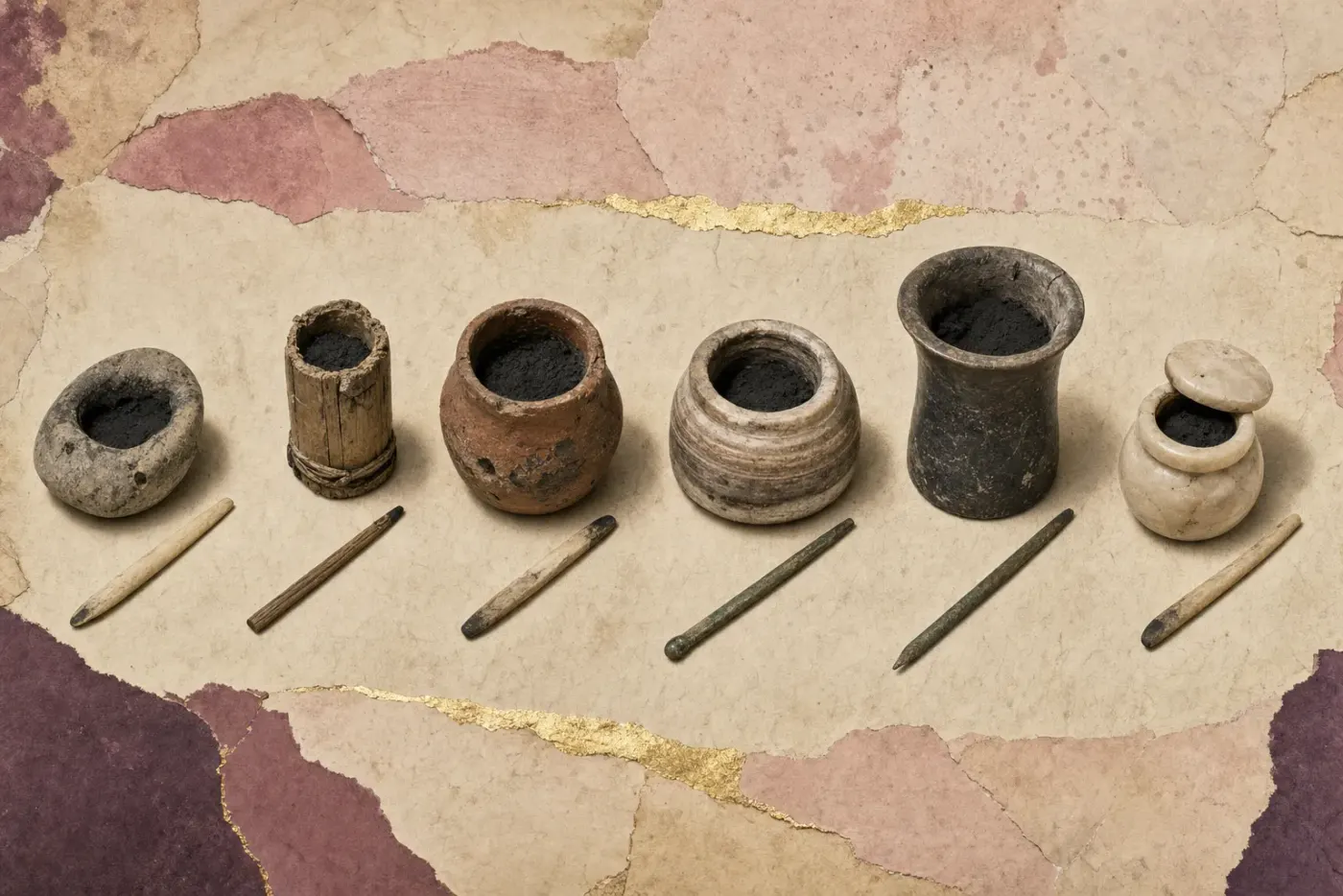
Malachite, galena and pyrolusite are the reference minerals of the Egyptian cosmetic kit, with Gebel Zeit named as a worked source of galena — a mine, which is to say an organised supply rather than opportunistic collection.[3]
A universal practice needs exactly that. Occasional use can live on what is picked up; daily use by a whole population requires extraction, transport and distribution, and the existence of a worked source is the clearest sign that the practice had the infrastructure its ubiquity would demand.[3]
A cosmetic everybody wears cannot be a cosmetic that sorts anybody.
Not One Product but Several
The dark eye paint was a family rather than a formula. Manganese-based, silicon-based and carbon-based preparations appear alongside the lead-based ones, with haematite among the minerals identified.[4]
Some of the lead content was made rather than found: analysis of Louvre kohl samples identified laurionite and phosgenite, compounds rare in nature but present in quantity in the containers, which means they were deliberately synthesised rather than simply ground from galena.[5]
That is a manufacturing operation, and it sits oddly with the picture of a universal folk practice. Somebody was running a chemical process at a scale that reached ordinary households, which implies specialists, a trade and a body of transmitted technique behind what looks from the outside like an everyday habit.[5]
The Argument From Function
One laboratory result is regularly offered as the reason everyone wore it. Amperometric measurement at single cells indicates that lead ions at very low concentrations stimulate nitric oxide production, proposed as a mechanism by which Egyptian lead preparations could have had an effect in the eye.[6]
That is a mechanism, not a vindication. It is not a clinical demonstration that the practice treated disease, and it does not weigh any benefit against lead exposure — so it belongs in this article as a hypothesis about why a universal practice might have been useful, and nowhere near a recommendation.[6]
The Modern Position
Whatever the ancient calculation was, the current one is not in doubt. The United States Food and Drug Administration warns against kohl on account of its lead content, and the warning is about a material still sold and still used, not about an archaeological curiosity.[7]
Both facts are true at once: a practice can be near-universal in one society for three thousand years and be a hazard in ours, and the history is not an argument about the present. A reader who takes the ubiquity as reassurance has read this the wrong way round.[7]
What Is Not Known
How often it was applied, by whom within a household, and whether children were painted as routinely as adults are not established by anything cited here. Representation is not frequency, and a tomb wall is a composed image rather than a census.[8]
Whether Egyptians themselves thought of it as protective, medical or decorative is also unrecoverable. Those are three of our categories, and there is no reason to assume the distinction existed for the wearer at all.[8]
Sources
- [1, 2, 8]Sacred Luxuries: Fragrance, Aromatherapy, and Cosmetics in Ancient Egypt Cornell University Press, 1999.
- [3]Cosmetic materials (Digital Egypt for Universities) University College London, 2001.View source (opens in a new tab) Accessed 2026-09-22.
- [4]Recipes of Ancient Egyptian kohls more diverse than previously thought Scientific Reports, volume 12, 2022.View source (opens in a new tab)
- [5]Making make-up in Ancient Egypt Nature 397, 483–484, 1999.
- [6]Finding Out Egyptian Gods' Secret Using Analytical Chemistry: Biomedical Properties of Egyptian Black Makeup Revealed by Amperometry at Single Cells Analytical Chemistry 82 (2), 457-460, 2010.View source (opens in a new tab) Accessed 2026-09-22.
- [7]Kohl, Kajal, Al-Kahal, Surma, Tiro, Tozali, or Kwalli: By Any Name, Beware of Lead PoisoningView source (opens in a new tab) Accessed 2026-09-22.
Filed under