The Morning Mirror: Adorning the Face in Early China
A moral text warned that people knew how to adorn their faces but not their natures. The poems and grave goods of the Tang show how thoroughly they knew the first.
In short
The Admonitions of the Court Instructress, written by Zhang Hua (about 232-300) and illustrated in a famous scroll in the British Museum, warns that people all know how to adorn their faces but none knows how to adorn their nature.
- 3min read
- 4chapters
- 7sources

Vivien
Your guide through time
Listen to this essay
5 min listenVivien reads our essays aloud, word for word — every date and every name in its place — so you can listen the way you would be walked through a gallery.
An AI voice, designed for History of Makeup
"People all know how to adorn their faces, but none knows how to adorn their nature. When the nature is not adorned, conduct may stray from propriety." The lines are from the Admonitions of the Court Instructress, and the same text warns that a face made alluring to win favour is what the gentleman detests.[1] The translation is ours.
The British Museum's record describes the text as a political parody by the poet Zhang Hua, who lived from about 232 to 300, attacking the excesses of an empress, and its famous painted scroll, made after the painter Gu Kaizhi, illustrates it in nine scenes.[2] It states, early and plainly, an argument that runs through this whole history: that the daily work of the face is a rival to the work of character.
The Poem at the Mirror
The other tradition does not admonish. It watches. A song lyric by the Tang poet Wen Tingyun describes a woman at her morning toilette: "Lazily she rises to paint her moth-brows; slow over her make-up, her combing and washing. She checks the flowers in her hair in mirrors front and back, and flower and face shine on each other."[3] The translation, again, is ours.
What the poem records is time. The brows are painted first, the rest is slow, and the check is made with two mirrors, one held behind the head so the back can be seen in the front. The toilette here is not a vice to be corrected but a leisure to be dwelt on, and the delay is the point of the poem.
A Mirror for the Afterlife
The Tang tombs carried the toilette with them. An eighth-century earthenware figure in the Victoria and Albert Museum, lead-glazed in the sancai manner and thirty-two centimetres high, shows a seated woman holding a mirror. The museum explains that grave goods of the period included small figures of people at work or at leisure, so that the dead could go on living in the same way.[4]
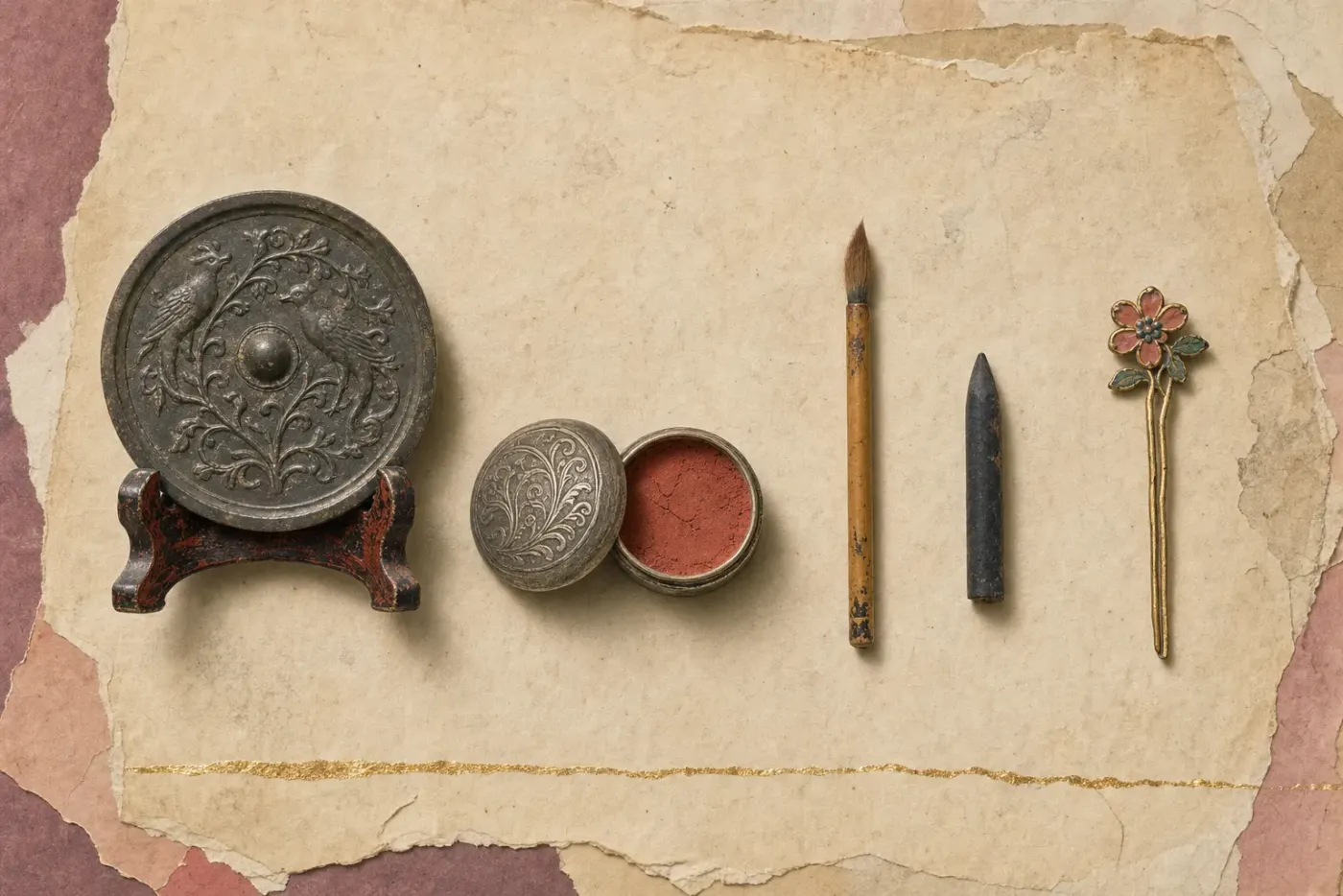
The equipment went too. A small silver box of about 675 to 750, five and a half centimetres across and chased with scrolling leaves, is described by the same museum as a box that "would have contained rouge for a wealthy lady".[5] Looking in the mirror was, it seems, something worth continuing after death.
People knew how to adorn their faces. The argument was over whether that was the part that mattered.
The Beast That Longs for the Moon
A mirror in China was more than a tool. A parcel-gilt bronze mirror stand of the thirteenth century, in the Victoria and Albert Museum, is shaped as a one-horned beast, the xiniu, lying down and looking round at a holder shaped as a crescent moon rising over clouds; the mirror, set in the holder, became the moon. The museum notes that mirrors in China were associated with ceremonial rites and magic as well as with ordinary cosmetic use, and that this stand seems to combine a practical use, perhaps for a lady of leisure, with Taoist symbolism.[6]
The object makes the same move as the poem. The moment at the mirror is ordinary, and it is dressed in an image that makes it something more.
What Is Not Known
How anyone outside the court made up. The admonition was written for palace women, the poem describes an aristocratic morning, and the silver box and the tomb figure were made for the rich. Even the objects can mislead: a gilt bronze box of the Western Han in the same museum is shaped like excavated toilet boxes, but the museum notes that it may have been a wine vessel made for burial instead.[7]
The Chinese toilette survives as a moral argument, a poetic image and a handful of luxury objects. What an ordinary woman kept by her bed, and how long she took over it, is not recorded in any of them.
Sources
- [1]女史箴 (Nüshi zhen, Admonitions of the Court Instructress), from the Wenxuan, juan 56 Chinese Wikisource transcription.View source (opens in a new tab) Accessed 2026-09-25.
- [2]Admonitions Scroll, after Gu Kaizhi Google Arts & Culture.View source (opens in a new tab) Accessed 2026-09-25.
- [3]菩薩蠻 (Pusa man), "小山重疊金明滅" Chinese Wikisource transcription, from the Quan Tang Wudai ci, juan 1.View source (opens in a new tab) Accessed 2026-09-25.
- [4]Figure of a seated woman holding a mirror, China, Tang dynasty, 8th century, museum number C.71-1935View source (opens in a new tab) Accessed 2026-09-25.
- [5]Box, silver, China, Tang dynasty, 675-750, museum number M.34:2-1935View source (opens in a new tab) Accessed 2026-09-25.
- [6]Mirror stand, parcel-gilt bronze, China, 13th century, museum number M.737:1&2-1910View source (opens in a new tab) Accessed 2026-09-25.
- [7]Toilet box, gilt bronze, China, Western Han dynasty, 206 BC-AD 9, museum number M.13-1935View source (opens in a new tab) Accessed 2026-09-25.
Filed under