Bronze Sticks at Chanhu-daro: An Excavator’s Hedge
Mackay thought the shape made it more than likely. Ninety years later the hedge has been quietly removed by everyone who repeats him.
In short
Ernest Mackay’s 1935–36 season at Chanhu-daro recovered rectangular red-ochre slips with bevelled ends, which he read as probably face paint and possibly lipstick; the reading is an inference from shape and the report does not demonstrate cosmetic use.
- 12min read
- 6chapters
- 1source

Vivien
Your guide through time
Listen to this essay
5 min listenVivien reads our essays aloud, word for word — every date and every name in its place — so you can listen the way you would be walked through a gallery.
An AI voice, designed for History of Makeup
Excavation reports are usually careful and their summaries usually are not. The distance between the two is where most confident claims about prehistoric cosmetics come from.
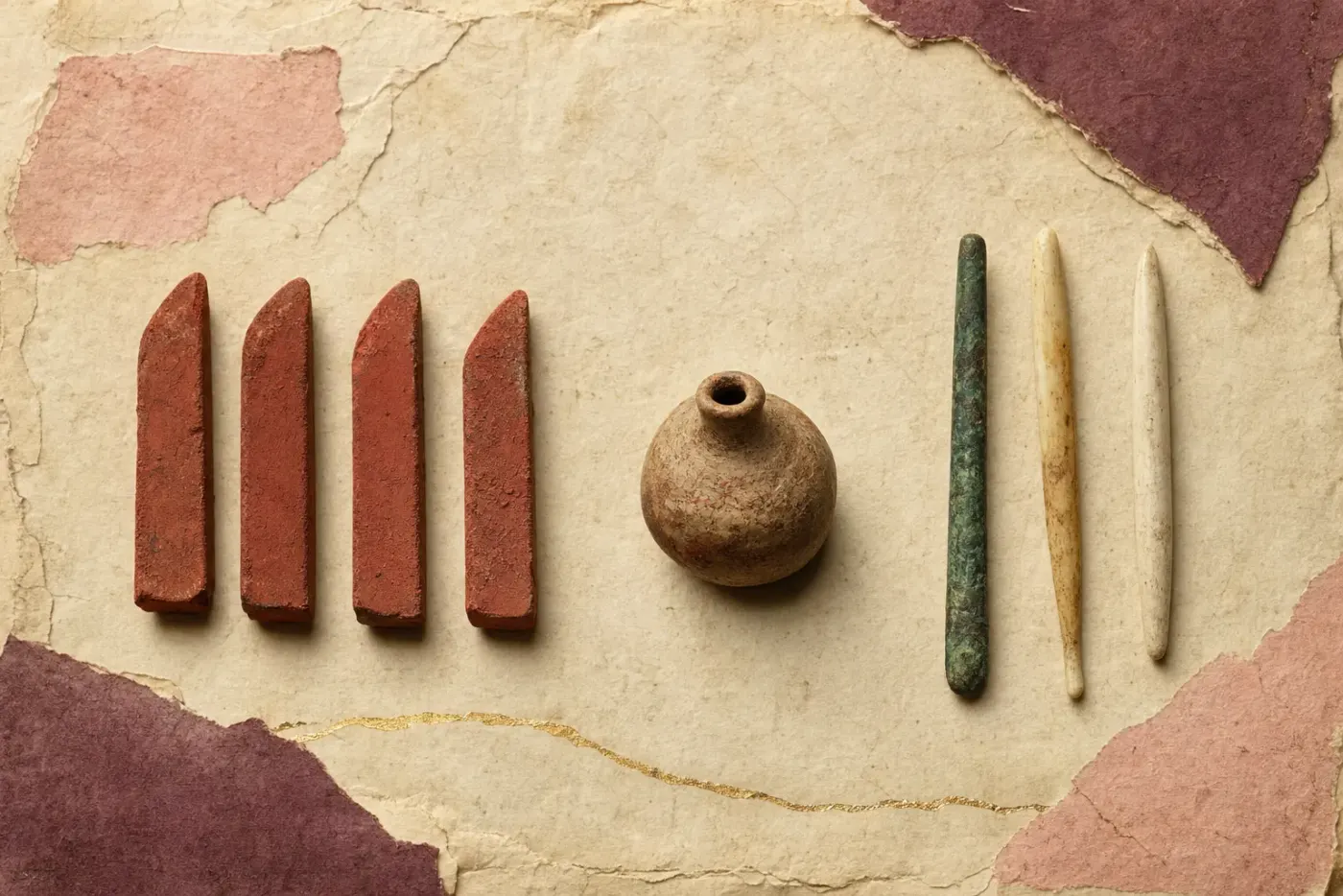
Chanhu-daro, a Harappan site in the Indus valley in Sindh, is the clearest case. Mackay’s 1935–36 season recovered rectangular slips of red ochre with bevelled ends, and he read them as probably face paint and possibly lipstick.[1]
What the Objects Are
Red ochre, shaped into rectangular slips, with the ends bevelled. Every word of that is observation: the material can be identified, the form can be measured, and the bevel is either present or not.[2]
Nothing in that description is a cosmetic. It is a coloured mineral worked into a shape, and the same sentence would fit a marking tool, a pigment blank prepared for grinding, a crayon for decorating a surface, or a piece of raw material shaped for storage and transport.[2]
Red ochre in particular is the least diagnostic material available. It is the most widely used pigment in human history, present at sites on every inhabited continent and put to purposes ranging from rock art to hide processing to burial, so its presence narrows almost nothing.[2]
What the Bevel Was Doing in the Argument
Carrying the whole inference. A bevelled end is a working end: it suggests the object was applied rather than ground, held rather than mounted, and used until the bevel formed or made with the bevel to begin with.[3]
That is a reasonable argument and it is still an argument from shape. A form suited to drawing on a surface does not identify the surface, and a face is one of several candidates rather than the obvious one.[3]
The objects are certain. The uses are inferred, and the inference is usually reasonable and never proof.
The Surrounding Material
The context is better than the slips alone. Pots and applicator sticks of copper, bronze, ivory and bone are common at Harappa and Mohenjo-daro, and many of the pots have narrow spouted mouths.[4]
Mackay took the narrow spouts to mean the contents were poured out and mixed with water rather than kept ready in the jar — again an inference, and a good one, because a vessel you cannot get a finger or a stick into is a vessel designed to dispense rather than to hold a prepared paste.[4]
That reading is also stronger than the one about the slips, because it argues from function rather than from resemblance. A narrow spout constrains what can physically be done with a vessel, and a constraint is harder evidence than a shape that merely suggests something.[4]
Why the Hedge Disappears
Because a hedge is unusable. "Probably face paint, possibly lipstick" cannot open an article, illustrate a museum label or support a claim about the world’s oldest cosmetics, and each retelling has a small incentive to firm it up.[5]
Compounded across enough retellings, an excavator’s careful maybe becomes a flat assertion with his name still attached to it — which is worse than an anonymous invention, because the authority survives the caution that made it worth having.[5]
How This Article Handles It
By paraphrasing rather than quoting. No page reference for the passage has been verified and the accessible record is a catalogue page for the book rather than its text, so putting Mackay’s words inside quotation marks would assert a precision this does not have.[6]
That is not scruple for its own sake. A quotation is a promise that the words are the author’s in that order, and a promise that cannot currently be checked should not be made in a piece whose subject is other people making exactly that promise too easily.[6]
What Is Not Known
Whether the slips were used on skin at all. Residue analysis of the kind now applied to Egyptian and Chinese material would settle a great deal, and nothing cited here reports it for these objects.[7]
Who used them, and whether the practice was general or particular to one site, is equally open. A single season at a single site is a sample of one.[7]
And the Harappan record is silent in the way that matters most. Without a decipherable script there is no text to say what any of these objects was called or what it was for, so every reading of them will remain an argument from form and context.[7]
Sources
- [1, 2, 3, 4, 5, 6, 7]Chanhu-daro Excavations 1935-36 American Oriental Society (American Oriental Series 20), 1943.View source (opens in a new tab) Accessed 2026-09-22.
Filed under