The Material Travels: Reading a Supply Chain Out of Lead
Lead carries the isotopic signature of the ore it came from. That turns a pot of eye paint into a shipping record.
In short
Lead isotope analysis of eleven Bronze Age kohl samples from Sudanese Lower Nubia yields two isotopic groups: some match galena ores from Gebel el-Zeit on the Egyptian Red Sea coast, while the second group points to a source not yet identified.
- 12min read
- 6chapters
- 4sources

Vivien
Your guide through time
Listen to this essay
5 min listenVivien reads our essays aloud, word for word — every date and every name in its place — so you can listen the way you would be walked through a gallery.
An AI voice, designed for History of Makeup
Most questions about ancient trade are answered with objects that look alike, which is weak evidence — similar things get made in similar ways in places that never met.
Lead is better than that. The isotopic composition of a lead ore varies by deposit and survives being mined, ground and mixed, so a lead-bearing cosmetic carries a signature of where its mineral came out of the ground.[1]
What Was Measured
Eleven kohl samples from Bronze Age Sudanese Lower Nubia were analysed. They do not form one population: the samples fall into two isotopic groups, which is already a result, because a single supplier would not produce two.[2]
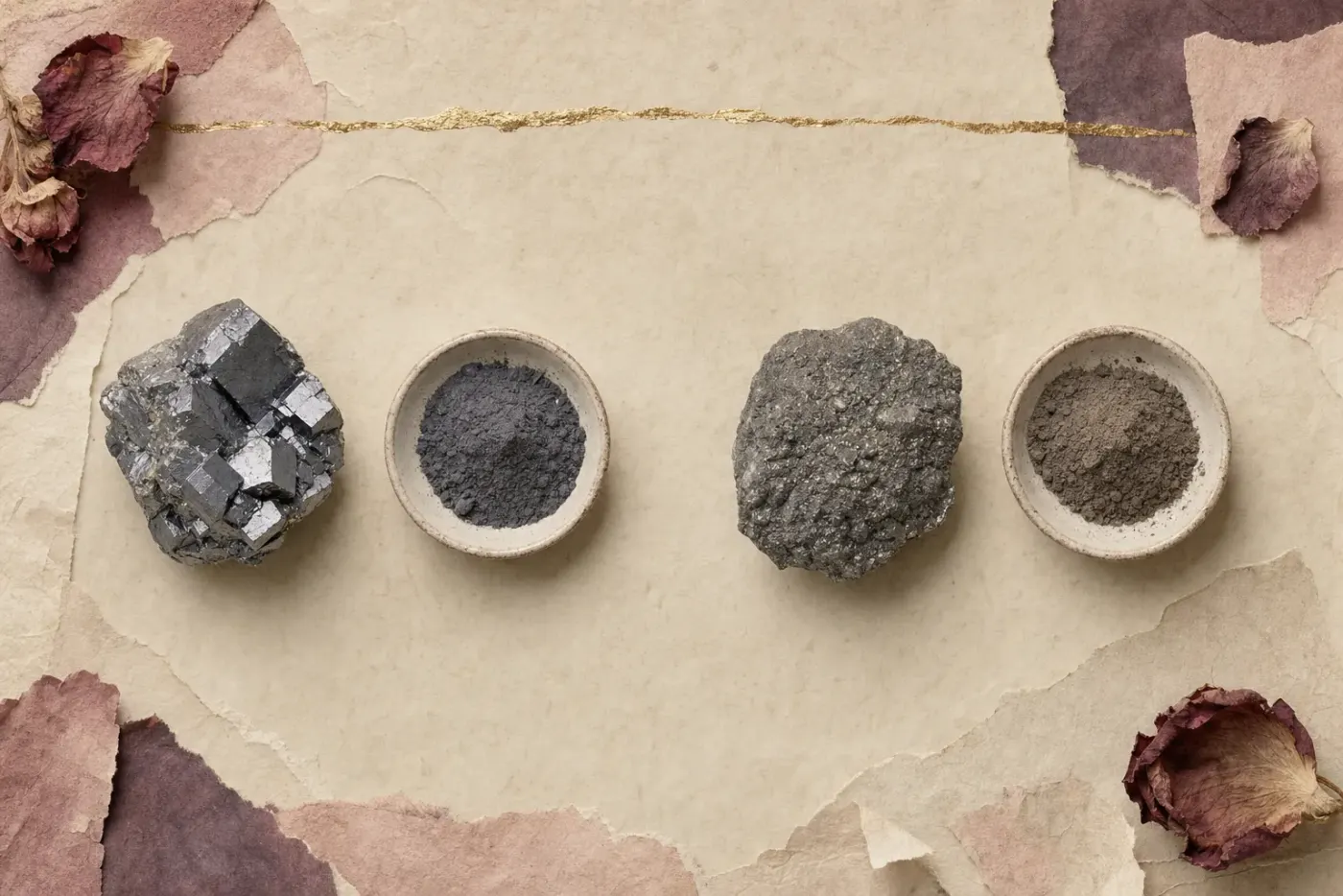
Some of the samples match galena ores from Gebel el-Zeit on the Egyptian Red Sea coast — a real, locatable place, and a source worked for galena.[2][3]
The Group That Does Not Match
The second group points to a source that has not yet been identified, and that is the more interesting half of the finding. An unmatched signature is not a gap in the analysis; it is a supplier the archaeological record has not yet located.[4]
It also rules something out. Two groups means the Nubian material was not simply Egyptian material moved south, which is the assumption a single-source result would have licensed and the evidence does not.[4]
A negative result of that kind is worth more than it looks. Plenty of reconstructions of ancient Nubia treat its material culture as Egyptian goods arriving; a second, unmatched source is direct evidence of supply that did not run through Egypt at all, whoever was operating it.[4]
An unmatched signature is not a gap in the analysis. It is a supplier nobody has found yet.
The Word This Study Will Not Support
The paper does not say which of the two groups is larger. That single absence forbids the sentence every summary wants to write — that most Nubian kohl came from Egypt — and no article here will write it.[5]
Eleven samples is also eleven samples. It is enough to demonstrate that more than one source was in use and not enough to describe the shape of a trade, and the difference between those two statements is the difference between a finding and a story.[5]
This is the ordinary condition of the evidence rather than a defect of this paper. Analyses of ancient cosmetics work with whatever survived, was excavated, was kept and was released for destructive testing, and every one of those filters operates before a sample reaches an instrument.[5]
Why Cosmetics Are Good Evidence
Cosmetic minerals are unusually informative for this kind of work. They are consumed rather than curated, so they are bought repeatedly rather than inherited once; they are small and high-value by weight, so they travel; and they end up in graves, so they survive.[6]
A cosmetic is also a domestic purchase. A traded weapon or ingot documents a transaction between institutions, while a pot of eye paint in a grave documents a household reached by a supply chain — which is a different and harder thing for trade to achieve.[7]
And because it is consumed, it dates itself usefully. An heirloom can sit in a family for generations and enter the ground long after it was made, whereas a pot of eye paint buried with its owner was in circulation within that owner’s lifetime, which ties the supply to the burial far more tightly.[7]
What the Isotopes Cannot Say
An isotopic match identifies an ore deposit, not a route, a merchant or a date of sale. Lead from Gebel el-Zeit in a Nubian grave is compatible with direct trade, with several intermediaries, with tribute, with plunder, and with a pot that changed hands four times.[8]
Nor does the ore tell you what was done with it afterwards. Some Egyptian lead compounds in kohl were synthesised rather than ground — laurionite and phosgenite are rare in nature and present in quantity in the containers — so the ore is a starting material, and the preparation is a separate question.[9]
What Is Not Known
Where the second group’s ore was mined is the open question, and until a deposit matches it the finding stands as a demonstration that the supply was plural rather than as a map of it.[10]
How representative eleven samples are of Nubian kohl generally is also unestablished. They come from a particular region and period, and nothing cited here licenses extending the pattern beyond them.[10]
Sources
- [1, 2, 4, 5, 6, 8, 10]Bronze age supply chains between ancient Egypt and Nubia revealed by lead isotope analysis of kohl samples Scientific Reports 14, article 27488, 2024.View source (opens in a new tab)
- [3]Cosmetic materials (Digital Egypt for Universities) University College London, 2001.View source (opens in a new tab) Accessed 2026-09-22.
- [7]Sacred Luxuries: Fragrance, Aromatherapy, and Cosmetics in Ancient Egypt Cornell University Press, 1999.
- [9]Making make-up in Ancient Egypt Nature 397, 483–484, 1999.
Filed under