Red Ochre
Identity
In current useas of 22 Sep 2026
- CAS
- 1309-37-1
- EC
- 215-168-2
- Colour Index
- CI 77491
- Origin
- Mineral
- First attested
- 100,000 BCE
- Also known as
- ruddle · rubrica · sinopia
No INCI name: this material predates the nomenclature and is not a listed cosmetic ingredient.
How it is dated
An ochre-processing toolkit with the mixture stored in two abalone shells at Blombos Cave, South Africa, dated to about 100,000 years ago. This is the earliest evidence of ochre being compounded and stored rather than used as found; ochre itself was collected and used earlier still, and the excavators state that what the mixture was applied to is not established.
No regulatory dataset is loaded. The status above is this archive's editorial summary of the documented record, not a statement of any substance's legal position in your jurisdiction, and nothing here is advice on whether to use it.
In short
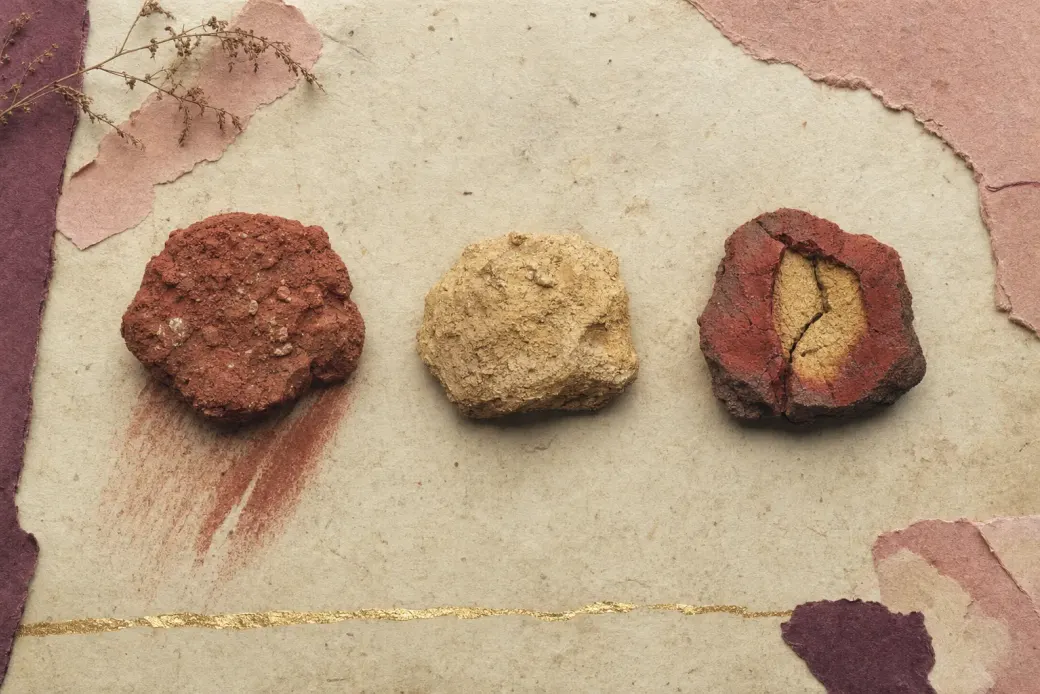
Red ochre is iron-oxide-rich earth, haematite mixed with clay and quartz: the oldest colouring material in the human record, and, purified and synthesised, still the red in most foundations.
- 3min read
- 4chapters
- 7sources

Vivien
Your guide through time
Listen to this entry
6 min listenVivien reads our essays aloud, word for word — every date and every name in its place — so you can listen the way you would be walked through a gallery.
An AI voice, designed for History of Makeup
Red ochre is earth coloured by iron oxide. The colouring agent is haematite; the rest is clay, quartz and whatever else the deposit happened to contain. It needs no processing beyond digging, grinding and sometimes heating, and it is the oldest colouring material that can be followed continuously in the human record: a processed ochre mixture was being compounded and stored in abalone shells at Blombos Cave in South Africa about a hundred thousand years ago.[1]
It has never really stopped. The red in a modern foundation or blusher is the same compound, synthesised to a controlled particle size and purity instead of dug out of a hillside, and it is still doing the same job. This entry is about the mined earth; the synthesised oxide that succeeded it is a separate material with a listing of its own.
What It Is
The colouring fraction is iron(III) oxide, Fe2O3, the mineral haematite.[2] Natural ochres vary enormously. The iron oxide content of a workable red earth may run from a fifth of the material to most of it, and the remainder governs how it grinds, how it covers and how it feels on the skin. Haematite is a distinct mineral with its own registry entry, and an ochre is a mixture in which haematite is the active component rather than another name for it.
Yellow ochre is the hydrated form, goethite. Heating it drives off water and converts it to haematite, turning a yellow earth red. That transformation is one of the earliest deliberate chemical operations anywhere in the record, and it leaves a mineralogical signature that can be read off archaeological ochre long afterwards.
In History
At Blombos Cave on the southern Cape coast, excavators recovered two abalone shells holding a processed ochre mixture, together with grindstones, hammerstones, bone and charcoal, in deposits dated to roughly one hundred thousand years ago. It is the earliest known evidence of a compound being made and stored rather than used as found. What it was applied to, the excavators say plainly, is not known.[3]
Ochre appears on Egyptian cosmetic palettes alongside malachite and galena, and Egyptian sources describe reddening the cheeks and the lips.[4] Roman writers call the material rubrica and grade it by source. Pliny rates the Lemnian earth highest, close to cinnabar in esteem and sold in sealed packages, from which it took the name seal red-ochre; sinopis takes its name from Sinope in Pontus, where it was first found, but Pliny says the best of it is extracted from the caverns of Lemnos and Cappadocia.[5]
What It Does
Iron oxide is a pigment and an opacifier. It is chemically inert, insoluble, essentially unaffected by light and stable across the pH range a cosmetic is likely to occupy. That combination is rare, and it is the reason iron oxide has outlasted every organic red that has competed with it.
Its range is wide for a single compound. Particle size and crystal habit carry it from a light salmon through brick to a dark maroon, so a full foundation shade ladder can be built from iron oxides alone, lightened with titanium dioxide. That is a description of how the material behaves in formulation rather than a regulatory statement, and it is offered here as the entry's own account.
Safety and Status
The colour additive listed for cosmetic use in the United States is the synthetic oxide. Under 21 CFR 73.2250 the listed additive consists of synthetically prepared iron oxides and their hydrated forms, is permitted in cosmetics generally including the area of the eye, and must meet limits of 3 ppm arsenic, 10 ppm lead and 3 ppm mercury.[6] Ochre dug from a deposit is not that listed additive, and the distinction is the whole point of the listing. The in-use status given for this entry refers to the synthesised oxide that succeeded the earth, not to mined ochre, and the CAS and Colour Index numbers recorded here identify that synthesised material.
Separately, the Food and Drug Administration has issued draft guidance recommending a maximum of 10 ppm lead as an impurity in cosmetic lip products and externally applied cosmetics. It is guidance, not a binding limit.[7] In the European Union iron oxides are permitted colorants under Annex IV of Regulation (EC) No 1223/2009, and are declared on the label by their Colour Index numbers, CI 77491 for the red.[8]
Sources
- [1, 3]A 100,000-Year-Old Ochre-Processing Workshop at Blombos Cave, South Africa Science 334(6053), 219-222, 2011.View source (opens in a new tab)
- [2]Substance Infocards, ECHA database of registered substancesView source (opens in a new tab) Accessed 2026-09-22.
- [4]Sacred Luxuries: Fragrance, Aromatherapy, and Cosmetics in Ancient Egypt Cornell University Press, 1999.
- [5]Naturalis Historia, Books XXXIII–XXXV 77.
- [6]Iron oxides, 21 CFR 73.2250 (Listing of Color Additives Exempt from Certification)View source (opens in a new tab) Accessed 2026-09-22.
- [7]Lead in Cosmetic Lip Products and Externally Applied Cosmetics: Recommended Maximum Level; Draft Guidance for Industry 2016.View source (opens in a new tab) Accessed 2026-09-22.
- [8]Regulation (EC) No 1223/2009 on cosmetic products 2009.View source (opens in a new tab) Accessed 2026-09-22.