Green on the Face: When the Pigment Left the Palette
A palette proves someone ground a mineral. A face proves someone wore it, and the difference took a cemetery to establish.
In short
Human remains at Adaima in Upper Egypt retain malachite residue around the eyes, and the UCL pigment project states there is no evidence for malachite as a paint in the Predynastic period — so the green was a cosmetic applied to the body.
- 12min read
- 6chapters
- 4sources

Vivien
Your guide through time
Listen to this essay
6 min listenVivien reads our essays aloud, word for word — every date and every name in its place — so you can listen the way you would be walked through a gallery.
An AI voice, designed for History of Makeup
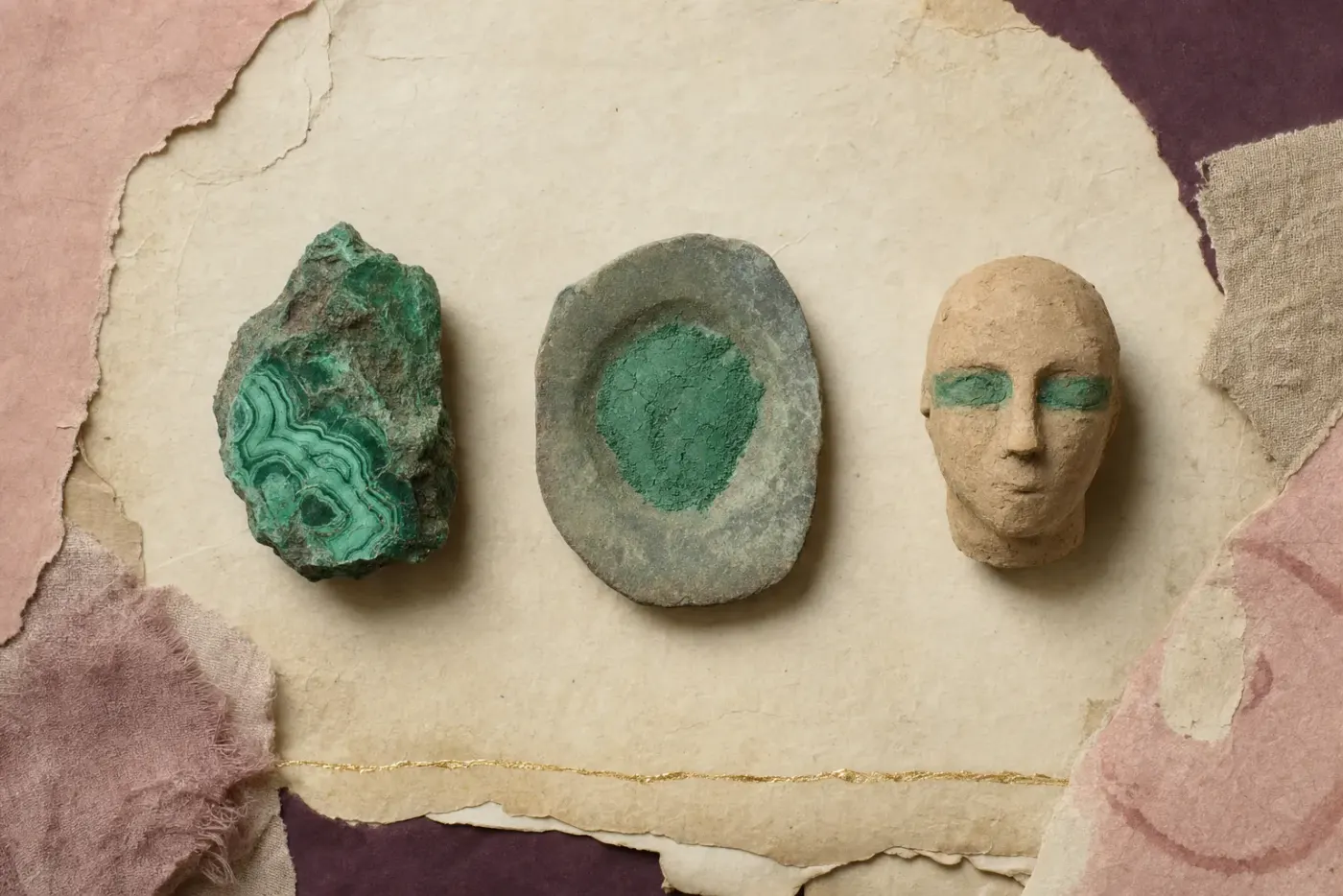
A grinding palette with green residue in its hollow proves that somebody ground malachite. It does not prove that anybody wore it, and for most of the history of the subject that gap was filled by assumption.
Human remains from Adaima in Upper Egypt close it. The malachite is still there, around the eyes, on the body — which is a different class of evidence entirely from a stain in a dish.[1]
Why the Distinction Matters
Ground mineral has more than one destination. It can colour a pot, a wall, a coffin, a textile or a face, and the palette alone cannot tell you which — so a cemetery full of palettes is consistent with a society that painted objects and never painted itself.[2]
The UCL pigment project is precise about this and its precision cuts the other way too: it states that there is no evidence for malachite being used as a paint in the Predynastic period, where pottery and other objects carry ochre- and gypsum-based paints instead. In that period malachite is a cosmetic, and the residue on the bodies is why.[2]
A Face That Is Not a Person
A painted clay head from tomb H.97 at el-Mahasna carries green malachite around its eyes as well, which is a second kind of witness: not a body that wore the pigment but an object made to show a body wearing it.[3]
That matters because a representation encodes an intention. Residue on skin says the material touched a face; a modelled head with the same green in the same place says that a face with green around the eyes was the recognisable, intended image of a person — which is a claim about convention rather than about one individual.[3]
The two kinds of witness also check each other. A body alone could be an individual habit and a modelled head alone could be an artistic convention with no wearer behind it; together they describe a practice that was both done and depicted, which is as close to a documented custom as a period without writing allows.[3]
A palette says somebody ground a mineral. A face says somebody wore it.
What Was Lying Beside the Palettes
The surrounding material is consistent. Lumps of ore have been found in Predynastic burials beside palettes and grinding pebbles — ore lying next to the equipment, which is a supply of raw material buried with the means of preparing it.[4]
It is worth stating exactly what that is and is not. It is ore beside a palette, not analysed residue on one, and the reference that records it makes no claim about which mineral turns up most often as a residue. Grave goods are a statement about what the living thought the dead required, and the requirement here was evidently the whole process rather than the finished product.[4]
Green Does Not Last
Malachite eye paint belongs to the early tradition and thins out of the later record, while the grey and black preparations built on galena and other dark minerals continue for the whole of dynastic Egypt.[5]
Why is not documented. Trade, fashion and religious association are all offered as explanations, they are all plausible, and not one of them rests on an Egyptian text that says so — which makes the disappearance of the green one of the better-attested facts in the subject and one of the least explained.[5]
What Replaced It Was Not Simpler
The dark preparations that outlasted malachite were not a single substance. Analysis of Egyptian kohls has identified manganese-based, silicon-based and carbon-based formulations alongside the lead-based ones, together with haematite among the minerals present.[6]
So the record does not show a simple colour succeeded by another simple colour. It shows one well-defined green giving way to a family of dark recipes, which is a change in the structure of the practice rather than only in its appearance.[6]
What Is Not Known
Who at Adaima wore malachite, and on what occasions, is not recoverable from residue. A burial is one moment at the end of a life, and green around the eyes of a body may record a daily habit, a funerary preparation, or a status the living observed and the dead kept.[7]
Whether the material was understood as protective, decorative, medical or religious is likewise not established by anything cited here. Those categories are ours, and the evidence that would separate them for a Predynastic wearer does not exist.[8]
Sources
- [1, 2, 3, 7]Pigment Stories: Eternal Green in Predynastic Egypt University College London, 2020.View source (opens in a new tab) Accessed 2026-09-22.
- [4]Cosmetic materials (Digital Egypt for Universities) University College London, 2001.View source (opens in a new tab) Accessed 2026-09-22.
- [5, 8]Sacred Luxuries: Fragrance, Aromatherapy, and Cosmetics in Ancient Egypt Cornell University Press, 1999.
- [6]Recipes of Ancient Egyptian kohls more diverse than previously thought Scientific Reports, volume 12, 2022.View source (opens in a new tab)
Filed under