Mourning and the Face: Two Kinds of Preparation
A funeral asks two faces to be got ready. One belongs to the dead, and one to the people who must be seen grieving.
In short
Death has produced two opposite cosmetic traditions: the preparation of the dead face, from Egyptian burial kits to the American funeral trade's restorative art, and the regulation of the living one, from Solon's Athenian law against mourners lacerating their cheeks to Victorian mourning dress.
- 8min read
- 6chapters
- 11sources
Vivien
Your guide through time
Listen to this essay
9 min listenVivien reads our essays aloud, word for word — every date and every name in its place — so you can listen the way you would be walked through a gallery.
An AI voice, designed for History of Makeup
A funeral requires two faces, and they are prepared by opposite rules.
The face of the dead is worked on. It is washed, closed, arranged and in many traditions painted, so that the body can be looked at. The face of the mourner is required to show damage: no colour, no ornament, no scent, and in some traditions no washing, because a person who looks well is a person who is not sufficiently sorry.
Both are cosmetic practices in the strict sense, and both are unusually well documented, because both have repeatedly been regulated in writing. The Egyptian dead were buried with complete cosmetic kits - palettes, pigment, pots and applicator sticks - from the predynastic period onward.[1]
The Face Prepared: Egypt
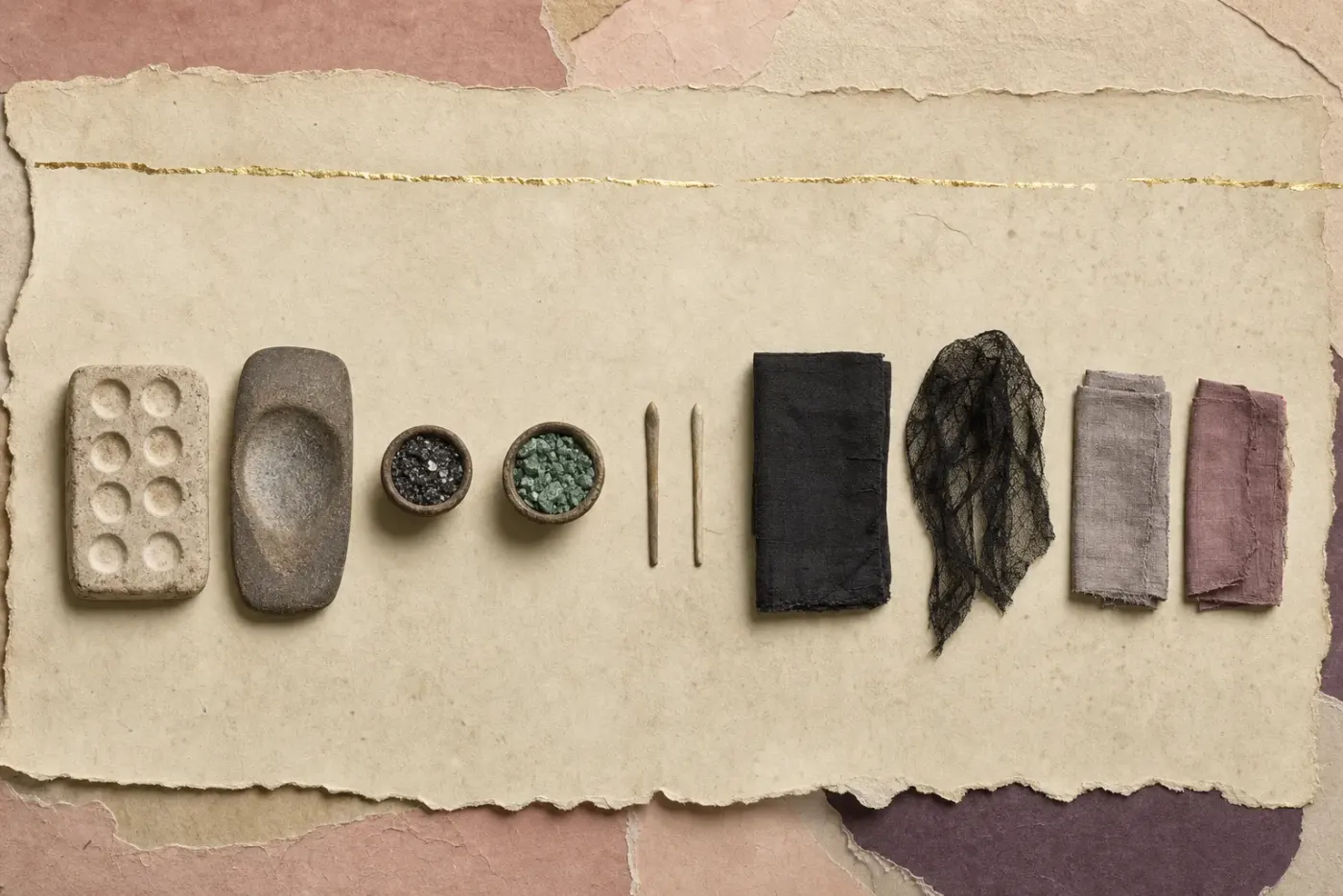
Egyptian burial treats cosmetics as equipment for a continuing life rather than as a farewell gesture. Pots of galena and malachite, grinding palettes, applicator sticks and sealed jars of oil appear in graves of both sexes across three thousand years.[2]
The offering ritual formalised the provision. The Metropolitan Museum holds one such object: an offering slab cut for Ankhwadjes in travertine, of Dynasty 5 or 6, with seven depressions for the seven sacred oils of the mortuary ritual, so that the supply continued in stone whether or not anyone renewed it in kind.[3] That is a single Old Kingdom example rather than a statement about the form as a class. The canonical offering list sets those oils beside two eye paints, the green and the black, as standard equipment for the dead.[2]
The purpose is not decorative. A face that can see, and that is protected, is a face fit for what comes next, and the same paint worn in life is supplied for use after it. The containers were often finely made, which is not what is done for a purely functional substance.[4]
The Face That Must Show It: Athens
Greek mourning ran the other way. The mourner's face was the medium: women tore their cheeks, cut their hair and beat themselves at the graveside, and professional mourners were hired to do it visibly and audibly.
It was legislated against. Plutarch, in his Life of Solon, reports that Solon forbade laceration of the flesh by mourners, set lamentations, and the bewailing of anyone at another person's funeral, as part of a wider law restricting the public appearances of women at funerals and festivals.[5]
A law is evidence that the thing was happening, and evidence of who was thought to be doing it. Solon's Athens is the earliest well-documented case of a state deciding how far a face may be marked in grief. It was not the last.
Refusing the Oil
Jewish mourning law codifies the same instinct as a set of abstentions. During shiva, the seven days following burial, the mourner is prohibited from bathing and from anointing - from oils, and by extension from perfumes, creams and cosmetics. The Babylonian Talmud states the rule at Moed Katan 15b and derives it from scripture rather than from any theory of pleasure. A mourner is prohibited from bathing, it says, because it is written "and do not anoint yourself with oil, but be as a woman that had for a long time mourned for the dead"; and bathing is folded into the category of anointing because both activities serve the same end, cleanliness.[6]
The reasoning that turns the rule into a judgement about intent belongs to the later codes. The Shulchan Arukh holds at Yoreh De'ah 381 that anointing of any kind is forbidden if the intention is merely for the sake of pleasure, but permitted if it is to remove dirt, and permitted without argument as a medicine.[7] That is the same move medieval Christian writers made about cosmetics in general: the substance is not the fault, the purpose is.
Comparable abstentions are documented for classical Greece. Robert Garland's account of Greek funerary practice describes mourners in dark clothing, with hair cut or torn, maintaining a conspicuous neglect of their own appearance for the duration.[8] It is the exact inverse of the Egyptian burial kit, and the inversion is the point: the same kind of preparation is supplied to the dead and withheld from the living.
Mourning is one of the few occasions on which the unmade face is the formal costume.
The Victorian Uniform
Nineteenth-century mourning is the most elaborate version on record, and it was a clothing system before it was anything else. The Metropolitan Museum's 2014 exhibition of a century of mourning attire set out the sequence: full mourning in dull black crape, then second mourning, then half-mourning in grey, mauve and white, with the duration of each stage fixed by the mourner's relationship to the dead.[9]
Queen Victoria's mourning for Prince Albert, who died in 1861, gave the black dress a public face for four decades and is the usual explanation for the system's reach. It is an incomplete one. Mourning dress was also a fashion business, and the exhibition's premise was precisely the pressure of high-fashion standards on the dress of bereavement.[9]
On the face itself the sources are thinner than the confident retellings suggest. Mourning etiquette regulated fabric, jewellery and veil in great detail; what it said about cosmetics is mostly implied by the period's general rule that nothing should look applied.[10] The claim that Victorian women were specifically forbidden cosmetics while in mourning is better treated as an inference than as a documented prohibition.
Restorative Art
The modern American funeral inverted the Victorian priority. Instead of a mourner made plain it produced a corpse made presentable, and it built a profession around doing so.
The mechanism was embalming, which spread in the United States during and after the Civil War of the 1860s as a means of getting the dead home recognisable, and which by the early twentieth century had become the normal treatment of a body before viewing. Gary Laderman's history of the American funeral home traces how the embalmed and cosmeticised body came to be what families expected rather than merely what they were sold.[11]
Jessica Mitford's The American Way of Death, published in 1963, put the trade's own phrase into general circulation. The corpse, in the industry's words that she quotes back at it, is transformed into a "Beautiful Memory Picture", and she set the phrase beside the rest of the trade vocabulary - restorative art, feature-setting, cosmetology - as the language of a business selling grief a product. The phrase is the industry's; the charge is hers.[12]
The two books disagree about the industry and agree about the practice.
Sources
- [1, 2]Sacred Luxuries: Fragrance, Aromatherapy, and Cosmetics in Ancient Egypt Cornell University Press, 1999.
- [3]Offering slab for seven oils of Ankhwadjes, Old KingdomView source (opens in a new tab) Accessed 2026-09-22.
- [4]Egyptian kohl pots and applicators, Department of Egypt and SudanView source (opens in a new tab) Accessed 2026-09-22.
- [5]Life of Solon, 21 Loeb Classical Library, trans. Bernadotte Perrin.View source (opens in a new tab) Accessed 2026-09-22.
- [6]Babylonian Talmud, Moed Katan 15b Sefaria edition.View source (opens in a new tab) Accessed 2026-09-22.
- [7]Shulchan Arukh, Yoreh De'ah 381 Sefaria edition.View source (opens in a new tab) Accessed 2026-09-22.
- [8]The Greek Way of Death Cornell University Press, 1985.
- [9]Death Becomes Her: A Century of Mourning Attire (exhibition, 21 October 2014 - 1 February 2015) The Costume Institute, Anna Wintour Costume Center, 2014.View source (opens in a new tab) Accessed 2026-09-22.
- [10]Fashions in Makeup: From Ancient to Modern Times Peter Owen, 1972.
- [11]Rest in Peace: A Cultural History of Death and the Funeral Home in Twentieth-Century America Oxford University Press, 2003.
- [12]The American Way of Death Simon and Schuster, 1963.
Filed under