Preparing the Dead: Paint, Resin and the Last Face
Ochre lies in some of the oldest burials known, and whether anyone put it on the body is the first thing the evidence will not say.
In short
Some of the oldest surviving ochre-stained human remains come from a grave rather than from the living: the burial at Goat’s Hole, Paviland, redated in 2008 to roughly thirty-three to thirty-four thousand years old.
- 7min read
- 5chapters
- 9sources
Vivien
Your guide through time
Listen to this essay
6 min listenVivien reads our essays aloud, word for word — every date and every name in its place — so you can listen the way you would be walked through a gallery.
An AI voice, designed for History of Makeup
In 1823 William Buckland excavated a burial in Goat’s Hole cave on the Gower peninsula in south Wales. The bones were stained with red ochre and accompanied by perforated shell and worked ivory. Buckland took the remains for a woman of the Roman period and the nickname stuck; they are in fact those of a young man, and a recalibration published in 2008 placed them at roughly thirty-three to thirty-four thousand years old.[1]
Ochre had been collected, ground and stored in prepared toolkits for a very long time before that: the workshop at Blombos Cave is dated to about a hundred thousand years ago, and its excavators are explicit that the intended use of the mixture is unknown.[2] What Paviland adds is ochre in a grave — material collected, processed and carried, then put beyond use with the dead.
Egypt: A Recipe with Names
Egyptian funerary preparation is the best-documented case by a wide margin, and it has recently become better documented still. In 2023 a team publishing in Nature analysed thirty-one labelled ceramic vessels from a Twenty-sixth Dynasty embalming workshop at Saqqara. Because the vessels carry both the names of their contents and instructions for their use, the chemistry could be matched to the ancient vocabulary: antiu, usually rendered as myrrh or incense, proved to be a mixture based on coniferous oils and tars, and sefet an unguent with plant additives.[3]
The materials had travelled. Pistacia and conifer products came from around the Mediterranean, dammar and elemi from tropical forest regions. Earlier work on resin-impregnated linen from Neolithic graves at Mostagedda had already pushed deliberate treatment of the body back by something on the order of a millennium and a half.[4]
The Kit in the Grave
Alongside the treatment of the body went equipment for the face. Egyptian graves contain kohl pots, grinding palettes, applicator sticks worn smooth with use, tweezers, mirrors and small spoons.[5][6] They are the same objects the living used, buried with their owners because the same needs were expected to continue.[5]
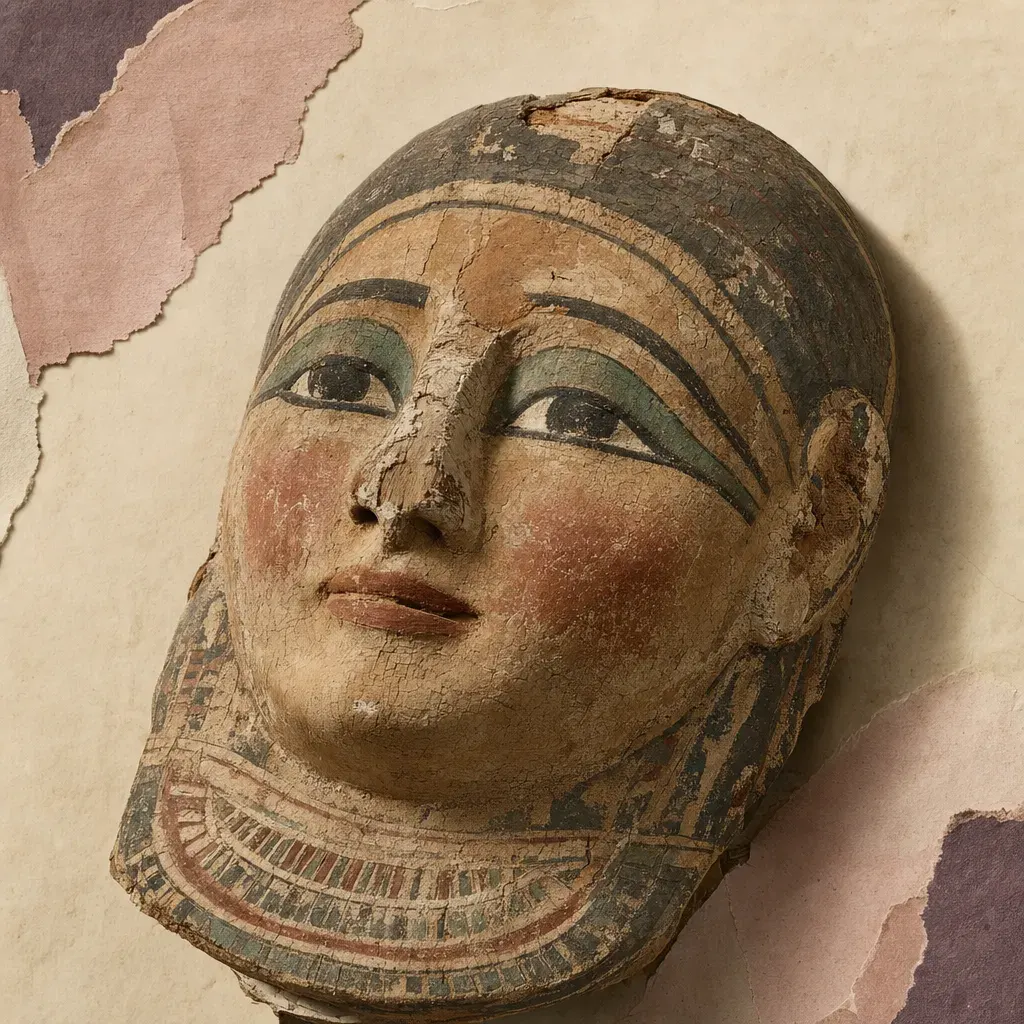
Eye paint appears on the dead as it does on the living: galena for the black, malachite for the green, red ochre for mouth and cheek. It appears a second time on the coffin, painted over the place where the face lies beneath. The distinction between making up a person and making up a portrait of a person is not one that Egyptian practice observes.[5]
Pigment ground, mixed and applied with care, for a face that was about to be closed away.
What Is Not Documented
Egypt is the exception, and there is a standing temptation to read the rest of the world through it. It should be resisted. Pigment found in a grave may have been applied to the body, scattered over it during the burial, or supplied in a container as a grave good. The three leave similar traces and are not always separable.[7]
For most societies, for most of the past, there is no record of whether the dead were painted, by whom, or to what standard. That absence is not evidence that nothing was done. It is an absence, and an account that fills it in with plausible detail has stopped writing history.
The American Viewing
The modern Western version begins from the opposite premise: the dead are prepared precisely in order to be seen. Gary Laderman’s history of the American funeral home traces how embalming spread in the decades after the Civil War and how the open-casket viewing became central to the American funeral, with the cosmetic work producing what the trade calls the memory picture, the last image the family will carry.[8]
It is a taught discipline with an examined syllabus. The American Board of Funeral Service Education is the national academic accreditation agency for college and university programmes in funeral service and mortuary science education in the United States.[9] Its accreditation standards, effective 1 January 2025, require an accredited programme to distribute a minimum of fourteen semester credits of public health and technical study across six named content areas — chemistry, microbiology, human anatomy, pathology, restorative art and embalming — and require graduates to demonstrate technical skill in embalming and restorative art.[10] Restorative art is not an elective enthusiasm. It is a line item in the standard against which the programme is measured.
The Common Thread
Two premises, pointing in opposite directions. Egyptian preparation was for a body that would be sealed away and not looked at again. American preparation is for a body that will be looked at for an afternoon and then buried.
What they share is the refusal to leave the face as death left it. In both cases someone grinds, mixes and applies a pigment for a person who cannot thank them, to a standard nobody is enforcing. It is one thing the two practices have in common, across four thousand years and opposite premises.
Sources
- [1]The “Red Lady” Ages Gracefully: New Ultrafiltration AMS Determinations from Paviland Journal of Human Evolution, vol. 55, no. 5, 2008.View source (opens in a new tab) Accessed 2026-09-22.
- [2]A 100,000-Year-Old Ochre-Processing Workshop at Blombos Cave, South Africa Science 334(6053), 219-222, 2011.View source (opens in a new tab)
- [3]Biomolecular Analyses Enable New Insights into Ancient Egyptian Embalming Nature, vol. 614, pp. 287–293, 2023.View source (opens in a new tab) Accessed 2026-09-22.
- [4]Evidence for Prehistoric Origins of Egyptian Mummification in Late Neolithic Burials PLOS ONE, vol. 9, no. 8, e103608, 2014.View source (opens in a new tab) Accessed 2026-09-22.
- [5, 7]Sacred Luxuries: Fragrance, Aromatherapy, and Cosmetics in Ancient Egypt Cornell University Press, 1999.
- [6]Egyptian kohl pots and applicators, Department of Egypt and SudanView source (opens in a new tab) Accessed 2026-09-22.
- [8]Rest in Peace: A Cultural History of Death and the Funeral Home in Twentieth-Century America Oxford University Press, 2003.
- [9]American Board of Funeral Service Education — Accreditation 2026.View source (opens in a new tab) Accessed 2026-09-22.
- [10]Accreditation Standards (new standards effective 1 January 2025), Chapter IX of the ABFSE and COA Accreditation and Policy Manual American Board of Funeral Service Education, 2025.View source (opens in a new tab) Accessed 2026-09-22.
Filed under