Cinnabar
Identity
Bannedas of 22 Sep 2026
- CAS
- 1344-48-5
- EC
- 215-696-3
- Colour Index
- CI 77766
- Origin
- Mineral
- First attested
- 2,900 BCE
- Also known as
- mercury(II) sulfide · mercuric sulphide · HgS · vermilion · Pigment Red 106
No INCI name: this material predates the nomenclature and is not a listed cosmetic ingredient.
How it is dated
The year records the earliest securely dated application of the mineral to human bodies: cinnabar spread over bodies, floors and grave goods at Valencina de la Concepcion in southern Spain, most intensively between about 2900 and 2650 BCE. That use is funerary rather than cosmetic, and no analysed residue establishes an earlier cosmetic use.
No regulatory dataset is loaded. The status above is this archive's editorial summary of the documented record, not a statement of any substance's legal position in your jurisdiction, and nothing here is advice on whether to use it.
In short
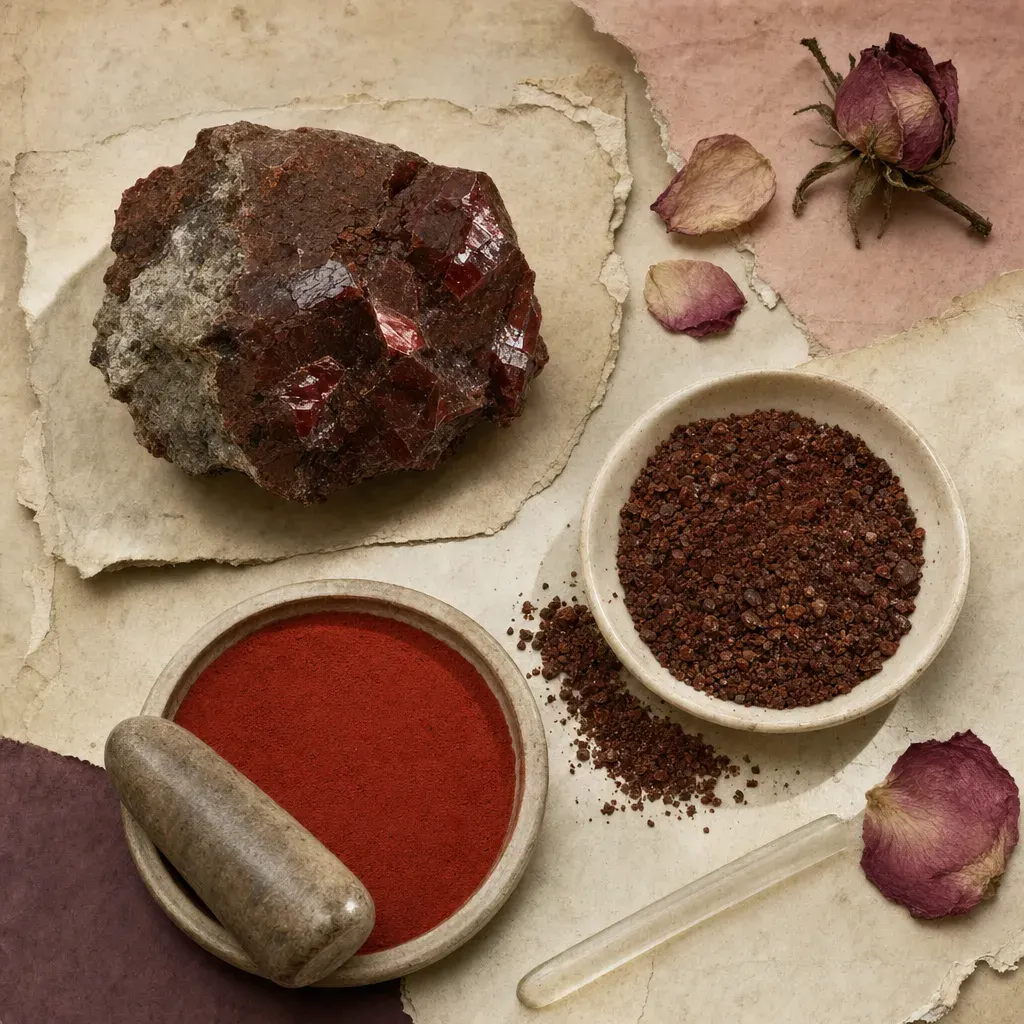
Cinnabar is the natural ore of mercury sulphide and the source of the pigment vermilion: a dense scarlet mineral spread on Copper Age bodies, Roman statues and, on contested evidence, Roman faces.
- 4min read
- 5chapters
- 8sources

Vivien
Your guide through time
Listen to this entry
6 min listenVivien reads our essays aloud, word for word — every date and every name in its place — so you can listen the way you would be walked through a gallery.
An AI voice, designed for History of Makeup
Cinnabar is the natural ore of mercury sulphide. It ranges from brownish red to a clean scarlet and grinds to one of the most saturated red powders available anywhere before synthetic dyes. Refined and levigated, it is the pigment called vermilion.
It reached the human body by two routes that are easy to confuse. It was poured over the dead in Copper Age funerary rites,[1] and it was used as a red in the Roman world, where the written sources are so slippery about which red they mean that the identification frequently cannot be made at all.
What It Is
The compound is mercury(II) sulphide, HgS.[2] The pigment is its red trigonal form; the black cubic form is metacinnabar and is useless as a colour. It is dense, soft and insoluble in water, which is why it grinds easily on a stone and why a cinnabar paint does not run.
Mercury sulphide carries the Colour Index number CI 77766 and the generic name Pigment Red 106. Both come from the Colour Index, the registry that gives a colorant a constitution number and a generic name so that it can be identified independently of any trade name.[3] They are identifiers of substance, not of permission: a Colour Index number says what a pigment is, never where it may be used.
In History
The best-dated ancient use is funerary. At the Copper Age site of Valencina de la Concepcion in southern Spain, cinnabar was sprinkled over bodies, floors and grave goods, most intensively between about 2900 and 2650 BCE. Mercury levels measured in the bones of the buried population are correspondingly high, and highest in the richest tombs.[4]
In Rome the mineral was a state asset. Pliny records that the principal supply came from Sisapo in Baetica, that it arrived sealed and crude for refining in Rome, and that its price was fixed by statute. He also describes the face of the statue of Jupiter, and the bodies of men celebrating a triumph, being reddened with it.[5]
What It Does
As a cosmetic material cinnabar behaves like the mineral it is. It is opaque, insoluble and soft enough to reduce to powder without specialist equipment, so it colours by covering rather than by staining and stays where it is put once bound in fat, gum or wax. Levigated, which is to say ground, suspended in water and allowed to settle so that the coarse fraction drops out first, it yields the fine high-chroma powder sold as vermilion, and very little of it is needed against a pale ground.
Its weaknesses are the ones the ancient sources complain about. The colour darkens under prolonged light, which is why Pliny recommends sealing a surface painted with it under hot wax and oil.[6] On skin it offered no advantage over the iron oxides, which were cheaper, more stable and available almost everywhere, and that comparison is the reason a red this expensive stayed rare in cosmetic use even where it was available.
The Minium Problem
Pliny's minium is not the minium of later usage. In the Natural History the word names the red mercury mineral, the ore mined at Sisapo and refined in Rome, while cinnabaris names dragon's blood, a plant resin with no mineral content at all. His complaint is that physicians, because they give the name cinnabar to minium as well, dose patients with the mineral in place of the resin, and he warns that minium is a poison.[7] Separately he describes a second and inferior minium, smelted from ore found in silver and lead mines; it is that sense, red lead, that the word carries in later usage, and red lead is a different substance with its own registry and Colour Index numbers.[7]
This matters for any statement about Roman cosmetics. The evidence for Roman cosmetic practice is mainly literary, with material remains adduced where they exist.[8] A text saying a woman reddened her cheeks with minium therefore does not establish what was on her face, and in the absence of an analysed residue the question stays open. Much of what circulates about Roman rouge is a guess with a citation attached to it.
Safety and Status
Mercury and its compounds are listed among the substances prohibited in cosmetic products by Annex II of Regulation (EC) No 1223/2009, adopted on 30 November 2009, applied in full from 11 July 2013 and amended many times since.[9] In the United States, 21 CFR 700.13 treats a cosmetic containing mercury as adulterated, with two narrow exceptions: an unavoidable trace of less than 1 ppm under good manufacturing practice, and use as a preservative in eye-area cosmetics at no more than 65 ppm where no safe non-mercurial substitute is available.[10] Mercury sulphide is not among the colour additives permitted for use in cosmetics there.[11]
The pigment itself has not disappeared. It remains in artists' materials and in conservation work, where it is handled as a mercury compound and labelled as one. No jurisdiction surveyed in this entry permits it in a cosmetic.
Sources
- [1, 4]Beautiful, Magic, Lethal: a Social Perspective of Cinnabar Use and Mercury Exposure at the Valencina Copper Age Mega-site (Spain) Journal of Archaeological Method and Theory 31(3), 1006-1061, 2024.View source (opens in a new tab)
- [2]Substance Infocards, ECHA database of registered substancesView source (opens in a new tab) Accessed 2026-09-22.
- [3]Colour Index InternationalView source (opens in a new tab) Accessed 2026-09-22.
- [5, 6, 7]Naturalis Historia, Books XXXIII–XXXV 77.
- [8]Cosmetics in Roman Antiquity: Substance, Remedy, Poison The Classical World 102.3, 2009.
- [9]Regulation (EC) No 1223/2009 on cosmetic products 2009.View source (opens in a new tab) Accessed 2026-09-22.
- [10]Use of mercury compounds in cosmetics, 21 CFR 700.13View source (opens in a new tab) Accessed 2026-09-22.
- [11]Color Additives Permitted for Use in Cosmetics, 21 CFR Parts 73 and 74View source (opens in a new tab) Accessed 2026-09-22.