The Red Lip: One Decision, Six Materials
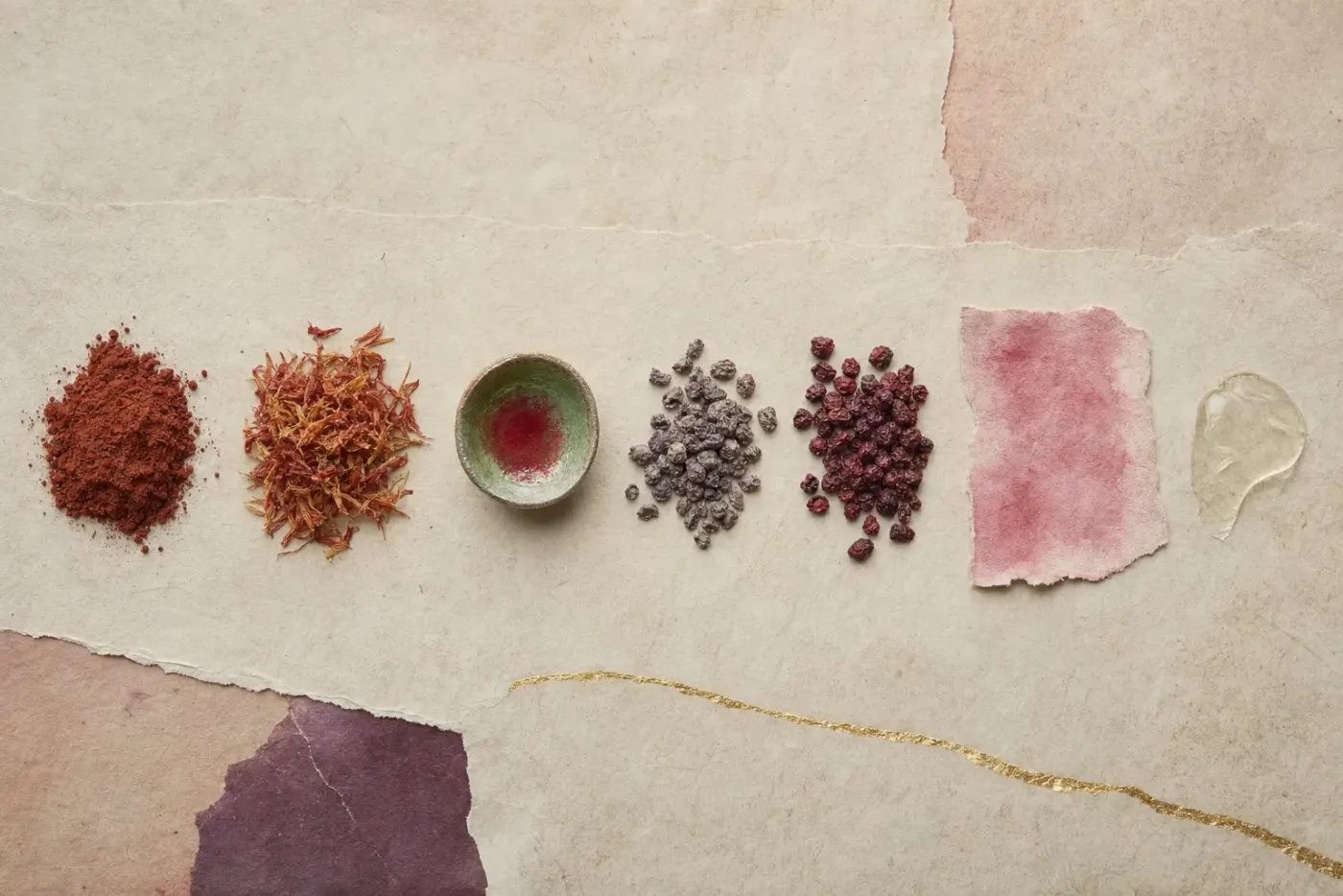
Iron oxide, safflower, kermes, cochineal, bromo acid, silicone resin — six answers to one unchanging question about the mouth.
In short
Red lip colour has been made from iron oxide, safflower, kermes, cochineal, bromo acid and silicone resin: the substance has been replaced almost completely while the gesture has not changed at all.
- 8min read
- 6chapters
- 18sources
A Single Colour at a Glance
- Historic Pigmentsiron oxide, safflower, kermes, cochineal, bromo acid, silicone resin
- Early Lipstick Containerscockle shells, metal tubes, paper twists, wrapped sticks
- Military Usestandard-issue lipstick for US Women Marines in 1942
- Modern Film Formerssilicone ester wax and MQ silicone resin in long-wear lipsticks
Vivien
Your guide through time
Listen to this essay
12 min listenVivien reads our essays aloud, word for word — every date and every name in its place — so you can listen the way you would be walked through a gallery.
An AI voice, designed for History of Makeup
Red on the mouth is the oldest cosmetic decision anyone still makes. It has been made with ground iron oxide, with safflower petals, with kermes, with cochineal, with bromo acid dyes and with silicone resin. The substance has been replaced almost completely. The gesture has not changed at all.
The deep background is pigment rather than lipstick. Ochre — iron oxide, in colours running from yellow through rust to deep red — was being collected, heated and ground at Blombos Cave on the South African coast around a hundred thousand years ago, in what the excavators describe as a processing workshop rather than a chance deposit.[1] That is not evidence that anyone painted a mouth. It is evidence that people were making red on purpose, tens of thousands of years before anyone wrote down why.
Ur, and the Limits of the Evidence
The claim that lipstick is five thousand years old usually points at Sumer. Leonard Woolley's excavations at Ur, running from 1922 into the 1930s, recovered cosmetic equipment from the graves of the Royal Cemetery, including cockle shells holding mineral pigment.[2] The shells are real, the pigment is real, and people in southern Mesopotamia were unmistakably colouring themselves.
What does not come from the excavation is the recipe. The line repeated in almost every popular account — that Queen Puabi wore a lip colour compounded from white lead and crushed red stone — is a modern embellishment, copied from one retelling to the next until it reads like a finding. Woolley's report records the containers and the pigment in them. It does not record that formula, and it does not say which part of the face any of it was put on.[2]
This is the pattern for the whole subject. The material evidence is good. The captions later attached to it are frequently invented, and the invented ones travel faster, because a recipe is more quotable than a shell with something in it.
Safflower, Kermes, Cochineal
Where a red came from decided who could wear it. In China the key plant was safflower, and the technique for extracting its red is set out in the Qimin Yaoshu, an agricultural manual compiled around 540 CE, which describes separating the flower's water-soluble yellow from the red that stays behind.[3] The same plant reached Japan, where the pigment is called beni. A Tokyo firm founded at Kobuna-cho in Nihonbashi in 1825 still makes a safflower lip rouge, painted into a cup as an iridescent green film that turns scarlet under a wet brush.[4]
In Europe the best reds were animal and expensive. Kermes came from insects living on the kermes oak; madder and brazilwood came from plants. After the Spanish conquest of Mexico in the 1520s, American cochineal gave a red far stronger than anything previously available, and the European dye trade reorganised itself around a single imported insect.[5]
Red was never one substance. It was whichever expensive thing was nearest, prepared by whoever knew how.
The Law That Never Was
One story about the red lip circulates more widely than any of the true ones. In 1770, it is said, the British Parliament passed an act declaring that a woman who used cosmetics to lure a man into marriage could be tried for witchcraft and the marriage voided.
No such act exists. PolitiFact, which put the question to the United Kingdom's National Archives, found nothing of the kind in the statutes or in the parliamentary record. There is one real fragment underneath the story — a bill against painting, patches and immodest dress brought before the Commons in 1650 — and the Archives told PolitiFact that, as far as they could see, it never had a full reading.[6]
The Witchcraft Act of 1735 ran the other way entirely. It repealed the earlier witchcraft statutes of England and Scotland and replaced the offence of witchcraft with a penalty for pretending to exercise witchcraft, sorcery, enchantment or conjuration: a law against claiming to be a witch rather than against being one.[7]
The story survives because it is a good story, and because it flatters everyone who repeats it. A regulatory claim with no instrument, no jurisdiction and no date attached is not a fact about the law. It is a rumour wearing a date.
The Tube
For most of its history lip colour was sold in a pot, a paper twist or a wrapped stick, and applied with a finger or a brush. Guerlain's archive dates a wax lip stick called Ne m'oubliez pas to 1870 and the house describes it as the first lipstick; that is a company's account of its own past, and the surviving descriptions of the object disagree with each other about its colour and its casing.[8]
Metal cases are older than the standard account allows. The British firm behind Vinolia Lypsyl was selling a lip preparation in a metal tube no later than 1892; a Dorin catalogue of 1893 shows lipsticks in nickel cases, already with more than one mechanism for raising and lowering the stick; Bourjois was making cosmetic pencils by 1898. The most careful survey of the subject declines to name a first, and says the question is unknown and likely to stay that way.[9]
Two later dates need separating. Scovill Manufacturing of Connecticut is generally credited with the first American metal case, and 1915 is the date usually attached to that credit. Maurice Levy, the name normally given as the inventor, appears in the record as an American investor who met the French cosmetics manufacturer Anthony Guash in New York that year, at a meeting arranged by a Scovill official, after which the two formed a company together. That is a business arrangement rather than an act of invention, and no patent filing by him has been produced.[9] James Bruce Mason Jr of Nashville did file: an application of 17 July 1922, serial number 575,479, granted on 16 October 1923 as United States patent 1,470,994 under the title Toilet article.[10] That is the screw mechanism still in use — a cup travelling on a threaded rod inside the casing, turned by a knurled base — and it arrived in a field already crowded with sliders, levers and screws rather than into an empty one.
What the case changed was not the colour but the habit. A cosmetic that can be reapplied in public, with one hand, at a table, is a different social object from one that needs a mirror and a closed door.[11]
Montezuma Red
The Second World War attached the red lip to the state. The United States Marine Corps Women's Reserve was established in 1942, to free men for combat duty, and its director, Lieutenant Colonel Ruth Streeter, went to Elizabeth Arden that year and asked for a line of makeup made specifically for Women Marines. Streeter lobbied for an initial budget of three thousand dollars and negotiated the contract herself.[12]
Arden already had a shade that matched the red piping and chevrons on the uniform, called Vibrant Red. In 1942 it was renamed Montezuma Red and became the standard-issue lipstick in the kit, with a matching cream rouge and nail polish. Every recruit was issued one in boot camp, along with instructions on how it was to be applied, and was expected to take no more than two minutes over it. When the first kit ran out, a replacement cost $2.27 at the PX.[12]
The grooming standard was enforced rather than suggested. Women Marines were five times more likely than men to pick up a non-judicial punishment for a dress-code violation, and the usual penalty was restriction to base or a cancelled liberty; Bernice Frankel, later known as Bea Arthur, collected two of them as a private in 1943.[12]
A second shade is often folded into this story and should not be. Helena Rubinstein's Regimental Red dates from 1941, and was hers — not Arden's, and not the Marine Corps'. Rubinstein also sold Fighting Red, Commando and Jeep Red. Where a published account dates Montezuma Red to 1941, it has almost always slid one house's product onto another's.[12] The broader point survives the confusion: cosmetics were part of regulated appearance for American servicewomen, and the industry sold a great deal on the strength of it.[13]
What It Is Now
Hazel Bishop, a chemist, put a long-wearing lipstick on sale in 1950 built on bromo acids — dyes that stain the lip rather than sitting on top of it — cut with lanolin to offset how harsh they were. Reported sales rose from under fifty thousand dollars in 1950 to more than ten million in 1953, and the industry spent the following decades chasing the same property.[14]
The modern answer is a film rather than a stain. A volatile solvent carries a film former onto the lip, evaporates, and leaves the colour locked into what is left behind. Revlon's transfer-resistance patent, granted in 1996, builds that film from a silicone ester wax at three to ten per cent, carried in a volatile blend of cyclic silicones and C8-to-C20 isoparaffins in a ratio of about one to one up to four to one.[15] Procter and Gamble's, with a priority date of November 1995, names the pair most long-wear liquid lipsticks still use: isododecane as the volatile hydrocarbon, and an MQ silicone resin — trimethylsiloxysilicate — as the film former.[16]
The colour itself is often still an insect. Carmine, from cochineal, remains in wide use. A final rule published on 5 January 2009 required cochineal extract and carmine to be declared by name on food and cosmetic labels in the United States, instead of being covered by a general colour term, following reports of allergic reactions.[17] The requirement took effect two years later, on 5 January 2011.[18]
About The Red Lip: One Decision, Six Materials
What materials have been used historically to make red lip colour?
Red lip colour has been made from ground iron oxide, safflower petals, kermes, cochineal, bromo acid dyes, and silicone resin. These materials reflect different historical periods and geographic regions, showing a progression from natural pigments to synthetic compounds.
Is there evidence that Queen Puabi wore lipstick made from white lead and crushed red stone?
No direct evidence supports the claim that Queen Puabi wore lipstick made from white lead and crushed red stone. This recipe is a modern embellishment not recorded in Leonard Woolley's excavation reports from Ur, which documented cosmetic equipment but did not specify formulas or application sites.
What is the story about the British Parliament banning lipstick in 1770?
The story that the British Parliament passed an act in 1770 punishing women who used cosmetics to lure men into marriage is unfounded. The United Kingdom's National Archives found no such act, and the tale appears to be a rumour based on a bill from 1650 that never passed and a later Witchcraft Act that did not address cosmetics.
When did metal tubes for lipstick first appear?
Metal cases for lipstick were in use by the late 19th century, with a British firm selling lip preparations in metal tubes by 1892 and a Dorin catalogue from 1893 showing lipsticks in nickel cases with mechanisms for raising and lowering the stick. The exact inventor of the modern screw mechanism is uncertain, with patents filed in the early 20th century.
What was Montezuma Red and how was it used during World War II?
Montezuma Red was a shade of lipstick renamed in 1942 to match the red piping on the United States Marine Corps Women's Reserve uniform. It was standard issue for Women Marines, who were required to apply it within two minutes as part of a regulated grooming standard enforced during their service.
What are the characteristics of modern long-wearing lipsticks?
Modern long-wearing lipsticks use a film-forming technology where a volatile solvent carries a silicone ester wax film former onto the lips, which then evaporates, leaving the colour locked in place. Many still use carmine from cochineal as a colourant, which must be declared by name on cosmetic labels in the United States due to allergic reaction reports.
Sources
- [1]A 100,000-Year-Old Ochre-Processing Workshop at Blombos Cave, South Africa Science, volume 334, 2011.View source (opens in a new tab)
- [2]Ur Excavations, Volume II: The Royal Cemetery British Museum and University of Pennsylvania Museum, two volumes (text and plates), 1934.
- [3]Cooking, Dyeing, and Worship: The Uses of Safflower in Medieval China as Reflected in Dunhuang Documents Asia Major, third series, volume 24, 2011.View source (opens in a new tab) Accessed 2026-09-22.
- [4]Japanese Traditional Craft: Beni for Cosmetics Google Arts & Culture.View source (opens in a new tab) Accessed 2026-09-22.
- [5]A Perfect Red: Empire, Espionage, and the Quest for the Color of Desire HarperCollins, 2005.
- [6]No, British Parliament didn't ban 'witchcraft' lipstick in 1770 Poynter Institute, 2019.View source (opens in a new tab) Accessed 2026-09-22.
- [7]Witchcraft Act 1735 (9 Geo. 2 c. 5) Parliament of Great Britain, 1735.
- [8]La Maison Guerlain: Metier d'Art of Makeup Guerlain.View source (opens in a new tab) Accessed 2026-09-22.
- [9]Lipsticks Cosmetics and Skin, 2009.View source (opens in a new tab) Accessed 2026-09-22.
- [10]US Patent 1,470,994 - Toilet article United States Patent Office, 1923.View source (opens in a new tab) Accessed 2026-09-22.
- [11]Fashions in Makeup: From Ancient to Modern Times Peter Owen, 1972.
- [12]Montezuma Red: Women Marines in WWII National Museum of the Marine Corps.View source (opens in a new tab) Accessed 2026-09-22.
- [13]War Paint: Madame Helena Rubinstein and Miss Elizabeth Arden — Their Lives, Their Times, Their Rivalry John Wiley & Sons, 2003.
- [14]Hazel Bishop Cosmetics and Skin.View source (opens in a new tab) Accessed 2026-09-22.
- [15]Cosmetic compositions with improved transfer resistance. United States Patent 5,505,937, assigned to Revlon, priority 15 December 1992, granted 9 April 1996 United States Patent Office, 1996.View source (opens in a new tab)
- [16]Transfer resistant cosmetic compositions. United States Patent 6,071,503, assigned to The Procter and Gamble Company, priority 7 November 1995, granted 6 June 2000 United States Patent Office, 2000.View source (opens in a new tab)
- [17]Listing of Color Additives Exempt From Certification; Food, Drug, and Cosmetic Labeling: Cochineal Extract and Carmine Declaration (final rule) Federal Register, 5 January 2009, 2009.View source (opens in a new tab) Accessed 2026-09-22.
- [18]Listing of Color Additives Exempt From Certification; Food, Drug, and Cosmetic Labeling: Cochineal Extract and Carmine Declaration; Confirmation of Effective Date Federal Register, 11 March 2009, 2009.View source (opens in a new tab) Accessed 2026-09-22.
Filed under