Ovid Writes Recipes: Cosmetics as Literature
A Roman poet published face preparations in elegiac couplets, and told his readers in a different poem never to be caught making them.
In short
Ovid’s Medicamina Faciei Femineae, composed around the turn of the first century, gives cosmetic preparations in elegiac verse and survives only as a fragment of about a hundred lines — a literary work rather than a description of Roman practice.
- 12min read
- 6chapters
- 3sources
Vivien
Your guide through time
Listen to this essay
6 min listenVivien reads our essays aloud, word for word — every date and every name in its place — so you can listen the way you would be walked through a gallery.
An AI voice, designed for History of Makeup
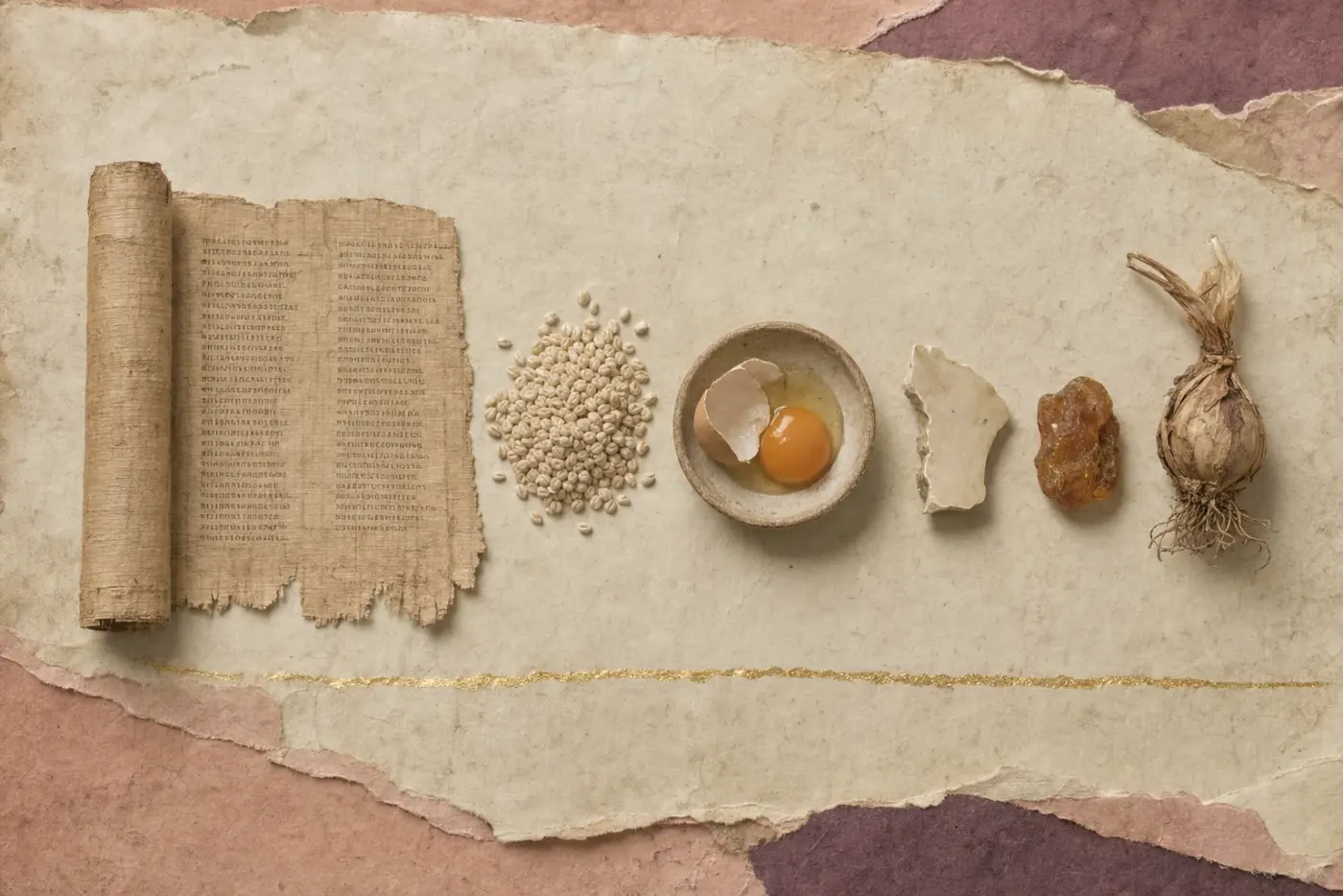
Around the turn of the first century a Roman poet published a short didactic poem giving preparations for the face. It is written in elegiac couplets — the metre of love poetry — and roughly half of what survives consists of actual recipes, naming materials including barley, vetch, egg, hartshorn, narcissus bulb, gum and honey.[1]
The Medicamina Faciei Femineae is the earliest surviving European cosmetic formulary. It is also, and this needs saying immediately, a poem: it survives as a fragment of about a hundred lines, it was written to be enjoyed, and its author was not a practitioner of anything it describes.[1]
What Putting It In Verse Does
Metre is a constraint that outranks accuracy. A quantity that does not scan has to be adjusted or dropped, a material with an awkward name gets substituted, and the order of operations can be rearranged for the line rather than for the result.[2]
So the poem cannot be read as a formulary in the sense the medieval compendia can. What it does establish is more interesting than a set of quantities: it shows that cosmetic preparation was a subject a cultivated audience would read about for pleasure, which is a claim about status rather than about chemistry.[2]
The choice of metre makes that point twice over. Elegiac couplets are the form of love poetry, and applying them to face preparations is a joke the audience is expected to get — which requires that the audience already found cosmetics both familiar and slightly ridiculous. The poem assumes a whole attitude it never states.[2]
The Instruction to Hide It
In a separate poem the same author gives the rule that governs the whole business. A lover should not catch the boxes out on the table; the art assists a face when it is concealed.[3]
That is the earliest crisp statement of a demand this site meets in every century afterwards: use it, and do not be seen to have used it. The Victorian rule against visible paint and the modern no-makeup look are the same instruction, and Ovid states it two thousand years before either.[3]
Use it, and do not be seen to have used it. Ovid states the rule two thousand years before the Victorians enforce it.
The Materials Are Domestic
What the poem names is striking for what it is not. Barley, vetch, egg, hartshorn, narcissus bulb, gum and honey are kitchen and farmyard materials, not exotic imports, and several are abrasive or film-forming in ways that would plausibly do something to a skin.[4]
They are also cheap, which cuts against the assumption that Roman cosmetic practice was necessarily a luxury. A preparation built on barley and egg is available to a great many more households than one built on imported mineral pigment.[5]
The Source Problem for Roman Cosmetics
Almost everything written about Roman cosmetic practice descends from a moralising literature: satire, invective and philosophical complaint, composed overwhelmingly by men, attacking women for artifice.[6]
That is a poor instrument for measuring anything. A satirist exaggerates by trade, and a description written in order to condemn selects the most extreme available example. The evidence establishes that the practice existed and that it was contested; it does not establish what was typical.[6]
Why It Survived At All
The Medicamina survives because Ovid wrote it. A cosmetic formulary by an unknown compiler of the same date would have had no reason to be copied through late antiquity and the Middle Ages, and would not be here.[7]
Which means the earliest European cosmetic text we possess is an accident of literary reputation rather than a representative sample of cosmetic writing. Whatever practical Roman formularies existed have not come down to us, and their absence is not evidence that they did not exist.[8]
That selection effect runs through this entire history and is worth stating once plainly. What survives from any period is what somebody with resources thought worth copying, keeping or burying — and for cosmetics, which were frequently regarded as beneath serious record, the filter is unusually severe.[8]
What Is Not Known
No quantity or method in the poem has been shown to correspond to anything anyone actually made, and the surviving fragment breaks off, so even the poem’s own contents are incomplete.[9]
The date is conventional. Composition around the turn of the era is the accepted placement, derived from the poet’s own chronology rather than from any dated manuscript.[9]
Sources
- [1, 2, 4, 7, 9]Medicamina Faciei Femineae (Cosmetics for the Female Face) Latin text, The Latin Library; composed c. 1 CE.View source (opens in a new tab) Accessed 2026-09-24.
- [3]Ars Amatoria, Book III Latin text, The Latin Library; composed c. 2 CE.View source (opens in a new tab) Accessed 2026-09-22.
- [5, 6, 8]Cosmetics in Roman Antiquity: Substance, Remedy, Poison The Classical World 102.3, 2009.
Filed under