Kohl as Manufacture: Compounds That Do Not Occur in Quantity
Two of the compounds in Egyptian kohl are rare in nature and common in the containers. Somebody was making them.
In short
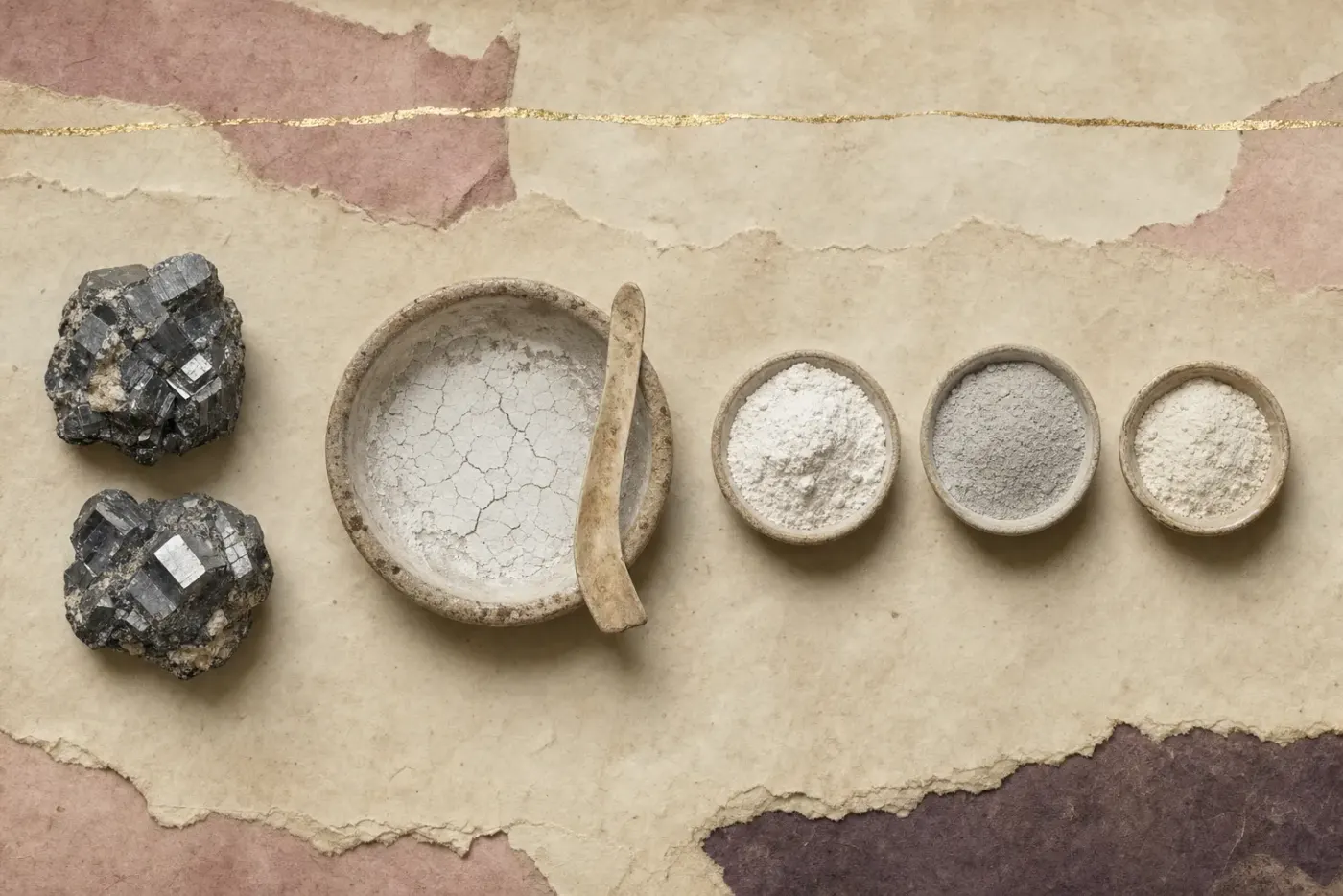
Analysis of Egyptian kohl samples in the Louvre identified laurionite and phosgenite, lead compounds that are rare in nature but present in quantity in the containers, indicating that they were deliberately synthesised rather than simply ground from galena.
- 12min read
- 6chapters
- 3sources

Vivien
Your guide through time
Listen to this essay
5 min listenVivien reads our essays aloud, word for word — every date and every name in its place — so you can listen the way you would be walked through a gallery.
An AI voice, designed for History of Makeup
For most of the twentieth century Egyptian kohl was described as ground galena: a lead ore, dug out of the ground and crushed. The description is not wrong so much as radically incomplete, and what it leaves out is the most impressive thing in the ancient cosmetic record.[1]
Analysis of kohl samples held in Paris identified laurionite and phosgenite among the compounds present. Both are lead compounds; both are rare in nature; and both were present in quantities that a natural source cannot account for. They were deliberately synthesised.[1]
What Deliberate Means Here
The inference is a comparison between two distributions. If a compound is scarce in the deposits available and abundant in the containers, the gap has to be explained, and a wet chemical process that produces it is the explanation that fits.[2]
It is worth being clear about what this does and does not establish. It shows a repeatable procedure producing a specific compound, carried out at scale over a long period. It does not show that anyone understood what a compound was, and no theory of matter is required to follow a set of steps that reliably yields a white powder.[2]
That distinction protects the finding from both directions. Overstated, it becomes ancient Egyptians doing chemistry, which imports a discipline that did not exist. Understated, it becomes people grinding rocks, which is what the analysis specifically rules out. What the evidence supports is a craft procedure transmitted by instruction and judged by its product.[2]
Why Make It At All
Synthesis is laborious, and galena was available. The question of why anyone would go to the trouble is where the record thins out, and several explanations have been offered — colour, texture, opacity, adhesion, or a medicinal property attributed to the product.[3]
What can be said without straying is that the effort was sustained for centuries, which is strong evidence that the makers believed the synthesised material was better for their purpose than the ground ore. What they thought that purpose was is not recorded.[4]
If a compound is scarce in the deposits and abundant in the containers, the gap has to be explained.
There Was Never One Kohl
Later analysis has made the picture more varied rather than less. Work on kohl containers in the Petrie Museum found recipes built on manganese, on silicon and on carbon as well as on lead — a family of preparations rather than a single formula.[5]
That finding disposes of the sentence that opens most accounts of the subject. Kohl is not a substance; it is a name for a black or dark powder applied to the eye margin, and the materials behind the name differ by period, by region and by maker.[5]
The Medical Argument
A line of argument holds that the synthesised lead compounds had a therapeutic function, and it is taken seriously rather than dismissed — classical writers report Egyptian eye preparations being used against eye disease, and the synthesis work observed properties consistent with such a use.[6]
It remains an argument rather than a finding. A property observed in a modern laboratory is not a demonstration of an ancient intention, and the classical reports are later, external and written by people describing a practice they did not share.[7]
What It Costs to Get This Wrong
The ground-galena version of the story is not merely simpler; it is condescending. It describes a people picking up a rock and crushing it, when the evidence describes a repeatable wet-chemical procedure sustained across centuries and conducted at a scale that fills museum containers.[8]
It also matters for the modern regulatory question. Kohl sold today under that name is a family of unrelated preparations, some containing dangerous quantities of lead, and the assumption that the word denotes one traditional substance is part of what makes that difficult to police.[9]
What Is Not Known
The procedure itself is not recorded. No Egyptian text describes the synthesis, and the reconstruction rests on what the products imply about the process rather than on any instruction.[10]
The −2000 marker is also approximate. The synthesised compounds appear across a long span, and a timeline entry has to choose a point inside a range that the evidence does not sharpen.[11]
Nor is it known who did the work. A procedure sustained at this scale implies specialists, and not one of them is named anywhere in the Egyptian record.[11]
Sources
- [1, 2, 3, 6, 8, 10]Making make-up in Ancient Egypt Nature 397, 483–484, 1999.
- [4, 7, 11]Sacred Luxuries: Fragrance, Aromatherapy, and Cosmetics in Ancient Egypt Cornell University Press, 1999.
- [5, 9]Recipes of Ancient Egyptian kohls more diverse than previously thought Scientific Reports, volume 12, 2022.View source (opens in a new tab)
Filed under