Men and Makeup: A History With One Gap In It
Kohl, powder, patches and paint were men's business for most of recorded history. The exception is the last two centuries.
In short
Men wore cosmetics across most of recorded history - kohl in Egypt and the Islamic world, powder and rouge at the European courts - and the notion that makeup is inherently feminine dates only from a shift in male dress that historians place somewhere between the 1660s and the 1790s.
- 9min read
- 6chapters
- 19sources
Vivien
Your guide through time
Listen to this essay
11 min listenVivien reads our essays aloud, word for word — every date and every name in its place — so you can listen the way you would be walked through a gallery.
An AI voice, designed for History of Makeup
The premise of this article is not that men have sometimes worn makeup. It is that for most of the period this archive covers, they simply wore it.
Egyptian eye paint was applied by men, women and children.[1] Kohl is commended to men in the Sunni hadith collections,[2] and it was still being made and sold across Oman when chemists surveyed the market there in the 1990s.[3] Powder, rouge and patches were standard equipment at the European courts, worn by men as well as by the women whose portraits are better known.[4] The ridicule that eventually attached to the painted man was aimed at least as much at his class as at his sex.[5]
Something then changed in Europe, and changed fast enough that within a few generations the painted man had become first a joke and then a scandal. Dress historians disagree about when it happened and why. They do not disagree that it happened, or that it is local and recent measured against the whole record.
Egypt: Paint Without a Gender
The Egyptian record is the clearest because so much of it survives. Cosmetic palettes, kohl pots, pigment and applicator sticks appear in graves of both sexes from the predynastic period onward,[7] and lined eyes appear on men throughout the visual record - on temple walls, on coffin lids, on the painted statues of officials.[6]
The two standard eye paints were green, ground from malachite, and grey-black, from galena.[6] A study published in 2022 found that Egyptian kohl recipes were considerably more varied than the lead-based model had assumed, including manganese-based, silicon-based and carbon-based formulations alongside the lead ones.[8]
Manniche finds no consistent distinction in the published material between a man's kit and a woman's: the same pots, the same sticks, the same pigments, buried with the same care.[6] That is an absence in a large and well-published record, which counts for more than it would in a thin one, and still for less than a positive finding.
Kohl as Practice, Not Ornament
In the Sunni hadith collections kohl is not merely a cosmetic that men are permitted. It is a practice they are commended to follow. Reports gathered in al-Tirmidhi's Shama'il, and in the Sunan of Abu Dawud, Ibn Majah and al-Nasa'i, describe the Prophet Muhammad using ithmid kohl, applying it to each eye before sleep and commending it for the sight.[9] The chemical literature is what identifies ithmid as antimony sulfide, the mineral stibnite, and as the Arabic name for the best grade of kohl; the hadith collections name the substance without analysing it.[10]
What a normative text prescribes is not the same as what people did, and here the material evidence shows the gap at its widest. A survey of forty-seven kohl samples collected in Oman analysed each by X-ray powder diffraction and scanning electron microscopy. Not one had antimony as its main component. Of the eighteen Omani-made samples, five were galena, twelve amorphous carbon and one hematite; the imported samples ran to galena, minium, amorphous carbon, magnetite, zincite, calcite and sassolite.[10]
That is why regulators treat the word with suspicion rather than any one substance. In the United States the Food and Drug Administration states that none of these materials has been approved and listed as a colour additive, and a cosmetic that fails the colour additive requirements is adulterated or misbranded. The Federal Food, Drug, and Cosmetic Act defines a colour additive at section 201(t) and requires that one be pre-approved and listed before use at section 721, codified at 21 U.S.C. 379e.[11] Eye-area cosmetics whose labels declare kohl, kajal or surma fall under Import Alert 130, which authorises detention without physical examination for colour additive violations.[12] Both were current when this article was checked in September 2026. This is a statement of one regulator's position, not advice about whether any particular preparation is safe to put on a face.
Rome: The Charge of the Painted Man
Roman writing takes a different line, and the line is instructive because it is about status rather than about gender as such. Men who used cosmetics are attacked in the satirists and the moralists, but the charge is rarely that paint belongs to women. It is that a man who spends his morning on his face is soft, idle and, by implication, unfit for public life.[13]
The Latin word for the fault is mollitia, softness. Catharine Edwards's study of Roman moralising discourse shows the accusation of effeminacy working as a political weapon rather than as a description: it was a way of saying that a man could not be trusted with power, and it was levelled at dress, depilation, scent and posture as readily as at anything sexual.[14]
Most of what survives is hostile literature rather than description, and must be read that way. A joke about a painted man is evidence that the joke landed, not a census of who was painted.[13] Pliny's Naturalis Historia is the useful counterweight, because it records the materials - white lead, the ochres, the whole pigment trade - as commodities rather than as scandals.[15]
The Roman objection turns out to be the objection the eighteenth century would make again: not that the painted man looks like a woman, but that he looks like he does not work.
The Court Face
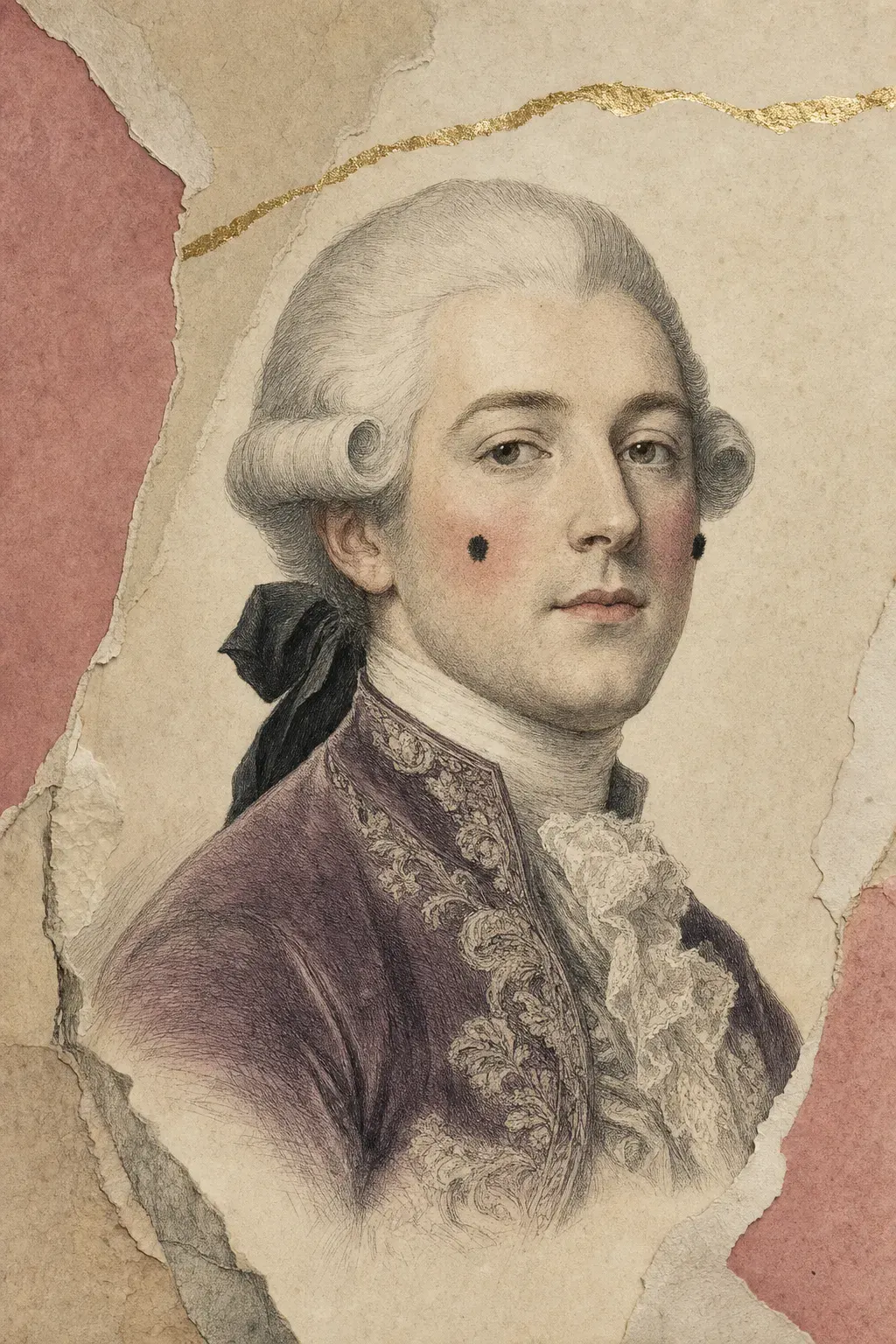
At the European courts of the seventeenth and eighteenth centuries a painted male face was a mark of rank. Hair was powdered, skin whitened, cheeks reddened, and small black patches applied by men and women alike. The materials were the same materials: white lead for the complexion, carmine and vegetable reds for the cheek and the lip.[16]
The macaroni - a London label of roughly 1760 to 1780 for young men who returned from the Grand Tour in an exaggerated continental style - is the episode most often cited, and usually cited wrongly. Peter McNeil's study, built on surviving dress, caricature and portraiture, presents the macaroni not as a fringe subculture borrowing women's clothes but as a conspicuous extreme of an ordinary courtly grammar, ridiculed at least as much for class pretension as for effeminacy.[17]
The caricatures are why the macaroni is remembered at all, and caricature is evidence of what was funny rather than of what was usual.
For most of recorded history a man with a painted face was not making a statement. He was dressed.
The Renunciation, and When It Happened
The standard name for the change is the Great Masculine Renunciation, coined by the psychologist J. C. Flugel in The Psychology of Clothes (1930). Flugel placed it at the end of the eighteenth century: men, he argued, gave up colour, ornament and display, and ceded the whole territory to women.[18]
Dress historians have since argued about the date, and the argument matters more than it sounds. David Kuchta puts the decisive moment more than a century earlier. On 7 October 1666 Charles II declared in council a resolution to set a new fashion in clothes; Samuel Pepys recorded it the following day, noting that it would be a vest and that it was meant to teach the nobility thrift.[19] Kuchta reads the three-piece suit that grew out of it as a long political argument about sober masculine authority, worked out over two centuries rather than adopted in one.[20]
Flugel's phrase has itself been criticised as a psychoanalytic reading rather than a historical finding.[18] What is not in dispute is the outcome. By the middle of the nineteenth century a European gentleman who visibly painted his face had done something remarkable, and the centuries in which that was unremarkable had been forgotten.
After the Renunciation
Men's cosmetics did not disappear. They were renamed. Hair oils, moustache waxes, shaving preparations and later aftershaves sold in quantity through the nineteenth and twentieth centuries as grooming - the same manoeuvre the Victorian trade used when it sold women complexion remedies rather than paint.[21]
Screen work renounced nothing. Film required makeup on every face in shot, and the studios built departments to apply it.[22] Max Factor's Pan-Cake, developed for Technicolor and first used on a feature released in 1937, was a professional product before it was a consumer one, and it went on male and female actors alike.[23]
The present position shows up in commerce rather than in manifestos. Euromonitor International put the South Korean men's cosmetics market at 1.09 trillion won, about 839 million US dollars, in 2022, and projected 1.16 trillion won by 2025.[24] Those are market-research estimates rather than audited figures, and they describe one country's domestic market. Nothing in them ranks South Korea against anywhere else, and this article does not.
A thread this long does not need a conclusion so much as a correction. The unusual thing in the history of men and makeup is not the lined Egyptian eye, the rouged courtier or the man buying foundation in Seoul. It is the stretch in between.
Sources
- [1, 6]Sacred Luxuries: Fragrance, Aromatherapy, and Cosmetics in Ancient Egypt Cornell University Press, 1999.
- [2, 9]Ash-Shama'il al-Muhammadiyya, chapter on the kohl of the Messenger of God Sunnah.com edition.View source (opens in a new tab) Accessed 2026-09-22.
- [3, 10]Composition of eye cosmetics (kohls) used in Oman Journal of Ethnopharmacology 60(3), 223-234, 1998.View source (opens in a new tab)
- [4, 16]Fashions in Makeup: From Ancient to Modern Times Peter Owen, 1972.
- [5, 17]Pretty Gentlemen: Macaroni Men and the Eighteenth-Century Fashion World Yale University Press, 2018.
- [7]Egyptian kohl pots and applicators, Department of Egypt and SudanView source (opens in a new tab) Accessed 2026-09-22.
- [8]Recipes of Ancient Egyptian kohls more diverse than previously thought Scientific Reports, volume 12, 2022.View source (opens in a new tab)
- [11]Kohl, Kajal, Al-Kahal, Surma, Tiro, Tozali, or Kwalli: By Any Name, Beware of Lead PoisoningView source (opens in a new tab) Accessed 2026-09-22.
- [12]Import Alert 130: Detention Without Physical Examination of Cosmetics That are Adulterated and/or Misbranded Due to Color Additive ViolationsView source (opens in a new tab) Accessed 2026-09-22.
- [13]Masculinity and Dress in Roman Antiquity Routledge, 2017.
- [14]The Politics of Immorality in Ancient Rome Cambridge University Press, 1993.
- [15]Naturalis Historia, Books XXXIII–XXXV 77.
- [18]The Psychology of Clothes Hogarth Press, 1930.
- [19]The Diary of Samuel Pepys, entry for 8 October 1666 Pepysdiary.com online edition, 1666.View source (opens in a new tab) Accessed 2026-09-22.
- [20]The Three-Piece Suit and Modern Masculinity: England, 1550-1850 University of California Press, 2002.
- [21]Hope in a Jar: The Making of America’s Beauty Culture Metropolitan Books, 1998.
- [22]Max Factor: The Man Who Changed the Faces of the World Arcade Publishing, 2008.
- [23]Pan-Cake Make-up Cosmetics and Skin.View source (opens in a new tab) Accessed 2026-09-22.
- [24]Men shopping cosmetics in South Korea growing The Korea Herald, 2022.View source (opens in a new tab) Accessed 2026-09-22.
Filed under