The Makeup Ingredients Dictionary
What makeup is actually made of — what each substance is, where it came from, what it does, and what is genuinely known about its safety.
40 ingredients in the dictionary
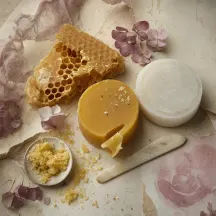
Beeswax
BEESWAX
Beeswax is the material a honeybee colony builds its comb from, and the oldest wax with a documented place in cosmetics: it sets the shape of a lipstick, thickens a balm, and holds oil and water together in a cream.
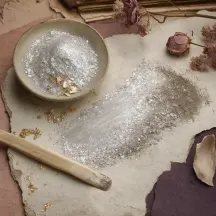
Bismuth Oxychloride
BISMUTH OXYCHLORIDE
A synthetic white that grows as flat, highly reflective crystals, giving the silvery pearl finish which dominated cosmetics for decades before coated mica arrived.
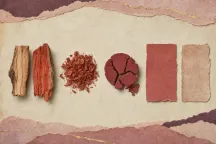
Brazilwood
CAESALPINIA SAPPAN BARK EXTRACT
A cheap, fugitive red drawn from several tropical heartwoods, traded in such quantity that Brazil is named after the tree rather than the tree after the country.
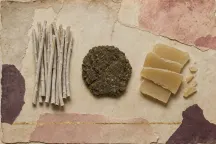
Candelilla Wax
EUPHORBIA CERIFERA (CANDELILLA) WAX
Candelilla wax is boiled off the stems of a leafless desert shrub that coats itself to keep from drying out, and it is the usual plant-derived stand-in for beeswax; its international trade is controlled under CITES.
Carbon Black
CI 77266
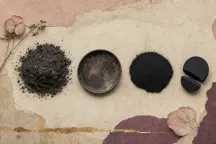
Near-pure elemental carbon made by burning hydrocarbons under controlled conditions: the densest black available to a formulator, certified batch by batch in the United States and carrying a separate European authorisation for its nano form.
Carmine (Cochineal)
CARMINE
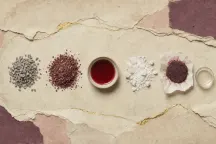
A deep crimson lake pigment made from the dried bodies of the female cochineal insect, and the only red of animal origin still in routine industrial use in cosmetics.
Carnauba Wax
COPERNICIA CERIFERA (CARNAUBA) WAX
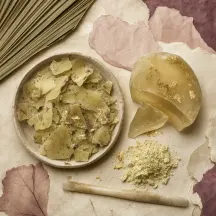
Carnauba is the hard, high-melting wax a Brazilian fan palm secretes onto its fronds to survive the dry season, and in cosmetics it is the ingredient that stops a lipstick going soft in a warm room.
Castor Oil
RICINUS COMMUNIS SEED OIL
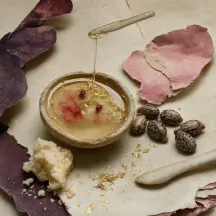
Pressed from the seed of Ricinus communis, castor oil is the one common vegetable oil that will dissolve the staining dyes used in lipstick, which is how it became the liquid backbone of the bullet.
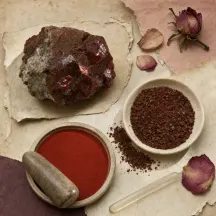
Cinnabar
Cinnabar is the natural ore of mercury sulphide and the source of the pigment vermilion: a dense scarlet mineral spread on Copper Age bodies, Roman statues and, on contested evidence, Roman faces.
Cyclopentasiloxane
CYCLOPENTASILOXANE
A volatile silicone ring of five repeating units, used as a carrier that spreads a product evenly and then evaporates, and now restricted in European cosmetics on environmental rather than dermatological grounds.
Dimethicone
DIMETHICONE
A synthetic silicone fluid sold in every viscosity from thinner than water to a cuttable gum, valued in cosmetics for spreading further than an oil of the same thickness and for leaving a dry rather than a greasy surface.
Disodium EDTA
DISODIUM EDTA
A synthetic chelating agent that closes around a metal ion like a cage, added in small amounts to stop trace iron and copper catalysing the breakdown of a formulation.
Galena (Kohl)
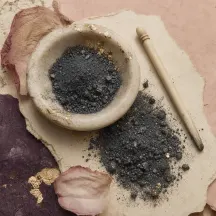
Galena is the natural ore of lead sulphide, ground on a stone palette and bound with fat to make the black eye paint of dynastic Egypt. It is the material behind the oldest sense of the word kohl.
Glycerin
GLYCERIN
A small three-carbon alcohol with a hydroxyl group on every carbon, isolated from olive oil in 1779 and now the most widely used humectant in cosmetics.
Henna
LAWSONIA INERMIS LEAF EXTRACT
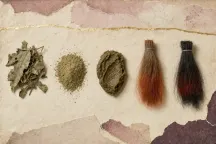
A red-orange stain for hair, skin and nails made from the milled leaf of Lawsonia inermis, whose colourant lawsone binds to keratin instead of coating it.
Iron Oxides
IRON OXIDES
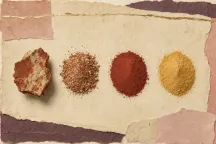
Three iron compounds, a red, a yellow and a black, which between them mix almost every shade of human skin and carry most of the colour in foundation, concealer and pressed powder.
Isododecane
ISODODECANE
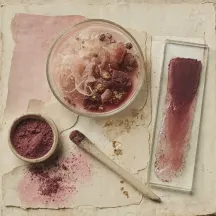
A branched twelve-carbon hydrocarbon that works as a volatile solvent: it thins a formulation during application and then evaporates completely, leaving the pigment and the film former behind.
Jojoba Oil
SIMMONDSIA CHINENSIS SEED OIL
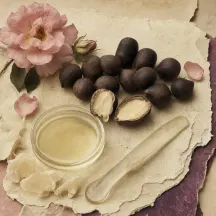
Not an oil but a liquid wax of long-chain esters, close enough in structure to sperm whale oil that it became the industrial substitute after the United States banned sperm whale oil imports in 1971.
Kaolin
KAOLIN
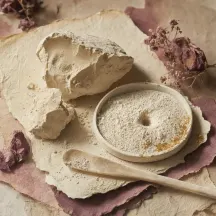
A white aluminium-silicate clay named after the hill near Jingdezhen where it was dug for porcelain; in cosmetics it mattifies by absorbing oil rather than by covering it.
Kermes
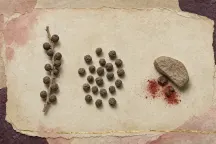
The scarlet of the Mediterranean world before American cochineal: a red dye taken from the dried females of a scale insect that lives on the kermes oak.
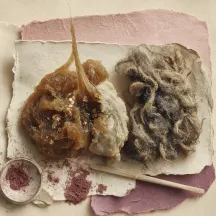
Lanolin
LANOLIN
The greasy secretion sheep make to keep their fleece from rotting in the rain, recovered from wool-scouring liquor: chemically a wax rather than a fat, despite the old pharmacy name wool fat.
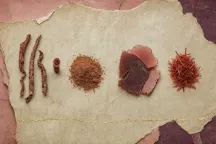
Madder
RUBIA TINCTORUM ROOT EXTRACT
A red from the root of Rubia tinctorum whose principal colourant, alizarin, became the first natural dye to be manufactured synthetically, and so ended its own cultivation.
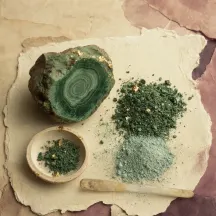
Malachite
MALACHITE
Malachite is a green copper carbonate mineral, ground on stone palettes into the green eye paint of Predynastic and Old Kingdom Egypt, and one of the earliest cosmetic colours that can be named as a specific substance.
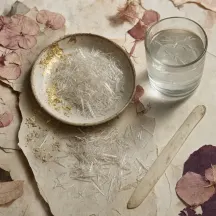
Methylparaben
METHYLPARABEN
The shortest-chain member of the paraben family, in use as a cosmetic and pharmaceutical preservative since the 1920s and still permitted in the European Union at up to 0.4 per cent.
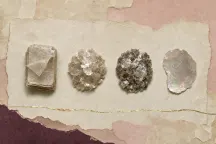
Mica
MICA
A platy potassium aluminium silicate that splits into flakes thin enough to be transparent, supplying the shimmer in most eyeshadows and the substrate for nearly every pearlescent pigment.
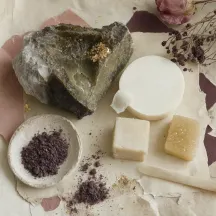
Ozokerite
OZOKERITE
Ozokerite is a mineral wax, mined out of rock rather than distilled from crude oil, whose fine tangled crystals trap liquid oils and stop a lipstick sweating them out onto its own surface.
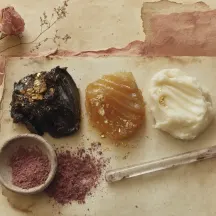
Petrolatum
PETROLATUM
The semi-solid mixture of saturated hydrocarbons left when refined petroleum residue is dewaxed; it forms a barrier film that slows water loss, and under Regulation (EC) No 1223/2009 the European Union permits it in cosmetics only where its refining history is documented.
Phenoxyethanol
PHENOXYETHANOL
A synthetic aromatic alcohol that has become the default broad-spectrum preservative in cosmetics, permitted in the European Union at a maximum of one per cent.
Polybutene
POLYBUTENE
A viscous, non-volatile hydrocarbon polymer that gives lip gloss its thickness, its cling and much of its shine; it is the fraction that stays behind once the volatile solvent it was dissolved in has gone.
Red Ochre
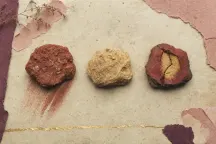
Red ochre is iron-oxide-rich earth, haematite mixed with clay and quartz: the oldest colouring material in the human record, and, purified and synthesised, still the red in most foundations.
Shellac
SHELLAC
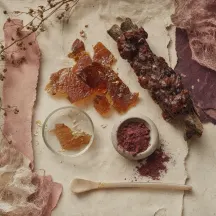
Shellac is a resin secreted by a scale insect on trees in India and South-East Asia; in cosmetics it is a film former, the thing that makes a mascara hold a curl and a nail lacquer set hard and glossy.
Squalane
SQUALANE
The fully hydrogenated form of squalene, a hydrocarbon the human body makes on its way to cholesterol and secretes in sebum; saturating it removes the six double bonds that let the parent go rancid.
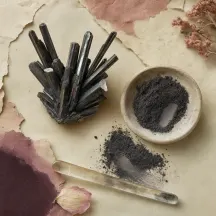
Stibnite (Antimony Kohl)
Stibnite is antimony trisulphide, the grey ore that gave the element its symbol, Sb, and the mineral that later tradition credits, mostly wrongly, as the basis of ancient Egyptian kohl.
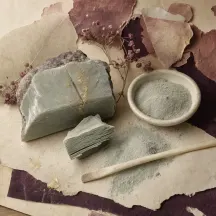
Talc
TALC
The softest mineral known, a hydrated magnesium silicate whose stacked platelets slide over one another under a fingertip; the material that gives a face powder its slip.
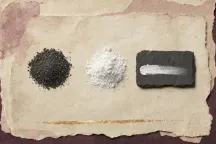
Titanium Dioxide
TITANIUM DIOXIDE
The manufactured white that replaced lead: a titanium oxide with a refractive index high enough to make it the most opaque white a cosmetic chemist can use, and a permitted mineral ultraviolet filter.
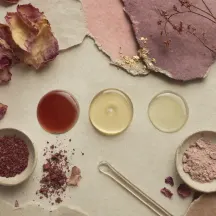
Tocopherol (Vitamin E)
TOCOPHEROL
A fat-soluble antioxidant, identified in 1922 as a dietary factor required for reproduction in rats, which protects the oils in a cosmetic from going rancid rather than protecting the product from microbes.
Trimethylsiloxysilicate
TRIMETHYLSILOXYSILICATE
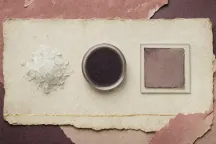
A brittle silicone resin built from trimethylsilyl caps around a silica-like core; dissolved in a volatile solvent and left behind when that solvent evaporates, it is the film that makes a lipstick transfer-resistant.
Ultramarine
ULTRAMARINES
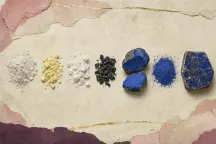
The blue of lapis lazuli, reproduced industrially from china clay, soda, sulphur and charcoal since 1828, and permitted in the United States only in externally applied cosmetics: nothing for the lips or any mucous membrane.
White Lead (Ceruse)
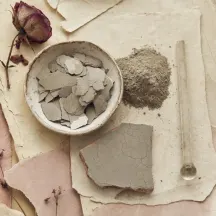
A synthetic basic lead carbonate, made since antiquity by corroding metallic lead over vinegar, which gave the face a dense opaque white and is the most consequential poisonous cosmetic in the European record.
Zinc Oxide
ZINC OXIDE
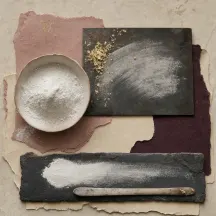
The white that came between lead and titanium: a manufactured zinc oxide, mildly astringent and mildly soothing, now met as often in a mineral sunscreen as in a face powder.