The Night Mask: A Face Put On to Be Taken Off
Some of the most elaborate beauty work in history was done for nobody: applied at night, slept in, and washed away before anyone could see it.
In short
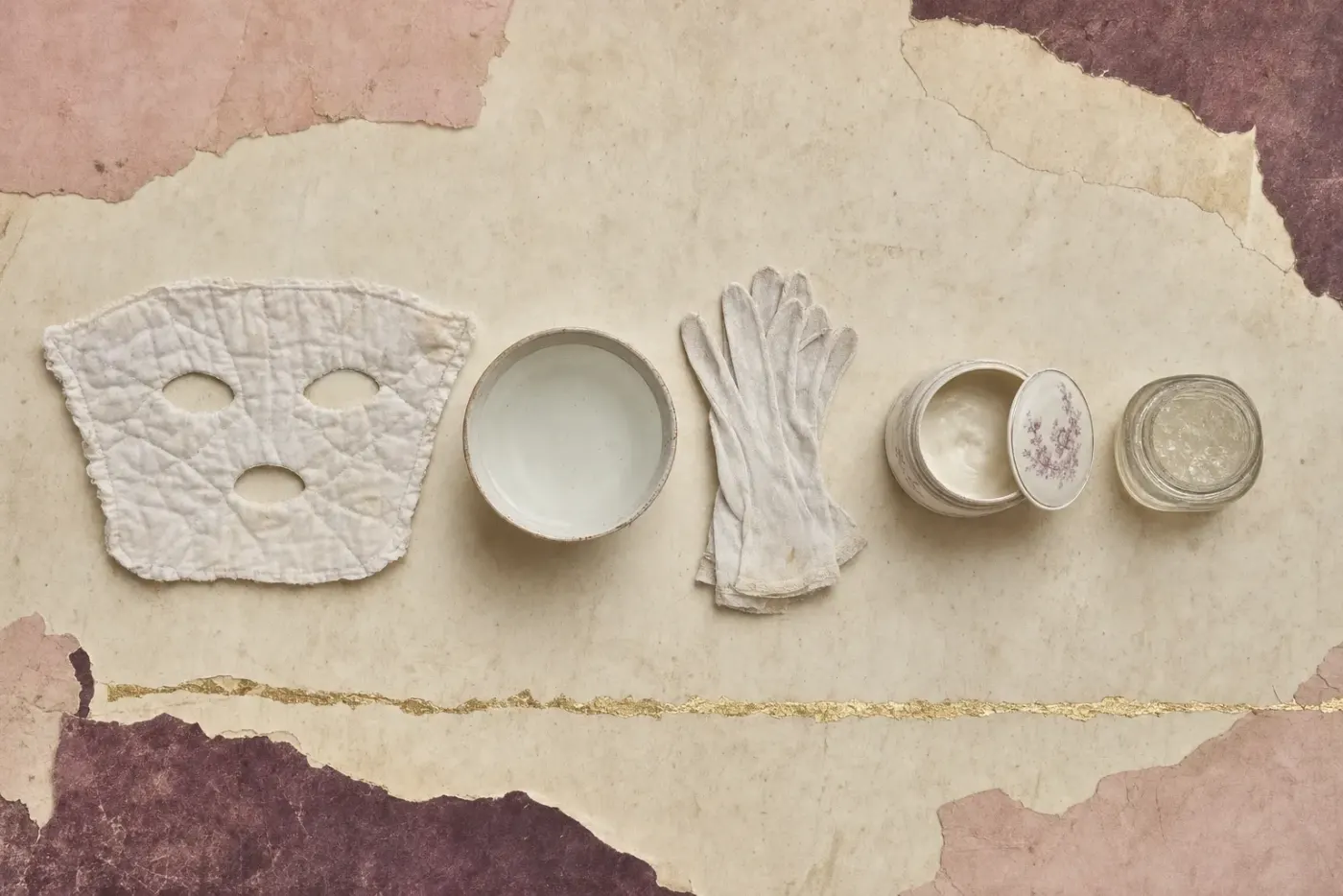
The Ugly-Girl Papers, an American beauty manual of 1874, advised a mask of quilted cotton wet in cold water every night for at least six weeks, noting that Roman ladies had used poultices of bread and asses' milk for the same purpose.
- 3min read
- 4chapters
- 4sources

Vivien
Your guide through time
Listen to this essay
4 min listenVivien reads our essays aloud, word for word — every date and every name in its place — so you can listen the way you would be walked through a gallery.
An AI voice, designed for History of Makeup
Juvenal's sixth satire has a portrait of a Roman wife at home. Her face, "shocking to look at, or ridiculous from the large poultice, is all swollen; or is redolent of rich Poppæan unguents, with which the lips of her wretched husband are glued up." For her lover she will appear with her skin washed clean. "When does she choose to appear beautiful at home?"[1]
At last, the satirist says, she takes off the first layer, and a face covered in so many poultices of damp flour leaves him asking whether to call it a face or a sore.[1] It is an attack, and it is also the oldest description here of a ritual most people still keep: the treatment worn in private and washed off before anyone sees.
Poppaea's Milk
The unguents Juvenal names are Poppaea's, after Nero's wife, and his nineteenth-century translator's notes gather the legends around her. An old commentator claimed she took she-asses with her into exile to supply milk for her bath, a story the translator thought very doubtful. Pliny, as he quotes him, reports that asses' milk was believed to make the face tender and white and prevent wrinkles, and that Poppaea took hundreds of she-asses with her wherever she went.[2]
The herd is a legend and it grew in the telling. What survived intact was the idea: that the face could be remade overnight, under something soft and wet, if one only persisted.
Six Weeks in a Wet Mask
In 1874 an American manual called The Ugly-Girl Papers revived it. "The worst face may be softened by wearing a mask of quilted cotton wet in cold water at night," it advised, adding that "Roman ladies used poultices of bread and asses' milk for the same purpose; but water, and especially distilled water, is all that is needful."[3]
It would take at least six weeks, the author warned, and "it will be a zealous girl who submits to the discomfort of the mask for that length of time". The reward promised was a new skin, "soft as an infant's". The same book recommended rubbing lettuce juice on the face at night and sleeping in tight gloves lined with cold cream.[3]
The most elaborate beauty work was often done for no one, in the dark.
Slugging
The newest version has a new name. Slugging means coating the face in petroleum jelly before bed to hold moisture in overnight. A health-system explainer calls it a K-beauty term and reports, citing the American Academy of Dermatology Association, that it first made a splash on TikTok in 2020.[4]
It was not new. National Geographic's account notes that it is nothing new to Black American women, who for generations used Vaseline to "grease up".[5] What 2020 added was an audience: a ritual kept in private for centuries became something filmed and shared in the evening, and then washed off in the morning like any other.
What Is Not Known
Whether any of it worked as promised. Juvenal was writing satire, not recording results.[6] The 1874 manual's new skin was a claim nobody tested.[7] Even slugging divides dermatologists: some recommend it for dry skin, and one quoted by National Geographic warns that it can cause acne and does not recommend it except for extremely dry or chapped skin.[8]
What is clear is the persistence of the form: something soft laid on the face at night, borne in discomfort for a promised morning.
Sources
- [1, 2, 6]The Satires of Juvenal, Persius, Sulpicia, and Lucilius, Satire VI Harper and Brothers, New York; Project Gutenberg eBook #50657.View source (opens in a new tab) Accessed 2026-09-25.
- [3, 7]The Ugly-Girl Papers; or, Hints for the Toilet Harper and Brothers, New York; Project Gutenberg eBook #75279, 1874.View source (opens in a new tab) Accessed 2026-09-25.
- [4]What Is Slugging in Skin Care? UPMC (published 3 February 2025, reviewed 5 January 2026), 2025.View source (opens in a new tab) Accessed 2026-09-25.
- [5, 8]What is slugging? Explaining the viral skincare trend National Geographic, 9 August 2024, 2024.View source (opens in a new tab) Accessed 2026-09-25.
Filed under