The No-Makeup Look: Artifice That Denies Itself
Ovid told Roman women to hide the pots. The instruction has been reissued, in new words, roughly once a century since.
In short
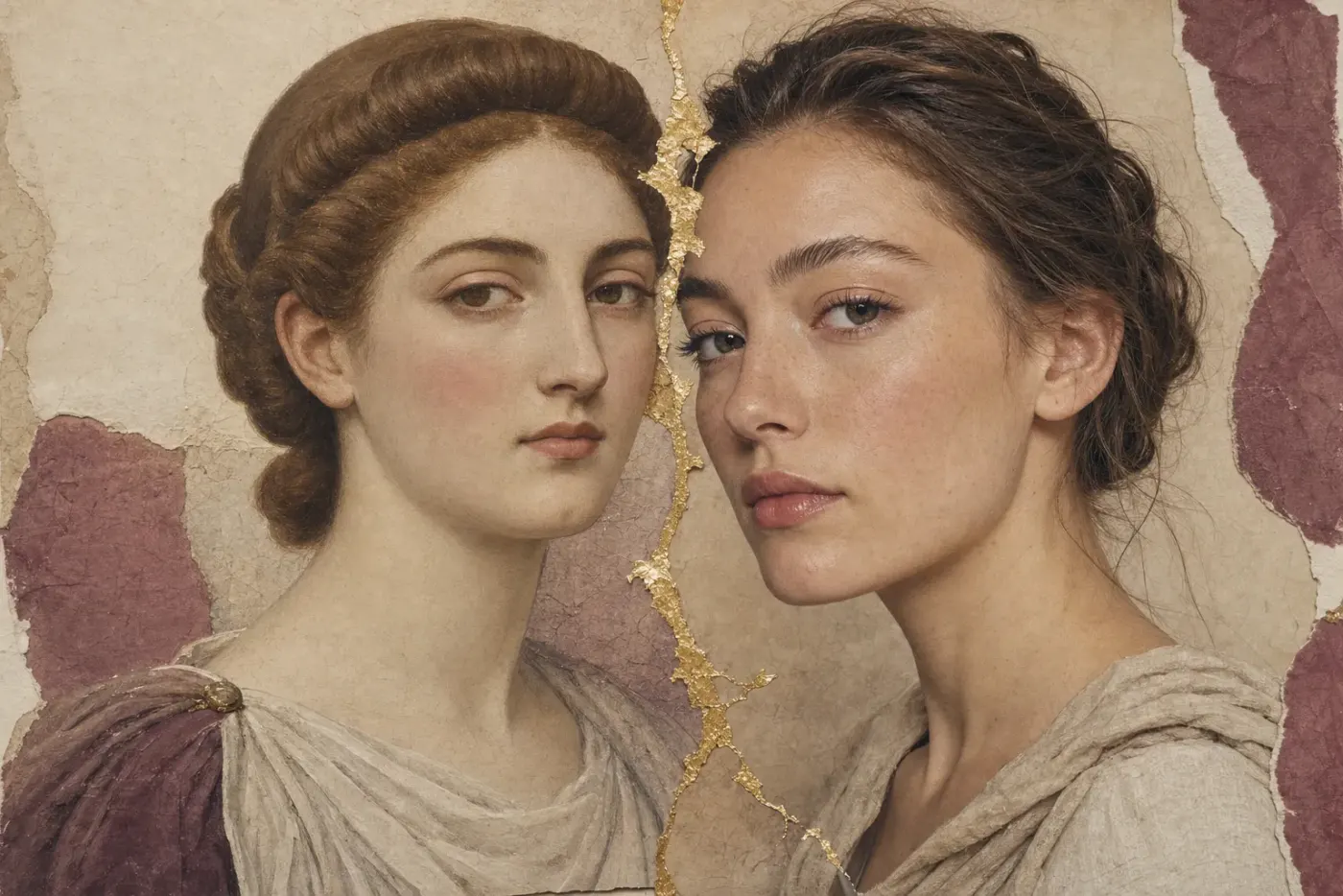
The no-makeup look is not a modern invention: Ovid instructed women to keep their cosmetic boxes out of a lover's sight, and the rule that beauty must appear unassisted has since been restated by medieval theologians, Renaissance courtiers, Victorian etiquette manuals and contemporary advertising.
- 9min read
- 6chapters
- 11sources
Vivien
Your guide through time
Listen to this essay
9 min listenVivien reads our essays aloud, word for word — every date and every name in its place — so you can listen the way you would be walked through a gallery.
An AI voice, designed for History of Makeup
There is a rule in the history of cosmetics older than any particular pigment, and it is not a rule about what to wear. It is a rule about being caught.
Ovid states it plainly in the third book of the Ars Amatoria: a lover should not come upon the boxes laid out on the dressing table, because ars faciem dissimulata iuvat - art improves the face when the art is concealed. He compares the half-made face to a sculpture still in the block, unpleasant to look at while it is being made and no argument against the finished thing.[1]
Almost everything that follows in this article is a restatement of that sentence by people who had not read it.
The Roman Version
Roman writing on cosmetics is mostly hostile, and the hostility is specific. The objection is rarely to colour on a face. It is to the discovery of colour on a face - to the smell of the preparations, to the residue, to the moment when the artifice becomes visible and the wearer is revealed as having worked at it.[2]
Ovid is the useful exception because he wrote both sides. His Medicamina Faciei Femineae sets out real formulations in verse, with quantities; the Ars Amatoria then tells the reader to make certain that nobody sees her use them.[3] Practical instruction and concealment instruction, from the same author, within a few years.
The satirists supply the enforcement. A face that runs, cracks or smells is a standing joke in the Roman literature, and the joke only works on an audience that already believes detection is the failure.[2]
Theology and the Trotula
The medieval position looks like prohibition and was not quite. Tertullian set the terms at the turn of the third century. In the second book of De cultu feminarum he writes that those who rub their skin with medicaments, stain their cheeks with rouge and make their eyes prominent with antimony sin against God, because the plastic skill of God is evidently displeasing to them and they are censuring the Artificer of all things; the charge he then adds is dishonesty, lying in your appearance when lying with the tongue is not lawful.[4] Churchmen restated the argument for a thousand years.
Thomas Aquinas, writing in the thirteenth century, made the distinction the rest of the period lived inside. In the Summa Theologiae he holds that a married woman who adorns herself in order to please her husband does so without sin, and locates the fault in the intention - adornment for sensual pleasure, or in contempt of God - rather than in the paint itself.[5]
Meanwhile the recipes circulated. The Salernitan compendium known as the Trotula contains a cosmetic treatise, De ornatu mulierum, with preparations for the skin, the hair, the lips and the teeth, transmitted across Latin Europe in a large number of manuscripts.[6] The sermons and the recipes were copied in the same centuries, often into the same libraries.
The medieval reader was not told to be plain. She was told to be plain-looking.
Sprezzatura
The Renaissance gave the rule a name and a theory. Baldassare Castiglione's Il Libro del Cortegiano, published in Venice in 1528, built an entire ideal of courtly conduct on sprezzatura. Count Ludovico defines it in Book I, section 26: avoid affectation to the uttermost, and practise in everything a certain nonchalance that conceals design and shows that what is done is done without effort and almost without thought.[7]
Applied to the face it produced a specific aesthetic judgement, set out in Book I, section 40. The Count prefers the woman who paints so sparingly that whoever sees her is in doubt whether she is painted at all, over one so plastered that she seems to have put a mask on her face and dares not laugh for fear of cracking it. Better still, he says, is the lady plainly seen to have nothing on her face, a little pale by nature and sometimes tinged with an honest flush, her hair artlessly unadorned. Heavy paint he treats as affectation, which in his system is the one unforgivable fault.[7]
The portraits of the period should be read with that in mind. Patricia Simons argues that the Renaissance female portrait, and the profile format in particular, is a construction made for a viewer inside a culture of display rather than a record of how a woman looked.[8] The inference this article draws from that is its own, and it is a modest one: a sitter shown with an even, pale complexion and a faint flush is not evidence of a bare face. She is evidence of the standard that face was expected to meet.
Deniability in the Nineteenth Century
The Victorian formulation is the most studied, because the commercial record survives it. The etiquette literature held that a lady used nothing. The trade sold complexion preparations, lip salves, rouges and powders in volume, describing them as remedies, toilet preparations and cures.[9]
What was policed was not use. It was detection. The approved techniques were the ones that could not be proved: rice and pearl powders that left no colour, clear pomade for the brows, a bitten lip, a pinched cheek, and any tinted preparation applied lightly enough to pass for health.[10]
This is why nineteenth-century testimony about how much makeup was worn is so unreliable. The people best placed to say were the people with the strongest reason not to.
The Modern Product
The twentieth century did not abolish the rule. It productised it. A natural register of cosmetics - sheer foundations, tinted moisturisers, neutral shades, brow and lash products sold as definition rather than colour - has been a standing commercial category since the interwar period, manufactured and advertised by the same firms that sell the full face.[11]
The business logic is plain in the industry's own history. A house that can sell both the visible face and its denial is insulated against a change of fashion in either direction, and the large firms have generally held both positions at once.[12]
The vocabulary is Victorian with the dates changed. Enhancing your natural features; your skin but better; barely there. Each is an instruction to use the product and not be seen to have used it, which is the instruction Ovid gave.
The No-Makeup Selfie
The clearest modern demonstration was not a campaign. In March 2014 users in Britain began posting photographs of themselves without makeup and nominating others to do the same, attaching donations to Cancer Research UK. The charity had not started it, and said so at the time; within days the trend had raised several million pounds, and the charity later put the total at about eight million.[13]
What makes the episode useful here is what it assumed. A bare face was legible as a sacrifice, an act of nerve and a thing worth sponsoring - which only works in a culture where the made-up face is the default and the unmade one is the exception.
The rule has therefore inverted without weakening. Ovid's reader hid the evidence of effort. The modern reader is asked to exhibit its absence. Both are performances, and both are judged on whether the audience believes them.
Sources
- [1, 3]Ars Amatoria, Book III Latin text, The Latin Library; composed c. 2 CE.View source (opens in a new tab) Accessed 2026-09-22.
- [2]Cosmetics in Roman Antiquity: Substance, Remedy, Poison The Classical World 102.3, 2009.
- [4]De cultu feminarum (On the Apparel of Women), Book II, chapter 5 New Advent English edition, trans. S. Thelwall; composed c. 200 CE.View source (opens in a new tab) Accessed 2026-09-22.
- [5]Summa Theologiae, Secunda Secundae, q. 169 a. 2: Of Modesty in the Outward Apparel New Advent English edition.View source (opens in a new tab) Accessed 2026-09-22.
- [6]The Trotula: A Medieval Compendium of Women’s Medicine University of Pennsylvania Press, 2001.
- [7]Il Libro del Cortegiano (The Book of the Courtier) Aldine Press, Venice; cited from the Opdycke English translation, 1528.
- [8]Women in Frames: The Gaze, the Eye, the Profile in Renaissance Portraiture History Workshop Journal 25, 4-30, 1988.View source (opens in a new tab)
- [9, 11]Hope in a Jar: The Making of America’s Beauty Culture Metropolitan Books, 1998.
- [10]Fashions in Makeup: From Ancient to Modern Times Peter Owen, 1972.
- [12]Beauty Imagined: A History of the Global Beauty Industry Oxford University Press, 2010.
- [13]#nomakeupselfie - some questions answered Cancer Research UK Science Blog, 2014.View source (opens in a new tab) Accessed 2026-09-22.
Filed under