The Cosmetic Kit: When the Equipment Became a Set
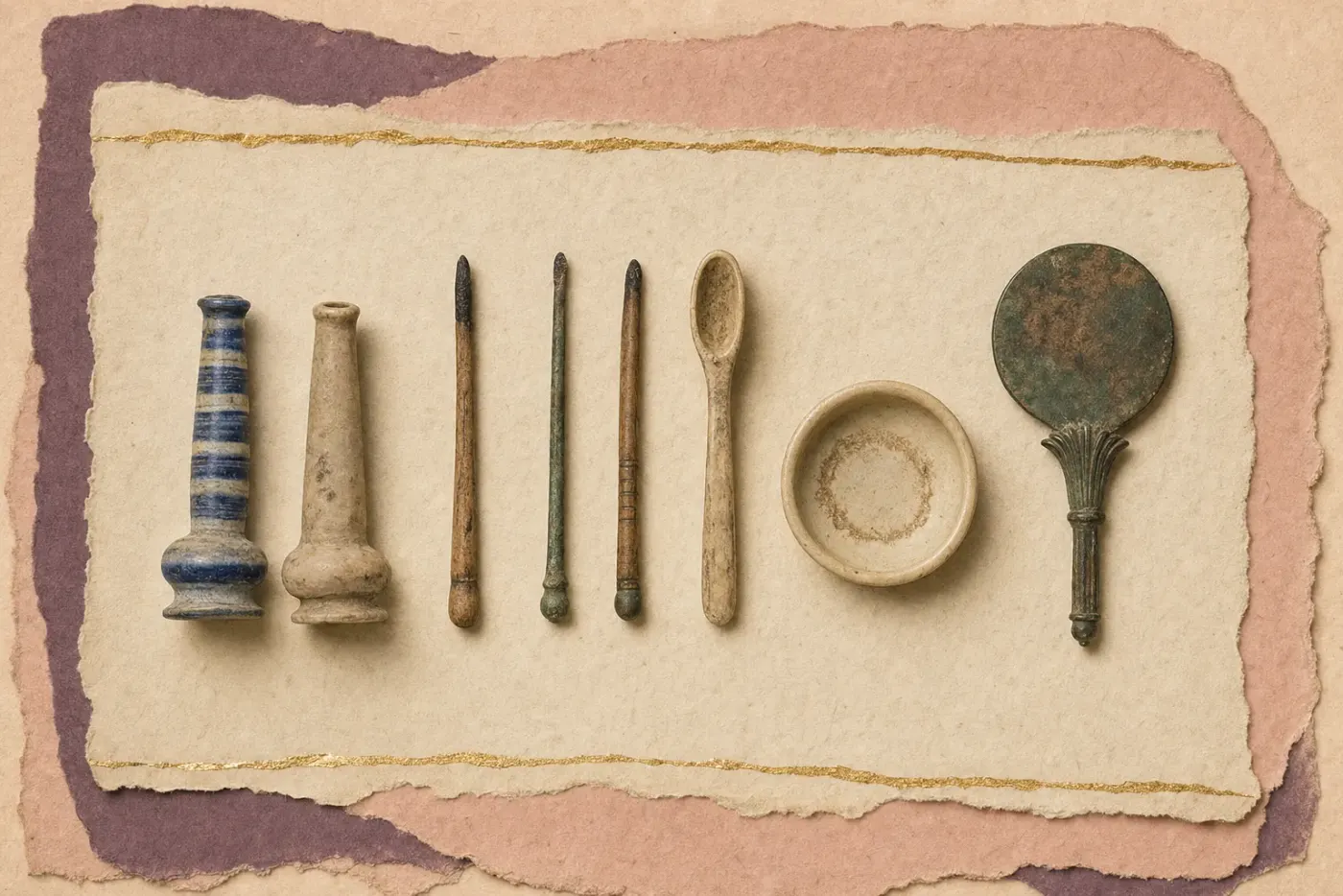
Pots, tubes, sticks, spoons and mirrors stop appearing singly and start appearing together — and a set implies a routine.
In short
By the Egyptian New Kingdom cosmetic equipment appears as a standard assemblage — containers, applicators, spoons and mirrors buried together — which indicates a routine involving several materials in sequence rather than a single preparation.
- 12min read
- 6chapters
- 4sources

Vivien
Your guide through time
Listen to this essay
6 min listenVivien reads our essays aloud, word for word — every date and every name in its place — so you can listen the way you would be walked through a gallery.
An AI voice, designed for History of Makeup
A single cosmetic container tells you a substance existed. A container buried alongside a second container, an applicator, a spoon and a mirror tells you something considerably more interesting: that these objects were understood to belong together, and that using them was a sequence rather than an act.[1]
By the New Kingdom that assemblage is standard. The kit, not the pot, is the unit — and the moment equipment becomes a set is the moment a practice has become a routine.[1]
What Is In One
The recurring components are containers for the powders, slender applicator rods for transferring them to the eye, spoons and small dishes for mixing, mirrors of polished metal, and vessels for oils and unguents.[2]
The kohl tube is the most distinctive of them: a narrow vessel with a small opening and a disproportionately heavy base, shaped to hold a fine powder without spilling and to stand upright while a rod is withdrawn. That is a container designed around its contents and its use, not a generic pot.[3]
What the Objects Reveal About the Routine
Applicator rods are the most informative items. A thin rod, wetted and dipped, lays a line along the lid margin — which tells you the application was linear and controlled rather than a smear or a wash, and that it was done close to the eye.[4]
A mirror in the same deposit implies the work was self-directed, and the presence of more than one container implies more than one material. The equipment describes the procedure even where no text does, which is the great advantage of an archaeology of tools.[5]
Wear supports the reading. Rods are frequently worn or stained at one end and not the other, which is what repeated dipping and drawing produces, and the interiors of tubes are scoured in a way that a single filling would not cause. Those traces are small and they are the difference between an object that was used and an object that was owned.[4]
The moment equipment becomes a set is the moment a practice has become a routine.
A Set Implies an Economy
Behind a standard kit sit standard suppliers. Containers of a consistent form imply production for a market; imported materials imply trade; and a recognisable assemblage implies that buyers knew what a complete set was and would notice a missing element.[6]
Lead isotopes make part of that trade visible: kohl samples from Bronze Age Lower Nubia carry signatures that place the material’s origin elsewhere, which turns an assumption about exchange into a measurement.[7]
This is one of the few points in the ancient record where a cosmetic can be traced to a source rather than described in place. A pigment with a measurable origin is a pigment with a route, and a route implies people whose work was moving it — none of whom appear anywhere in the written record of the period.[7]
Beautiful Objects Are a Sampling Problem
The kits that appear in museum cases are the fine ones — carved, inlaid, made of materials worth the carving. They are disproportionately represented because they were disproportionately collected, catalogued and kept.[8]
Plainer equipment in cheaper materials is far less visible in the record and was almost certainly far more common. Any impression that Egyptian cosmetics were a luxury of the elite is partly an artefact of what museums acquire.[8]
The Kit Outlives the Culture
The structure survives everything. A container for the colour, a tool to apply it, a surface to mix on and a mirror to work by is still the specification, and every kit in this history is a variation on it.[9]
The 1920s vanity case is the same four functions in a hinged metal box, and its innovation is portability rather than concept. Three and a half thousand years separate them and the list of components does not change.[10]
What Is Not Known
Whether a buried kit was used in life or assembled for the burial cannot be settled object by object. Wear on an applicator is suggestive; an unworn rod in an otherwise worn set is ambiguous.[11]
Nor does the equipment say how often any of it was used. A routine is implied by the assemblage; its frequency is not recoverable from it.[11]
And the contents of most containers are long gone. Where a residue survives it can be analysed; where it does not, a tube is simply a tube, and a great many of them are.[11]
Sources
- [1, 2, 5, 6, 8, 9, 11]Sacred Luxuries: Fragrance, Aromatherapy, and Cosmetics in Ancient Egypt Cornell University Press, 1999.
- [3, 4]Egyptian kohl pots and applicators, Department of Egypt and SudanView source (opens in a new tab) Accessed 2026-09-22.
- [7]Bronze age supply chains between ancient Egypt and Nubia revealed by lead isotope analysis of kohl samples Scientific Reports 14, article 27488, 2024.View source (opens in a new tab)
- [10]Vanity Case by Richard Hudnut, accession number 1995.238a-z The Costume Institute, The Metropolitan Museum of Art.View source (opens in a new tab) Accessed 2026-09-22.
Filed under