Stibnite (Antimony Kohl)
Identity
Bannedas of 22 Sep 2026
- CAS
- 1345-04-6
- EC
- 215-713-4
- Origin
- Mineral
- First attested
- 77 CE
- Also known as
- antimony trisulfide · antimony(III) sulphide · Sb2S3 · ithmid · ithmed · stibium · stimmi
No INCI name: this material predates the nomenclature and is not a listed cosmetic ingredient.
How it is dated
Pliny's account of stibi as an ingredient of women's eye preparations, written in the first century CE; earlier archaeological identifications of antimony eye paint are far less secure than the lead ones.
No regulatory dataset is loaded. The status above is this archive's editorial summary of the documented record, not a statement of any substance's legal position in your jurisdiction, and nothing here is advice on whether to use it.
In short
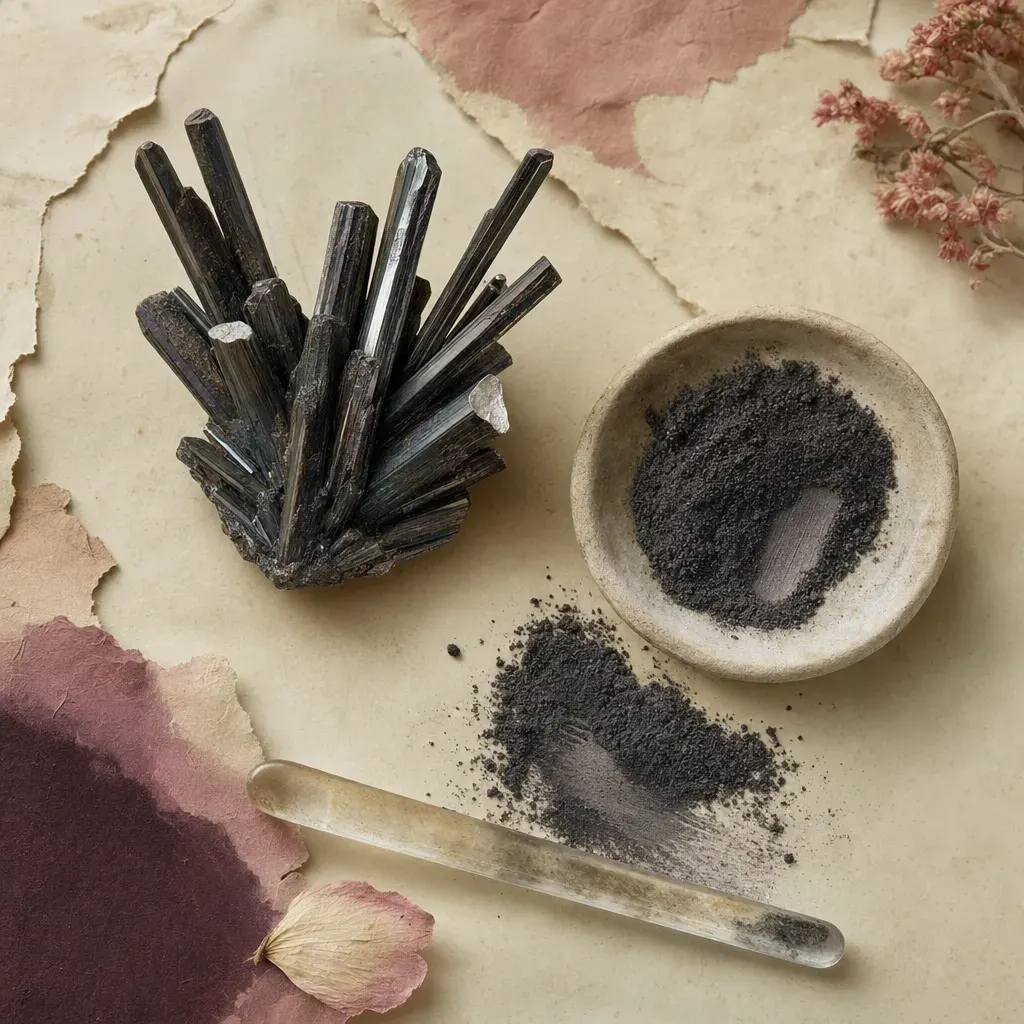
Stibnite is antimony trisulphide, the grey ore that gave the element its symbol, Sb, and the mineral that later tradition credits, mostly wrongly, as the basis of ancient Egyptian kohl.
- 3min read
- 5chapters
- 6sources

Vivien
Your guide through time
Listen to this entry
5 min listenVivien reads our essays aloud, word for word — every date and every name in its place — so you can listen the way you would be walked through a gallery.
An AI voice, designed for History of Makeup
Stibnite is antimony trisulphide, a soft mineral of grey metallic needles that grinds to a fine black-grey powder. It is the ore that gave the element its symbol, Sb, from Latin stibium, and in Arabic pharmacological tradition it is ithmid, the mineral of the best kohl.[1]
It is also the source of one of the most durable errors in cosmetic history. Ancient Egyptian eye paint is still routinely described as antimony. The analytical record says it was overwhelmingly lead.[2]
What It Is
The compound is antimony(III) sulphide, Sb2S3.[3] It crystallises in long grey prisms, is soft enough to leave a mark on paper, and is opaque and insoluble in water.
Antimony is a metalloid, and its compounds are toxicologically distinct from lead compounds. That distinction is regularly lost when kohl is discussed as though it were a single substance. The two minerals look broadly alike in a pot and behave alike on an applicator stick, which is part of why the record confuses them.
In History
The securest early description is Roman. Pliny treats stibi under several names, notes that most people call it by a Greek word meaning wide-eye, and says it is used in preparations for women's brows because it has the property of enlarging the eye. He also describes it in remedies for inflamed and ulcerated eyes.[4]
The mineral is central to later Near Eastern and South Asian practice, where ithmid and surma name kohls understood to be antimony-based, and where a medical value is claimed alongside the cosmetic one. Whether the powders actually sold under those names contain antimony is a separate question, and frequently they do not.[5]
What It Does
Stibnite works as a pigment. It is opaque, insoluble and soft enough to reduce to powder on a stone, so it colours by covering rather than staining, and bound in fat or gum it holds a drawn line along the lid margin. Ground and bound it gives a cooler, faintly more silvered black than galena, though the difference is slight once a line is drawn and neither powder is reliably distinguishable from the other by eye.
The advantage claimed for it over galena is medical rather than optical: antimony kohl is sold and recommended on the strength of a tradition that treats ithmid as good for the eye. The tradition is old and well attested as a tradition, which is not the same as evidence that the powder does what is claimed of it, and surveys of the powders actually on sale repeatedly fail to find antimony in them at all.[6]
The Galena Confusion
The error has a linguistic shape. Greek stimmi and Latin stibium denote antimony sulphide, and those terms were applied to the Egyptian black eye-paint mineral by later writers working from the classical vocabulary.[7]
Analysis has not supported the identification. Eye-paint residues from Egyptian museum collections are lead-based: galena and cerussite, with two lead chlorides that appear to have been synthesised deliberately.[8] Modern kohl is no better a guide. Of forty-seven samples collected in Oman and examined by X-ray diffraction, the principal components reported were galena, amorphous carbon, haematite, magnetite, zincite, calcite, minium and sassolite. Antimony sulphide was not among them.[9]
Safety and Status
Antimony and its compounds are listed among the substances prohibited in cosmetic products by Annex II of Regulation (EC) No 1223/2009, adopted on 30 November 2009, applied in full from 11 July 2013 and amended many times since.[10] In the United States the Food and Drug Administration states that kohl, kajal and surma are not approved colour additives and maintains an import alert against eye cosmetics declaring them. That position rests on lead content and labelling, and applies to the category by name rather than to any one mineral.[11]
Stibnite kohl continues to be made, sold and recommended, and health claims continue to be made for it. Those claims sit outside what this entry can assess.
Sources
- [1, 5, 6, 9]Composition of eye cosmetics (kohls) used in Oman Journal of Ethnopharmacology 60(3), 223-234, 1998.View source (opens in a new tab)
- [2, 8]Making make-up in Ancient Egypt Nature 397, 483–484, 1999.
- [3]Substance Infocards, ECHA database of registered substancesView source (opens in a new tab) Accessed 2026-09-22.
- [4, 7]Naturalis Historia, Books XXXIII–XXXV 77.
- [10]Regulation (EC) No 1223/2009 on cosmetic products 2009.View source (opens in a new tab) Accessed 2026-09-22.
- [11]Kohl, Kajal, Al-Kahal, Surma, Tiro, Tozali, or Kwalli: By Any Name, Beware of Lead PoisoningView source (opens in a new tab) Accessed 2026-09-22.