Madder
Identity
Contestedas of 22 Sep 2026
- INCI name
- RUBIA TINCTORUM ROOT EXTRACT
- CAS
- 84650-16-8
- EC
- 283-497-9
- Colour Index
- CI 75330
- Origin
- Plant
- First attested
- 2,500 BCE
- Also known as
- Rubia tinctorum · dyer's madder · common madder · garance · madder lake
What it does
How it is dated
A madder-dyed cotton fragment from Mohenjo-daro places the dye in the third millennium BCE, making it one of the earliest dyes identified on an excavated textile.
No regulatory dataset is loaded. The status above is this archive's editorial summary of the documented record, not a statement of any substance's legal position in your jurisdiction, and nothing here is advice on whether to use it.
In short
A red from the root of Rubia tinctorum whose principal colourant, alizarin, became the first natural dye to be manufactured synthetically, and so ended its own cultivation.
- 3min read
- 4chapters
- 6sources

Vivien
Your guide through time
Listen to this entry
5 min listenVivien reads our essays aloud, word for word — every date and every name in its place — so you can listen the way you would be walked through a gallery.
An AI voice, designed for History of Makeup
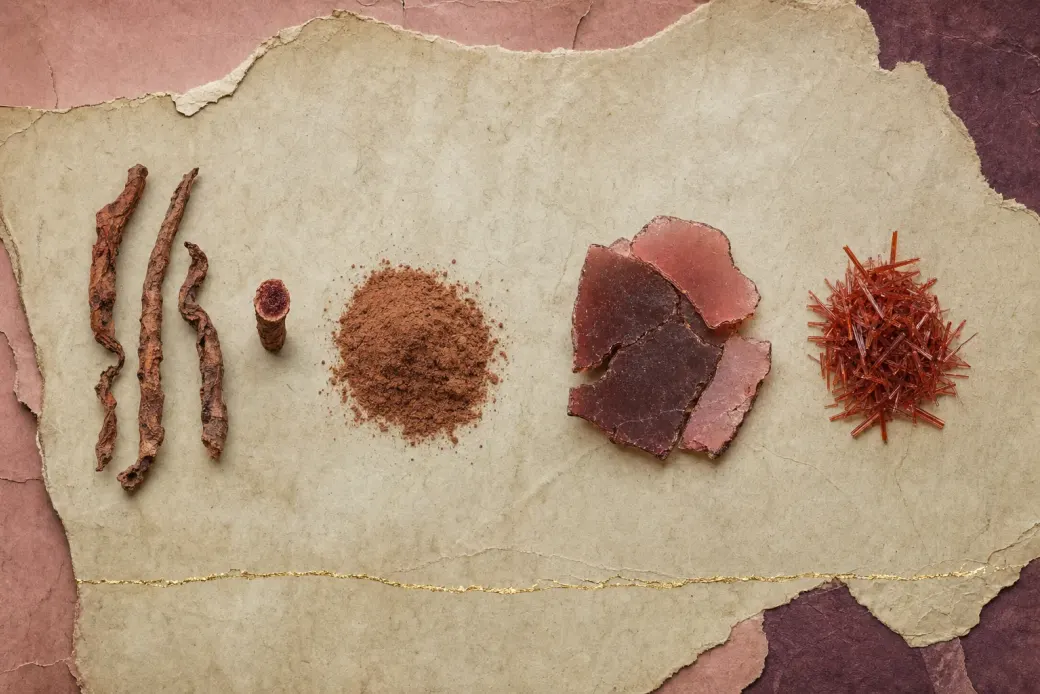
Madder is the root of Rubia tinctorum, a scrambling perennial of the coffee family, and the most important plant red of the Old World. The roots are lifted after two or three years, dried and ground; the colour develops as stored glycosides break down into free anthraquinones.[1]
It is the one classic natural red whose chemistry destroyed its own industry. Alizarin, madder's principal colourant, was the first natural dye to be made synthetically at commercial scale, and madder farming did not survive the change.[2]
What It Is
Madder root contains a family of anthraquinones rather than a single dye. The two that matter most for colour are alizarin and purpurin; the root also carries ruberythric acid, lucidin, lucidin primeveroside and rubiadin, in proportions that vary with the age of the plant, the soil and how the root is dried and stored.[3]
Alizarin on its own gives a cool red. With an aluminium mordant on cotton it gives the brilliant and unusually fast red known as Turkey red, produced by a long sequence of oil, alum and calcium treatments that European dyers spent decades trying to reverse-engineer.[4]
In History
A madder-dyed cotton fragment from Mohenjo-daro places the dye in the third millennium BCE, and madder is identified in Egyptian and Roman-period textiles thereafter.[5] Medieval and early modern Europe grew it as a field crop, above all in the Netherlands and in the French Vaucluse, where it was called garance.[5]
Carl Graebe and Carl Liebermann worked out that alizarin could be reduced to anthracene and verified the hypothesis in 1868 by a total synthesis — the first total synthesis of a natural pigment.[6] Synthetic alizarin was introduced commercially in 1871, after which the natural product's share of the textile trade declined rapidly.[7]
Madder acreage collapsed within a generation. It did not vanish entirely: the natural lake survived in artists' colours[7] and the crop was revived on a commercial scale in the Dutch province of Groningen about a century later.[6]
What It Does
Precipitated onto alum, madder gives madder lake, a translucent pigment ranging from pink to a deep brown-red depending on the extraction and the substrate.[8] Lakes of this kind are what carried plant reds into cosmetics at all: a lake can be ground into a wax or a fat, where a dye solution cannot.[9]
In current cosmetic use madder is mostly not a colourant. RUBIA TINCTORUM ROOT EXTRACT is listed with skin-conditioning, soothing and tonic functions and with no colour function at all, which is a different proposition from the dyestuff.[10] The colour functions recorded for this entry describe the historical dye and its lake; skin conditioning is the function the registered ingredient actually carries, which is why it is listed first.
Safety and Status
Madder is the one material here with a formal carcinogenicity evaluation. The International Agency for Research on Cancer reviewed it in 2002 and placed madder root itself in Group 3, not classifiable as to its carcinogenicity in humans, while placing 1-hydroxyanthraquinone, one of its constituents, in Group 2B, possibly carcinogenic to humans.[11]
The same review records that lucidin, another root constituent, is mutagenic in bacteria and in cultured mammalian cells and forms DNA adducts in mice, and that madder root given orally to rats produced liver and kidney tumours.[11] Reducing or avoiding lucidin has been a recurring aim of madder research since.[12]
An IARC classification is a hazard identification, not a licence or a prohibition: the Monographs programme asks whether an agent can cause cancer under some conditions of exposure, and it is issued for no jurisdiction in particular. In the European Union a cosmetic product is not authorised ingredient by ingredient. Regulation (EC) No 1223/2009 requires that every product placed on the market carry a safety assessment made by a qualified assessor, and that general obligation, rather than any listing naming madder, is what governs a cosmetic containing the root extract.[13] The status recorded at the head of this entry therefore describes an unsettled toxicological literature, not a regulatory restriction, and it depends heavily on which fraction of the root is being discussed.
Sources
- [1, 4, 7, 8]Madder, CAMEO: Conservation and Art Materials Encyclopedia Online Museum of Fine Arts, Boston, 2026.View source (opens in a new tab) Accessed 2026-09-22.
- [2, 3, 6, 12]Red, Redder, Madder: Analysis and Isolation of Anthraquinones from Madder Roots (Rubia tinctorum) Wageningen University, doctoral thesis, 2001.View source (opens in a new tab) Accessed 2026-09-22.
- [5, 9]Natural Dyes: Sources, Tradition, Technology and Science Archetype Publications, 2007.
- [10]CosIng ingredient entry: Rubia tinctorum root extract, reference number 59430 European Commission, Directorate-General for Internal Market, Industry, Entrepreneurship and SMEs, 2026.View source (opens in a new tab) Accessed 2026-09-22.
- [11]Rubia tinctorum, Morinda officinalis and anthraquinones, IARC Monographs on the Evaluation of Carcinogenic Risks to Humans, Volume 82 International Agency for Research on Cancer, 2002.View source (opens in a new tab) Accessed 2026-09-22.
- [13]Regulation (EC) No 1223/2009 on cosmetic products 2009.View source (opens in a new tab) Accessed 2026-09-22.