Mica
Identity
In current useas of 22 Sep 2026
- INCI name
- MICA
- CAS
- 12001-26-2
- EC
- 310-127-6
- Colour Index
- CI 77019
- Origin
- Mineral
- Also known as
- muscovite · potassium aluminium silicate · Muscovy glass · sericite
What it does
No regulatory dataset is loaded. The status above is this archive's editorial summary of the documented record, not a statement of any substance's legal position in your jurisdiction, and nothing here is advice on whether to use it.
In short
A platy potassium aluminium silicate that splits into flakes thin enough to be transparent, supplying the shimmer in most eyeshadows and the substrate for nearly every pearlescent pigment.
- 3min read
- 4chapters
- 5sources

Vivien
Your guide through time
Listen to this entry
5 min listenVivien reads our essays aloud, word for word — every date and every name in its place — so you can listen the way you would be walked through a gallery.
An AI voice, designed for History of Makeup
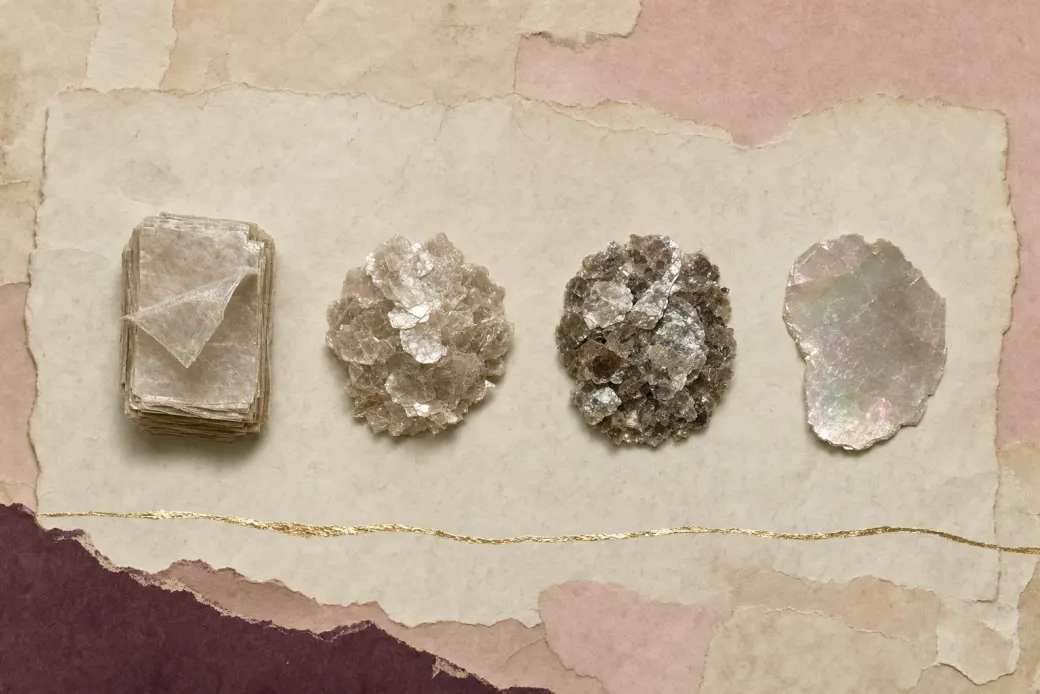
Mica is a family of silicate minerals that cleave into flakes so thin they are transparent. Ground to a controlled particle size, those flakes lie flat against skin and reflect light from their surfaces. That is the whole basis of shimmer in cosmetics, and it is a description of the optics rather than of any regulatory text: no colour additive listing says anything about cleavage, platelets or reflection.
Most of the time mica is not the pigment but the thing the pigment is built on. Coat a mica flake with titanium dioxide or iron oxide and it becomes an interference pigment, generating colour from the thickness of the coating rather than from any dye.
What It Is
For the colour additive listed in the United States, muscovite is not merely the usual grade but the definitional one: 21 CFR 73.1496(a)(1) describes mica as a white powder obtained from the naturally occurring mineral, muscovite mica, consisting predominantly of a potassium aluminum silicate.[1] The cosmetic listing at 21 CFR 73.2496 adopts that identity by cross-reference rather than restating it.[2] The structure of the mineral is a stack of sheets held together weakly, which is why it splits into platelets rather than crumbling into grit. The name is from Latin mica, a crumb or grain, later associated with micare, to glitter.
Particle size decides the effect, and the chemistry does not change with it. Very fine grades read as a soft satin sheen and help a powder spread. Coarse grades read as visible sparkle. The same mineral produces both.
In History
Mica has no clean origin story in cosmetics. The mineral is ancient, abundant and widely distributed, and flakes of it survive in archaeological contexts from Egypt to Mesoamerica, but a flake in a tomb is not evidence of a face powder. No securely dated early cosmetic use is established, and this entry does not assert one.
What can be dated is the effect pigment. The pearlescent behaviour of titanium dioxide on mica was described in 1942 but did not become widely available until the 1960s.[3] It displaced two older pearls: guanine extracted from fish scales, used in nail polish from the 1920s, and bismuth oxychloride.[3] Coated mica was cheaper than the first and brighter and more versatile than the second.
What It Does
Mica does several jobs at once, which is why it sits near the top of so many ingredient lists. As a filler it gives a powder slip and lets it spread without dragging. As an optical material it scatters light rather than blocking it, which softens the look of fine lines and pores; at the loadings used in a pressed powder that scattering also contributes a diffuse opacity, which is a different thing from the flat coverage a white pigment gives.
As a substrate it carries other pigments. A thin titanium dioxide coating yields a white or silver pearl, and thicker coatings produce interference colours that shift with viewing angle. None of that optical behaviour appears in the American colour additive listing, which describes the raw mineral and then specifies it: the fineness requirement is that 100 per cent shall pass through a 100-mesh sieve.[4]
Safety and Status
Mica is listed at 21 CFR 73.2496 in the United States for colouring cosmetics generally, including the area of the eye, and is exempt from batch certification.[5] In the European Union it is a permitted colourant under Annex IV of Regulation (EC) No 1223/2009 as CI 77019.[6]
The contested question about mica is not toxicological but ethical. SOMO and Terre des Hommes Netherlands estimated in their first mica investigations, in 2015, that up to 22,000 children were involved in mica mining in the Indian states of Jharkhand and Bihar, much of it unregulated scrap gathering outside the formal mining sector; the estimate is restated in their 2018 report mapping the trade globally.[7] It is an upper bound rather than a count. Several suppliers now offer synthetic fluorphlogopite as a substitute. It behaves similarly, but it is a different material with a different INCI name. It is not mica.
Sources
- [1, 4]21 CFR 73.1496 - Mica Code of Federal Regulations, title 21, part 73, subpart B, 2026.View source (opens in a new tab) Accessed 2026-09-22.
- [2, 5]21 CFR 73.2496 - Mica Code of Federal Regulations, title 21, part 73, subpart C, 2026.View source (opens in a new tab) Accessed 2026-09-22.
- [3]Pearl Essence Cosmetics and Skin, 2009.View source (opens in a new tab) Accessed 2026-09-22.
- [6]Regulation (EC) No 1223/2009 on cosmetic products 2009.View source (opens in a new tab) Accessed 2026-09-22.
- [7]Global Mica Mining and the Impact on Children's Rights Terre des Hommes Netherlands, 2018.View source (opens in a new tab) Accessed 2026-09-22.