Brazilwood
Identity
Obsoleteas of 22 Sep 2026
- INCI name
- CAESALPINIA SAPPAN BARK EXTRACT
- CAS
- 89958-14-5
- EC
- 289-637-5
- Colour Index
- CI 75280
- Origin
- Plant
- First attested
- 1101 CE
- Also known as
- sappanwood · Biancaea sappan · Caesalpinia sappan · Natural Red 24
How it is dated
Brazilwood dyeing is documented in European textile work from the twelfth century, and the year given is that first documented use. Asian sappanwood had reached Europe through earlier medieval trade, and the American species entered the trade only after 1500.
No regulatory dataset is loaded. The status above is this archive's editorial summary of the documented record, not a statement of any substance's legal position in your jurisdiction, and nothing here is advice on whether to use it.
In short
A cheap, fugitive red drawn from several tropical heartwoods, traded in such quantity that Brazil is named after the tree rather than the tree after the country.
- 3min read
- 4chapters
- 7sources

Vivien
Your guide through time
Listen to this entry
5 min listenVivien reads our essays aloud, word for word — every date and every name in its place — so you can listen the way you would be walked through a gallery.
An AI voice, designed for History of Makeup
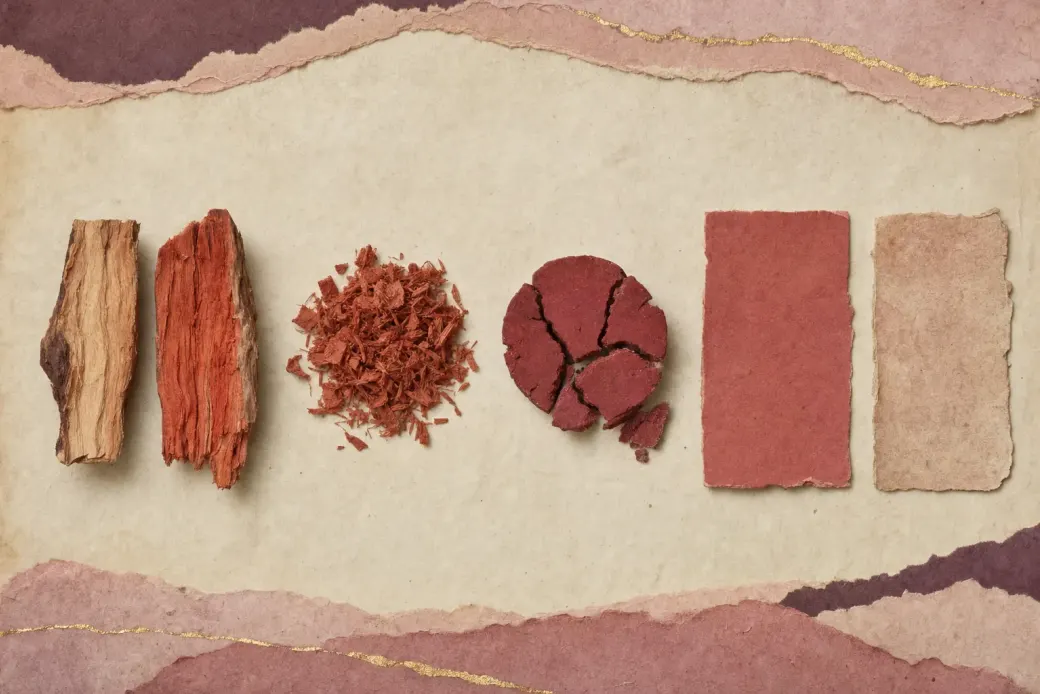
Brazilwood is not one tree. The name covers several unrelated tropical hardwoods whose heartwood yields the same red colourant: Asian sappanwood, Biancaea sappan, long traded to Europe under the name Caesalpinia sappan; the American Paubrasilia echinata; and Haematoxylum brasiletto of Central America.[1][2]
The wood was valuable enough to name a country. Portuguese sailors called the American tree pau-brasil, ember wood, after the Asian dyewood they already knew, and the coast became the land of brazilwood before it became Brazil.[2]
What It Is
The heartwood contains brazilin, a pale homoisoflavonoid that is not itself red.[4] Exposed to air it oxidises to brazilein, which is; the colour then swings from red towards violet as pH rises, and that swing is one of the ways the material is identified.[3]
Mordanted on alum and chalk it gives lakes running from lavender through cherry to a deep red. These lakes are notoriously fugitive. Brazilwood reds fade under light far faster than madder or cochineal, and that weakness, rather than the colour itself, is what fixed their place in the market as the cheap option.[3]
In History
Sappanwood reached Europe through Indian Ocean and Levantine trade in the early Middle Ages, and brazilwood dyeing is documented in European textile work from the twelfth century.[5] The American species entered the same trade after 1500 and was logged at scale for three centuries.
For cosmetics the significant form was not the dyebath but the coloured paper and wool. Eighteenth-century rouge was sold as prepared sheets and pads, moistened and pressed to the cheek, and the reds worked into them included brazilwood alongside safflower and sandalwood.[6][7]
What It Does
The form that survives under an INCI name is the Asian species, not the American one. CAESALPINIA SAPPAN BARK EXTRACT is listed as a skin-conditioning ingredient.[8] The colour index number CI 75280, Natural Red 24, is assigned separately, to the brazilein colourant that the several woods share.[9]
As a colourant brazilwood is effectively historical. Its lightfastness rules it out of anything expected to hold a shade on a shelf, and the modern extract is bought for the plant chemistry rather than for the red.[9]
Safety and Status
The constraint on brazilwood is conservation rather than toxicology, and it falls on one species only. Paubrasilia echinata, the American tree, has been listed on Appendix II of the Convention on International Trade in Endangered Species since 13 September 2007. The annotation that governs it, Annotation #10, was narrow as it then stood: it covered logs, sawn wood and veneer sheets, including the unfinished wood articles used to make bows for stringed instruments.[10][11]
At the nineteenth Conference of the Parties, held in Panama in 2022, Brazil proposed transferring the species to Appendix I, which would have tightened trade considerably further.[10] The species stayed in Appendix II, and the annotation was rewritten instead. It has since been rewritten again, and the text now in force is stricter rather than looser: as amended at the twentieth Conference of the Parties, in Samarkand, and effective from 5 March 2026, it exempts finished musical instruments, accessories and parts for non-commercial trade only — paid and unpaid performance, personal use, display, loan, competition, teaching, appraisal or repair, without a change of ownership — and it sets a zero quota for wild-harvested specimens traded for commercial purposes.[11]
None of this binds the cosmetic ingredient. What these instruments govern is timber, and the species they govern is not the one this entry's identifier table describes: CAESALPINIA SAPPAN BARK EXTRACT comes from the Asian sappanwood, which CITES does not list. The status recorded at the head of this entry is an editorial judgement about the red — as a cosmetic colourant brazilwood is out of use — and not a legal restriction. The bark extract itself remains a listed ingredient in current cosmetic commerce, bought as a skin conditioner.[12]
Sources
- [1, 3, 9]Brazilwood dye, CAMEO: Conservation and Art Materials Encyclopedia Online Museum of Fine Arts, Boston, 2026.View source (opens in a new tab) Accessed 2026-09-22.
- [2, 4, 5]Natural Dyes: Sources, Tradition, Technology and Science Archetype Publications, 2007.
- [6]The Artificial Face: A History of Cosmetics David & Charles, 1973.
- [7]Fashions in Makeup: From Ancient to Modern Times Peter Owen, 1972.
- [8, 12]COSMILE Europe ingredient entry: Caesalpinia sappan bark extract Cosmetics Europe, 2026.View source (opens in a new tab) Accessed 2026-09-22.
- [10]CoP19 Prop. 49: Transfer of Paubrasilia echinata from Appendix II to Appendix I CITES Secretariat, nineteenth meeting of the Conference of the Parties, Panama City, 2022.View source (opens in a new tab) Accessed 2026-09-22.
- [11]Pernambuco CITES Annotation #10 Implementation FAQs United States Fish and Wildlife Service, International Affairs, 2026.View source (opens in a new tab) Accessed 2026-09-22.