Candelilla Wax
Identity
In current useas of 22 Sep 2026
- INCI name
- EUPHORBIA CERIFERA (CANDELILLA) WAX
- CAS
- 8006-44-8
- EC
- 232-347-0
- Origin
- Plant
- First attested
- 1900 CE
- Also known as
- candelilla cera · Euphorbia cerifera cera · Euphorbia antisyphilitica wax · E 902
What it does
How it is dated
Secure evidence is for the wax as a traded commodity: organised collection from the wild shrub built up in northern Mexico from about 1900. The 1829 date often quoted is Zuccarini's botanical description of the plant, which is not evidence of the wax being used.
No regulatory dataset is loaded. The status above is this archive's editorial summary of the documented record, not a statement of any substance's legal position in your jurisdiction, and nothing here is advice on whether to use it.
In short
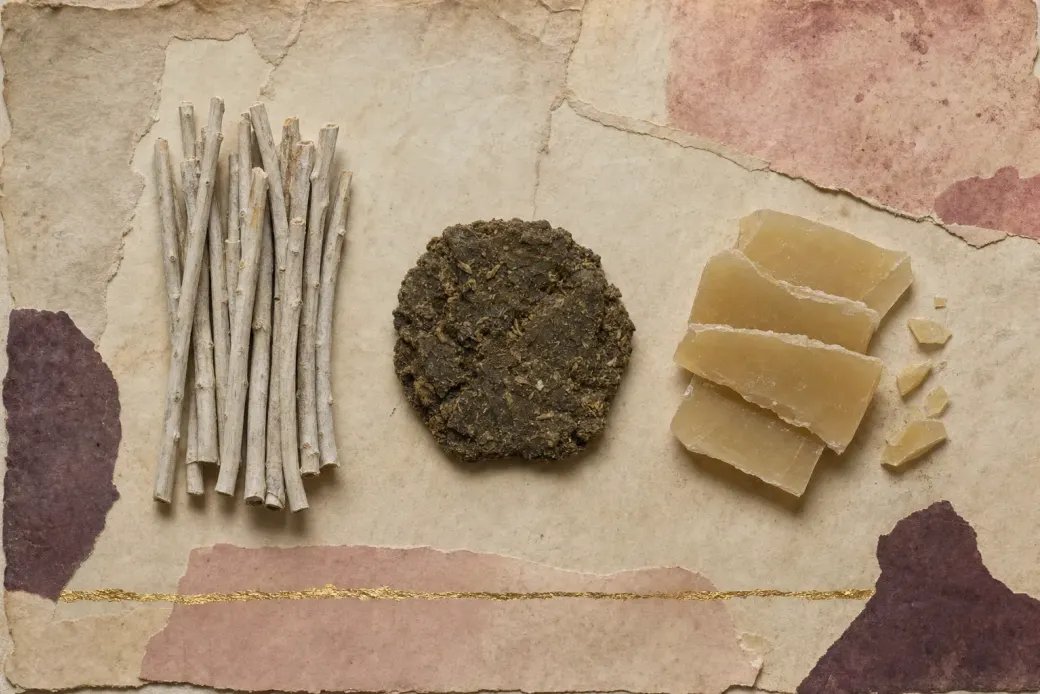
Candelilla wax is boiled off the stems of a leafless desert shrub that coats itself to keep from drying out, and it is the usual plant-derived stand-in for beeswax; its international trade is controlled under CITES.
- 2min read
- 4chapters
- 5sources

Vivien
Your guide through time
Listen to this entry
4 min listenVivien reads our essays aloud, word for word — every date and every name in its place — so you can listen the way you would be walked through a gallery.
An AI voice, designed for History of Makeup
Candelilla wax is the bloom on the stems of a leafless shrub of the Chihuahuan Desert, in northern Mexico and the Trans-Pecos of Texas. The plant coats itself to slow water loss. Harvesters lift whole plants and boil them in acidified water; the wax rises and is skimmed off.
In a formulation it does much the same work as beeswax, and it is the substitute normally reached for when a product must contain nothing of animal origin.[1]
What It Is
Candelilla is chemically unlike the ester-dominated plant waxes. Roughly half of it is straight-chain hydrocarbons, clustered around thirty-one carbons, with esters, free acids and sterols making up the rest. It is hard and brittle, but it melts lower than carnauba, which makes it easier to work into a blend.
Its naming is inconsistent. The plant is Euphorbia antisyphilitica, while the cosmetic ingredient is commonly listed as Euphorbia cerifera wax or simply as candelilla cera.[2] All three refer to the same shrub.
In History
The species was described botanically in 1829 by the German botanist Joseph Gerhard Zuccarini. The epithet antisyphilitica preserves a folk use of the plant against syphilis; it is a record of what was believed, not of what was shown.[3]
Commercial extraction of the wax is a twentieth-century development. Collection built up from about 1900 for sealing wax, phonograph records, polishes and insulation, and demand rose sharply during both world wars. The industry contracted after 1945, as cheaper petroleum waxes took its markets and harvested stands thinned; what revived it was demand from food and cosmetics rather than from industry.[3]
What It Does
Candelilla gives a moulded stick hardness, rigidity and gloss, and it binds oil well enough to reduce the tendency of a lipstick to weep its liquid phase on standing.[4] In balms and mascaras it is used as a structurant and film former on the same reasoning.
It is not a like-for-like replacement for beeswax. Candelilla is harder and less plastic, so a formula converted from one to the other generally has to be rebalanced rather than simply swapped.
Safety and Status
The Cosmetic Ingredient Review panel covered candelilla in its 1984 assessment of plant waxes and left that conclusion in place on re-review.[5] As a food additive it is E 902 under Regulation (EC) No 1333/2008 of 16 December 2008.[6]
The constraint that distinguishes candelilla is conservational rather than toxicological. Euphorbia antisyphilitica falls under Appendix II of the Convention on International Trade in Endangered Species of Wild Fauna and Flora, as part of a genus-wide listing in force since the convention took effect in 1975, so raw wax crossing a border requires a CITES permit issued by the Mexican management authority. Since 2010 an annotation has exempted finished products packaged and ready for retail sale, which is why a lipstick travels freely and a drum of wax does not.[7]
Sources
- [1, 7]CITES and livelihoods: Harvest and trade of Candelilla in Mexico CITES Secretariat, 2022.View source (opens in a new tab) Accessed 2026-09-22.
- [2, 3]Euphorbia antisyphilitica - Wax Plant Native Plant Society of Texas.View source (opens in a new tab) Accessed 2026-09-22.
- [4]Lipstick Formulation Cosmetics and Skin.View source (opens in a new tab) Accessed 2026-09-22.
- [5]Final Report on the Safety Assessment of Candelilla Wax, Carnauba Wax, Japan Wax, and Beeswax Journal of the American College of Toxicology, volume 3, issue 3, 1984.View source (opens in a new tab)
- [6]Regulation (EC) No 1333/2008 of the European Parliament and of the Council of 16 December 2008 on food additives Official Journal of the European Union, 2008.View source (opens in a new tab) Accessed 2026-09-22.