Talc
Identity
Contestedas of 22 Sep 2026
- INCI name
- TALC
- CAS
- 14807-96-6
- EC
- 238-877-9
- Origin
- Mineral
- Also known as
- talcum · hydrated magnesium silicate · French chalk · steatite · soapstone
No regulatory dataset is loaded. The status above is this archive's editorial summary of the documented record, not a statement of any substance's legal position in your jurisdiction, and nothing here is advice on whether to use it.
In short
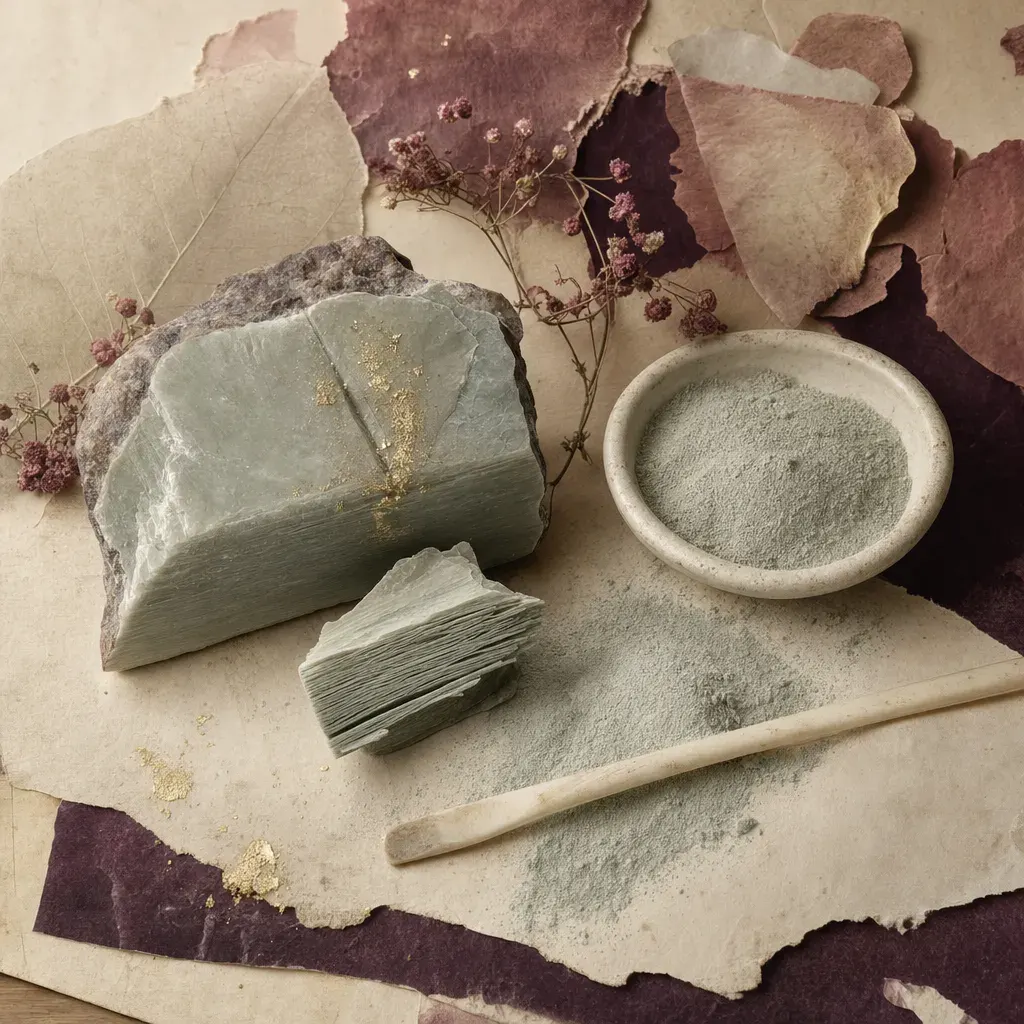
The softest mineral known, a hydrated magnesium silicate whose stacked platelets slide over one another under a fingertip; the material that gives a face powder its slip.
- 3min read
- 4chapters
- 4sources

Vivien
Your guide through time
Listen to this entry
4 min listenVivien reads our essays aloud, word for word — every date and every name in its place — so you can listen the way you would be walked through a gallery.
An AI voice, designed for History of Makeup
Talc is the softest mineral there is — it defines the bottom of the Mohs hardness scale — and that softness is the whole point of it. Its crystals are stacked sheets, held to one another weakly enough that they slide apart under a fingertip.
What is experienced as the slip of a face powder, the sensation of it gliding rather than dragging, is that sliding. No other common cosmetic mineral reproduces it exactly, which is why talc has proved difficult to replace even as the case against it has hardened.
What It Is
Talc is a hydrated magnesium silicate, Mg₃Si₄O₁₀(OH)₂, mined as a rock rather than manufactured. In cosmetic use it is TALC, CAS 14807-96-6, EC 238-877-9.[1]
Its central problem is geological rather than chemical. Talc forms in the same metamorphic settings as asbestiform amphiboles, so deposits can contain them, and the purity of any particular cosmetic talc is a question about its mine and its testing rather than about the mineral in the abstract. That distinction — talc as a substance against talc as it arrives from the ground — runs through every assessment of it.
In History
Talc is an old material put to a comparatively new use. It was quarried and carved as steatite for millennia, but the point at which it became a cosmetic powder is much harder to fix than popular accounts of it suggest, and this entry records no first attestation for that reason.
Its mass-market history is firmer. Talcum toilet and nursery powders became a staple of the American and British trade in the last decade of the nineteenth century and stayed there, carried by a claim of mildness and by the fact that a tin of powder was cheap.[2]
What It Does
In a powder, talc is the bulk. It carries pigment, dilutes it to a wearable strength, absorbs a little sebum, and supplies the slip that makes the product feel finished rather than dusty. In a pressed powder it also binds: under pressure the platelets interlock enough to hold a cake together in the pan.
Substitutes exist — mica, kaolin, starches, silica — and each of them replaces part of what talc does. None replaces all of it at once, which is why reformulating away from talc tends to mean a blend rather than a swap.
Safety and Status
The documented position has moved recently and is not settled. In June 2024 a working group convened by the International Agency for Research on Cancer classified talc as probably carcinogenic to humans, Group 2A, on limited evidence for ovarian cancer in humans, sufficient evidence in experimental animals and strong mechanistic evidence.[3]
In September 2024 the European Chemicals Agency's Committee for Risk Assessment adopted an opinion recommending harmonised classification of talc under Regulation (EC) No 1272/2008 — the CLP Regulation — as a category 1B carcinogen, with specific target organ toxicity on repeated inhalation.[4] That is an opinion within a procedure, not law. Article 15 of Regulation (EC) No 1223/2009 prohibits substances classified as category 1A or 1B carcinogens in cosmetic products unless a derogation is granted, so adoption would engage that prohibition. Talc's existing entry in the same Regulation is much narrower: entry 59 of Annex III requires powdery products intended for children under three years of age to carry the warning "Keep powder away from children's nose and mouth".[5]
Sources
- [1, 5]Regulation (EC) No 1223/2009 on cosmetic products 2009.View source (opens in a new tab) Accessed 2026-09-22.
- [2]Hope in a Jar: The Making of America’s Beauty Culture Metropolitan Books, 1998.
- [3]IARC Monographs evaluate the carcinogenicity of talc and acrylonitrile (Press Release No. 352) International Agency for Research on Cancer, Volume 136, 2024.View source (opens in a new tab) Accessed 2026-09-22.
- [4]Opinion proposing harmonised classification and labelling at EU level of talc (Mg3H2(SiO3)4) 2024.View source (opens in a new tab) Accessed 2026-09-22.