Jojoba Oil
Identity
In current useas of 22 Sep 2026
- INCI name
- SIMMONDSIA CHINENSIS SEED OIL
- CAS
- 61789-91-1
- Origin
- Plant
- First attested
- 1925 CE
- Also known as
- jojoba · goat nut oil · deer nut oil
What it does
How it is dated
The year dates the material rather than the plant: the first experimental planting recorded in the published record was made at the Boyce Thompson Southwestern Arboretum in Arizona in 1925. The botany is older — Johann Link described the shrub as Buxus chinensis in 1822 and Camillo Schneider gave it its present name in 1912 — and indigenous use of the seed in Sonora and Baja California is older still, but is not dated in that record.
No regulatory dataset is loaded. The status above is this archive's editorial summary of the documented record, not a statement of any substance's legal position in your jurisdiction, and nothing here is advice on whether to use it.
In short
Not an oil but a liquid wax of long-chain esters, close enough in structure to sperm whale oil that it became the industrial substitute after the United States banned sperm whale oil imports in 1971.
- 3min read
- 4chapters
- 4sources

Vivien
Your guide through time
Listen to this entry
5 min listenVivien reads our essays aloud, word for word — every date and every name in its place — so you can listen the way you would be walked through a gallery.
An AI voice, designed for History of Makeup
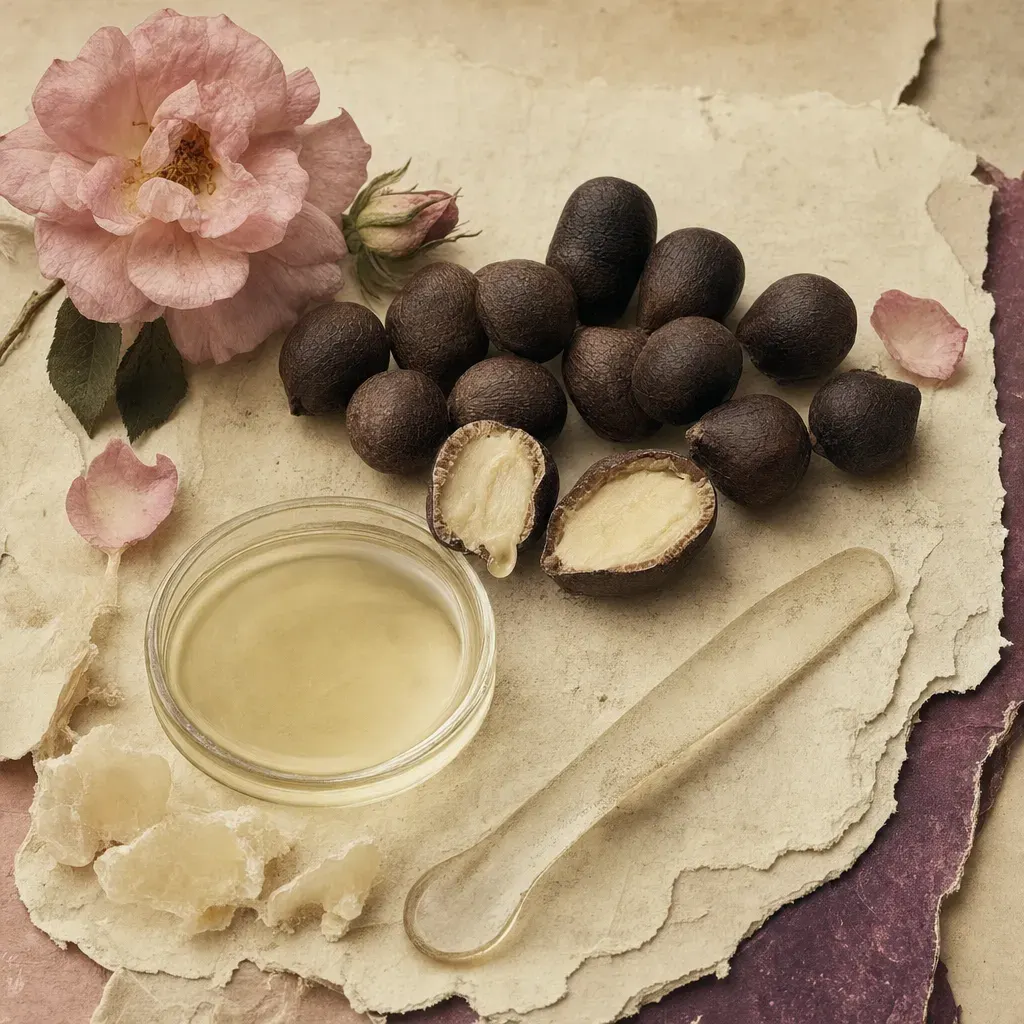
Jojoba comes from the seed of Simmondsia chinensis, a slow-growing evergreen shrub of the Sonoran Desert in Arizona, California and north-western Mexico.
The name misleads. Johann Link of the Berlin Botanical Garden described the plant as Buxus chinensis in 1822, Thomas Nuttall moved it to Simmondsia californica in 1844, and the Austrian botanist Camillo Karl Schneider settled the present Simmondsia chinensis in 1912 — leaving a Chinese epithet on a North American desert shrub.[1] The material misleads too: it is not an oil but a liquid wax, and that distinction is the reason anyone outside the desert ever took an interest in it.
What It Is
Almost every seed oil is a triglyceride: fatty acids on a glycerol backbone. Jojoba is not. It is composed of esters of long-chain fatty acids with long-chain fatty alcohols, unbranched, and liquid at room temperature — a wax that happens not to be solid.[2]
The consequence is stability. There is no glycerol backbone to hydrolyse and little to oxidise, and the material holds up to heat and pressure well enough to be used as a high-temperature, high-pressure lubricant as well as a cosmetic ingredient.[2]
In History
The peoples of Sonora and Baja California used the seed and its oil for food, for hair and as a medicine long before it was described in a laboratory.[3] How far back that use runs is not settled by the published record, and the precise early dates that circulate should be treated with caution.
Scientific attention arrived in stages. The first experimental planting was made at the Boyce Thompson Southwestern Arboretum in Arizona in 1925, and in 1935 chemists at the University of Arizona established that the oil closely resembled sperm whale oil, then a staple high-temperature, high-pressure lubricant. The consequence came decades later. The Endangered Species Conservation Act of 1969 brought sperm whales under protection, the United States banned imports of sperm whale oil in 1971, and an industry built on that oil needed a replacement. Commercial plantations began in 1978 and reached about 16,000 hectares by 1985 — but by 1990 roughly two-thirds of the plantings had been abandoned or were expected to be, a collapse blamed chiefly on inexperienced growers who had rushed into the crop and on plantations too poor to be worth harvesting.[3]
What It Does
Jojoba is used as an emollient and as a carrier. Cosmetics Europe's COSMILE ingredient database gives its declared cosmetic functions as emollient, skin conditioning and hair conditioning.[4] It spreads without heaviness and leaves little residue.
In colour cosmetics it turns up wherever a stable, low-odour liquid is wanted: in lipsticks and balms, in cream products, and as part of the liquid binder that holds a pressed powder together. Its stability suits formulations with a long shelf life, where an ordinary vegetable oil would eventually go rancid.
Safety and Status
Jojoba seed oil is in current cosmetic use. It is not named in Annex II or Annex III of Regulation (EC) No 1223/2009, the European Union's lists of prohibited and restricted cosmetic substances, as of September 2026.[5]
It is tracked under CAS 61789-91-1, which the European Chemicals Agency carries under the entry for waxes and waxy substances, jojoba.[6] No EC number is given here. That CAS resolves at ECHA to a List number, 612-381-6, rather than to an EINECS registration, and the EINECS number that circulates for jojoba, 289-964-3, belongs to Simmondsia chinensis extract — a different registration from the pressed seed oil.[6]
Sources
- [1, 2, 3]Jojoba: A Unique Liquid Wax Producer from the American Desert In J. Janick and J. E. Simon (eds), Advances in New Crops, Timber Press, Portland, 1990.View source (opens in a new tab) Accessed 2026-09-22.
- [4]Simmondsia Chinensis Seed Oil — Ingredient profile Cosmetics Europe.View source (opens in a new tab) Accessed 2026-09-22.
- [5]Regulation (EC) No 1223/2009 on cosmetic products 2009.View source (opens in a new tab) Accessed 2026-09-22.
- [6]Waxes and Waxy substances, jojoba — Substance InfocardView source (opens in a new tab) Accessed 2026-09-22.