Shellac
Identity
In current useas of 22 Sep 2026
- INCI name
- SHELLAC
- CAS
- 9000-59-3
- EC
- 232-549-9
- Origin
- Animal
- First attested
- 100 CE
- Also known as
- lac resin · lac · gum lac · seedlac · E 904
What it does
How it is dated
The earliest securely dated physical evidence is analytical: laccaic acids from lac have been identified in textiles from Xinjiang dated between the second and ninth centuries CE, while earlier references in Sanskrit literature are textual and hard to date precisely.
No regulatory dataset is loaded. The status above is this archive's editorial summary of the documented record, not a statement of any substance's legal position in your jurisdiction, and nothing here is advice on whether to use it.
In short
Shellac is a resin secreted by a scale insect on trees in India and South-East Asia; in cosmetics it is a film former, the thing that makes a mascara hold a curl and a nail lacquer set hard and glossy.
- 3min read
- 4chapters
- 5sources

Vivien
Your guide through time
Listen to this entry
4 min listenVivien reads our essays aloud, word for word — every date and every name in its place — so you can listen the way you would be walked through a gallery.
An AI voice, designed for History of Makeup
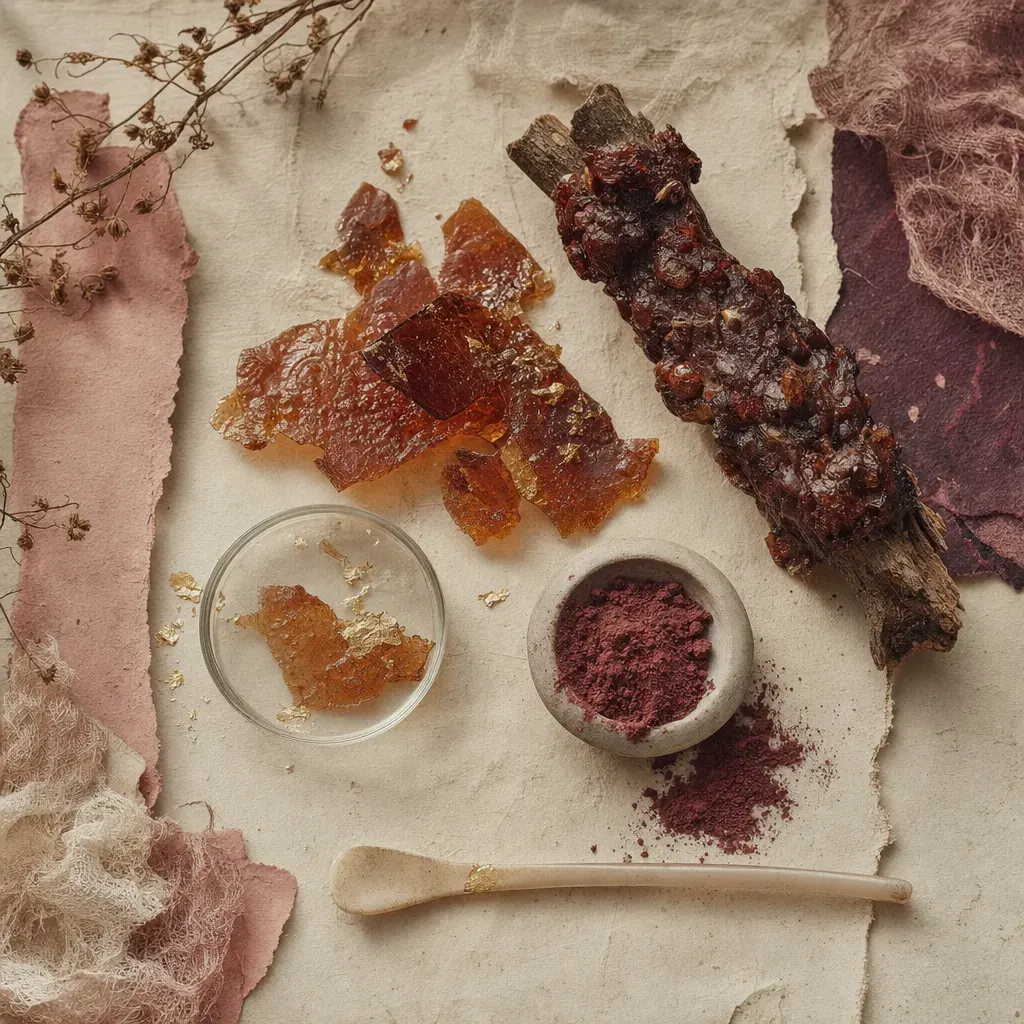
Shellac is not a wax, though it sits with the waxes in a formulator's cupboard and does some of the same work. It is a resin, secreted by the lac insect Kerria lacca as an encrustation over itself and the twig it feeds on. The encrusted twigs are scraped, the crude lac washed and sieved, and the resin melted and drawn into sheets.
Its function in cosmetics is to dry to a hard, continuous, glossy film. That is what a mascara needs in order to hold a lash in a curl, and what a nail lacquer needs in order to survive being knocked.[1]
What It Is
Shellac is a polyester: a mixture of hydroxy fatty acids and sesquiterpenoid acids esterified into a resin of moderate molecular weight. It carries a natural wax fraction, removed for grades where clarity matters, and a red colouring fraction of anthraquinones known as the laccaic acids.
That colouring fraction is a material in its own right. Lac dye and shellac are two products of a single secretion, separated during processing: the anthraquinones wash out in water and the resin does not.[2]
In History
The secure early evidence for lac is analytical rather than textual. Laccaic acids have been identified in textiles from Xinjiang dated between the second and ninth centuries CE, which places the material on the trade routes out of South Asia well before any European account of it.[3] References in Sanskrit literature are older but harder to date, and the round figures of three or five thousand years of continuous use that circulate in trade literature are not something the physical record independently fixes.
In Europe lac arrived first as a dyestuff and a varnish resin, and identifying it in historic textiles and lake pigments is now routine conservation analysis.[4] Its industrial career came later — gramophone discs were pressed from a shellac compound before vinyl displaced it — and its cosmetic use is a late and minor branch of the same supply chain.
What It Does
Shellac is used as a film former and binder. Dissolved in alcohol or dispersed as an ammoniated solution, it is laid down as a coating that hardens as the solvent leaves. In mascara it stiffens the deposit on the lash; in nail products it contributes gloss and adhesion; in lip products it adds hold and transfer resistance.[5]
Its solubility is the useful lever. Shellac dissolves in alcohol and in alkali but not in water, so a film can be made to resist water while remaining removable with the right solvent.
Safety and Status
The Cosmetic Ingredient Review panel published a safety assessment of shellac in 1986, reporting no measurable irritation and no sensitisation or photosensitisation in clinical testing of formulations containing up to six per cent, the highest concentration tested.[6] That is a statement about the formulations examined at the time, not a general guarantee.
In food it is E 904 under Regulation (EC) No 1333/2008 of 16 December 2008,[7] and Commission Regulation (EU) No 1147/2012 of 4 December 2012 set out its use as a glazing agent on certain fruits.[8] One point is worth stating plainly for label readers: shellac is an animal product. The resin is harvested from encrusted twigs, insects are collected along with it, and no stage of refining alters that origin.
Sources
- [1, 5, 6]Final Report on the Safety Assessment of Shellac Journal of the American College of Toxicology, volume 5, issue 5, pages 309-327, 1986.View source (opens in a new tab)
- [2, 3]Chemical evidence for the spread of lac colorant in Xinjiang from the 2nd to 9th centuries CE npj Heritage Science, 2025.View source (opens in a new tab)
- [4]Lac dye colours: A review of the origin, history and identification techniques in textiles Journal of Cultural Heritage, 2025.View source (opens in a new tab)
- [7]Regulation (EC) No 1333/2008 of the European Parliament and of the Council of 16 December 2008 on food additives Official Journal of the European Union, 2008.View source (opens in a new tab) Accessed 2026-09-22.
- [8]Commission Regulation (EU) No 1147/2012 of 4 December 2012 amending Annex II to Regulation (EC) No 1333/2008 as regards the use of beeswax (E 901), carnauba wax (E 903), shellac (E 904) and microcrystalline wax (E 905) on certain fruits Official Journal of the European Union, 2012.View source (opens in a new tab) Accessed 2026-09-22.