Ozokerite
Identity
In current useas of 22 Sep 2026
- INCI name
- OZOKERITE
- CAS
- 8021-55-4
- Origin
- Mineral
- First attested
- 1854 CE
- Also known as
- ozocerite · mineral wax · earth wax · fossil wax
How it is dated
The earliest secure evidence is industrial rather than cosmetic: the mineral had been named and described by the mid-nineteenth century, and it was being mined around Boryslav in Austrian Galicia, now western Ukraine, from the 1850s.
No regulatory dataset is loaded. The status above is this archive's editorial summary of the documented record, not a statement of any substance's legal position in your jurisdiction, and nothing here is advice on whether to use it.
In short
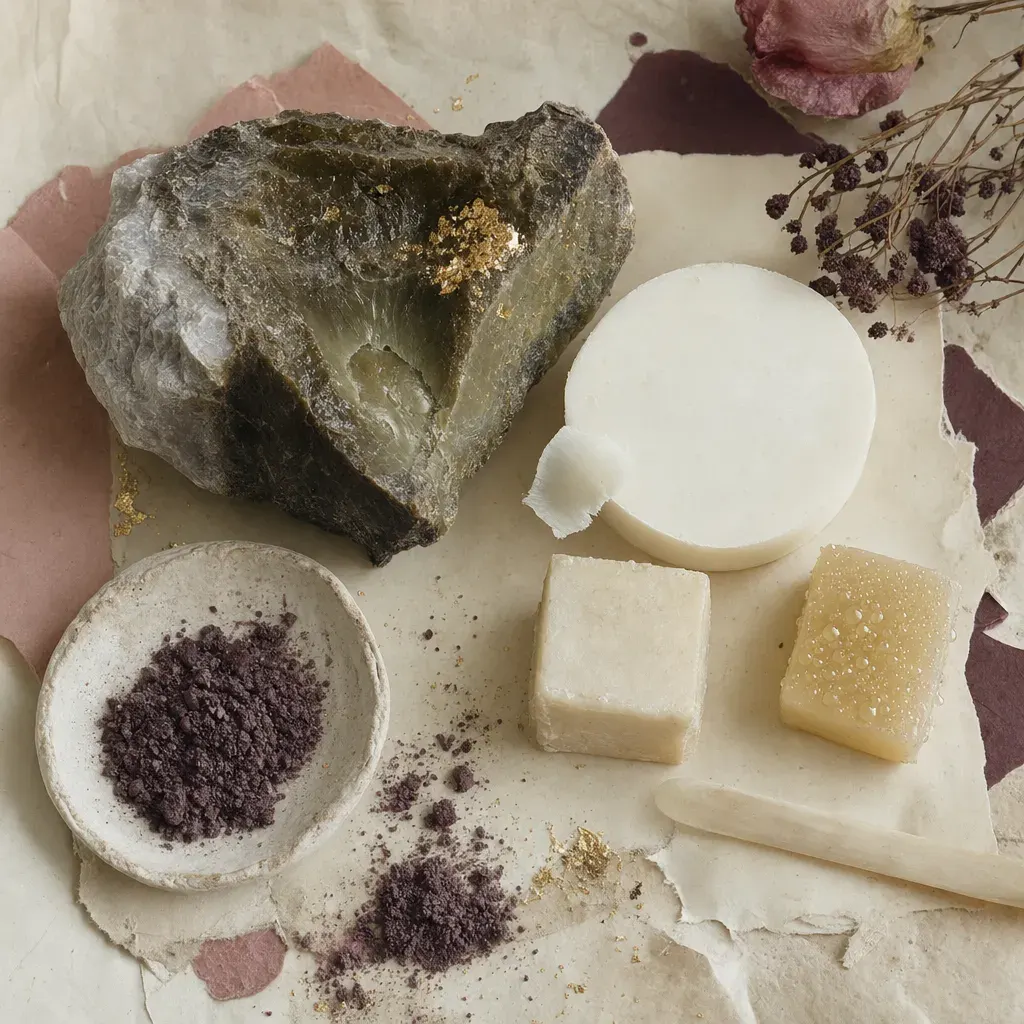
Ozokerite is a mineral wax, mined out of rock rather than distilled from crude oil, whose fine tangled crystals trap liquid oils and stop a lipstick sweating them out onto its own surface.
- 2min read
- 4chapters
- 4sources

Vivien
Your guide through time
Listen to this entry
4 min listenVivien reads our essays aloud, word for word — every date and every name in its place — so you can listen the way you would be walked through a gallery.
An AI voice, designed for History of Makeup
Ozokerite is a mineral wax. It occurs in veins in sedimentary rock, formed where petroleum has migrated and lost its lighter fractions, and it was originally cut out as a solid rather than refined out of crude. Purified, it is sold as ceresin.
In a cosmetic it does a job no plant wax does as well. Ozokerite crystallises as fine tangled needles that trap liquid oil within the solid, which is why it appears in sticks that would otherwise sweat their emollient phase to the surface.[1]
What It Is
Chemically it is a mixture of saturated hydrocarbons, both straight-chain and branched, with chain lengths spread across a wide range. That spread is the point. A wax of mixed chain lengths cannot pack into large regular crystals, so it sets as a microcrystalline mass rather than a coarse one, and a microcrystalline mass holds oil.
The trade names are loose. Ozokerite properly means the mined mineral wax; ceresin means ozokerite that has been purified, historically by treatment with sulphuric acid and charcoal. A good deal of what is now sold under both names is blended with, or replaced by, petroleum-derived microcrystalline wax, so the ingredient name alone does not establish a mined origin.[2]
In History
Ozokerite was an industrial mineral of Austrian Galicia, worked around Boryslav in what is now western Ukraine alongside the oil seepages of the same district. By the early twentieth century the mines were mechanised, with electric haulage, pumping and ventilation, and the wax was a substantial regional export.[3]
Its cosmetic career came later and indirectly. When moulded lipstick became a mass product, formulators needed something to stop the castor oil phase migrating out of the stick, and the mineral waxes already being produced for candles, polishes and electrical insulation were to hand.[4]
What It Does
Ozokerite is used as a structurant and an oil binder. It raises viscosity, contributes to the hardness of a stick, and holds liquid emollients inside the solid so they do not bleed out. In anhydrous products it also leaves an occlusive film.
Its value in a blend is a matter of crystal habit more than melting point. Pairing a microcrystalline wax with a coarser-crystallising one such as beeswax or carnauba produces a solid that is both strong and stable, which neither achieves on its own.[5]
Safety and Status
The Cosmetic Ingredient Review panel assessed ozokerite together with ceresin, montan wax, paraffin, microcrystalline wax and several synthetic waxes, publishing its conclusion in 1984 that they were safe in the practices of concentration and use then current.[6]
Regulatory attention to fossil-derived cosmetic materials is directed at refining history rather than at the waxes as a class. Under Regulation (EC) No 1223/2009 of 30 November 2009, a number of named oil-derived substances are prohibited unless the full refining history is known and it can be shown that the material they are produced from is not a carcinogen.[7] Whether that proviso bears on a particular ozokerite grade depends on what that grade actually is, and the ingredient name does not settle it.
Sources
- [1, 4, 5]Lipstick Formulation Cosmetics and Skin.View source (opens in a new tab) Accessed 2026-09-22.
- [2, 6]Final Report on the Safety Assessment of Fossil and Synthetic Waxes Journal of the American College of Toxicology, volume 3, issue 3, pages 43-99, 1984.View source (opens in a new tab)
- [3]Ozokerite Encyclopaedia Britannica, 11th edition, via Wikisource, 1911.View source (opens in a new tab) Accessed 2026-09-22.
- [7]Regulation (EC) No 1223/2009 of the European Parliament and of the Council of 30 November 2009 on cosmetic products Official Journal of the European Union, 2009.View source (opens in a new tab) Accessed 2026-09-22.