Castor Oil
Identity
In current useas of 22 Sep 2026
- INCI name
- RICINUS COMMUNIS SEED OIL
- CAS
- 8001-79-4
- EC
- 232-293-8
- Origin
- Plant
- First attested
- 1,500 BCE
- Also known as
- ricinus oil · oleum ricini
How it is dated
The Ebers Papyrus, an Egyptian medical compilation which Polito et al. date to before 1500 BCE, prescribes castor for internal and external use, and the roughly contemporary Hearst Papyrus does the same. The year is the bound the cited source gives, not the conventional c. 1550 BCE dating of the papyrus, for which this entry carries no source.
No regulatory dataset is loaded. The status above is this archive's editorial summary of the documented record, not a statement of any substance's legal position in your jurisdiction, and nothing here is advice on whether to use it.
In short
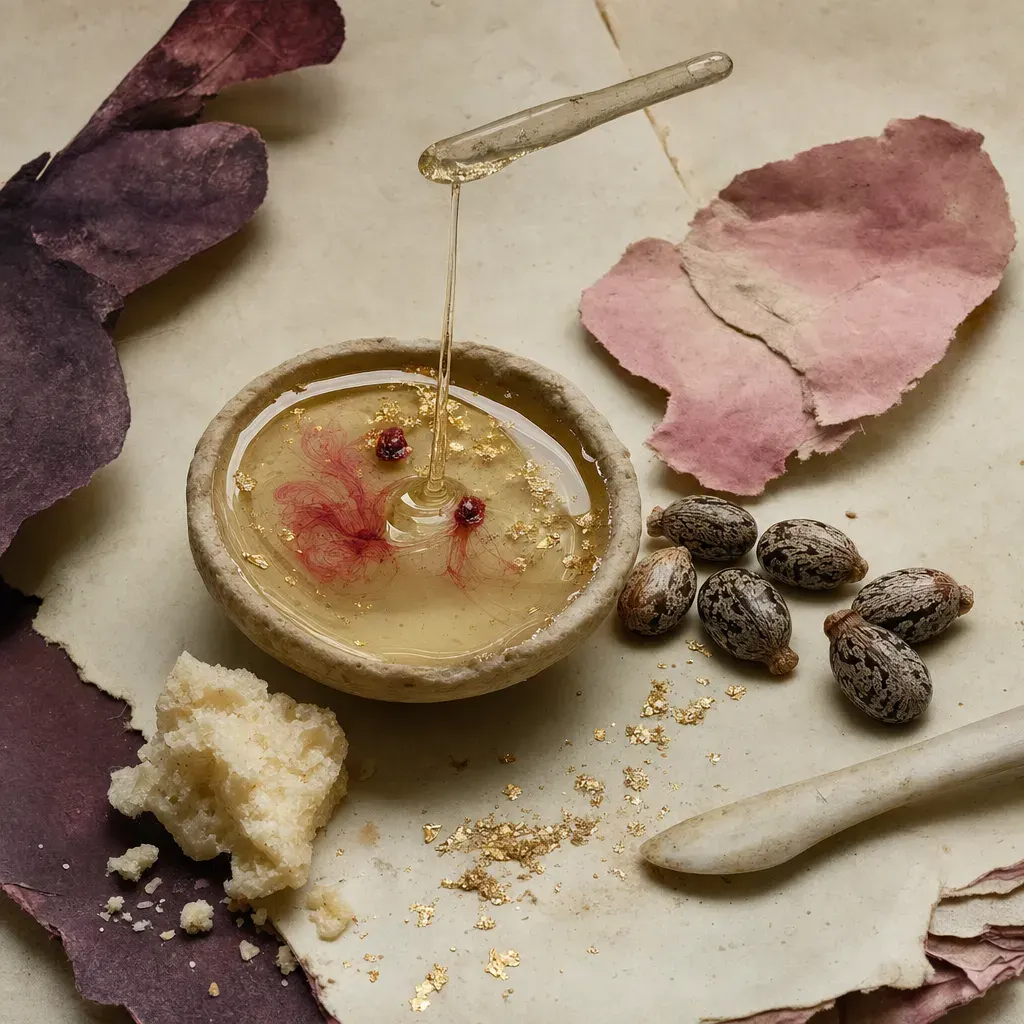
Pressed from the seed of Ricinus communis, castor oil is the one common vegetable oil that will dissolve the staining dyes used in lipstick, which is how it became the liquid backbone of the bullet.
- 3min read
- 4chapters
- 6sources

Vivien
Your guide through time
Listen to this entry
4 min listenVivien reads our essays aloud, word for word — every date and every name in its place — so you can listen the way you would be walked through a gallery.
An AI voice, designed for History of Makeup
Castor oil is pressed from the seed of Ricinus communis, a fast-growing shrub cultivated across the tropics and grown as an ornamental well beyond them. It is thick, clear and faintly yellow, and unlike linseed oil it does not dry to a film.
In makeup it is not chosen for how it feels. It is chosen for what it will dissolve. The staining lipsticks of the last century were built on castor oil because it took the dyes into solution better than the stearic acid, acidic coconut oil and glycols formulators had been using.[1]
What It Is
The oil is a triglyceride, but an unusual one. Most of its fatty acid content is ricinoleic acid — 12-hydroxy-9-octadecenoic acid — which carries a hydroxyl group partway along the chain, a feature no other common vegetable oil shares.[2] That high ricinoleic content is what lets castor oil dissolve the bromo acids, and it is described in the lipstick literature as a property no other natural oil has.[3]
The single hydroxyl accounts for the oil's whole character: the viscosity, the solubility in alcohol, and above all the polarity that lets it dissolve dyes and wet pigment particles a hydrocarbon oil would leave in clumps.[4]
The seed also contains ricin, among the more toxic proteins known. It does not follow the oil. Ricin and the alkaloid ricinine stay in the pressed cake and are not carried into the oil fraction by either cold or warm pressing.[5]
In History
Castor is among the oldest documented oil crops. It appears in the Ebers Papyrus, an Egyptian medical compilation written before 1500 BCE, recommended as a purgative and against abscesses and baldness; the roughly contemporary Hearst Papyrus prescribes castor components both internally and on the skin. Egyptian practice recognised the seed's danger and limited what was taken by mouth.[6]
Its cosmetic career is far more recent and far more specific. The indelible lipsticks that spread after the First World War worked by staining the lip with halogenated fluorescein dyes, of which an acid form of eosin was the first, and those dyes had to be got into solution. By the 1930s castor oil was the usual choice of solvent, though not the only one in production: Paul Baudecroux's Rouge Baiser, launched in 1927, dissolved its eosin in propylene glycol instead. Castor oil's high viscosity, even when warm, helped to keep the insoluble pigments in suspension, and its oily nature gave the stick its gloss and emolliency.[7]
What It Does
In a lipstick bullet castor oil is the continuous liquid phase. Waxes give the stick its shape and its melting point; the castor oil carries everything else — the dissolved stain, the suspended pigment, the pearl — and governs how the whole thing pays off on the lip.[8]
Elsewhere it does quieter work: an emollient in balms, a solvent in nail products, and the feedstock for a long list of derivatives. Hydrogenating it gives a hard wax used as a structurant. Treating it with sulphuric acid gives the water-dispersible material known in the trade as turkey red oil.
Safety and Status
Castor oil is in current cosmetic use. It is tracked under CAS 8001-79-4 and EC 232-293-8.[9] It is not named in Annex II or Annex III of Regulation (EC) No 1223/2009, the European Union's lists of prohibited and restricted cosmetic substances, as of September 2026.[10]
The recurring confusion is the ricin question, which is a question about the seed and the press cake rather than about the pressed oil.[11]
Sources
- [1, 3, 7]Indelible Lipsticks Cosmetics and Skin.View source (opens in a new tab) Accessed 2026-09-22.
- [2]Final Report on the Safety Assessment of Ricinus Communis (Castor) Seed Oil, Hydrogenated Castor Oil, Glyceryl Ricinoleate, Ricinoleic Acid and Related Ingredients International Journal of Toxicology, vol. 26, suppl. 3, pp. 31–77, 2007.View source (opens in a new tab)
- [4, 8]Lipsticks History, Formulations, and Production: A Narrative Review Cosmetics, vol. 9, no. 1, article 25, 2022.View source (opens in a new tab)
- [5, 6, 11]Ricin: An Ancient Story for a Timeless Plant Toxin Toxins, vol. 11, no. 6, article 324, 2019.View source (opens in a new tab)
- [9]Castor oil — Substance InfocardView source (opens in a new tab) Accessed 2026-09-22.
- [10]Regulation (EC) No 1223/2009 on cosmetic products 2009.View source (opens in a new tab) Accessed 2026-09-22.