Henna
Identity
Restrictedas of 22 Sep 2026
- INCI name
- LAWSONIA INERMIS LEAF EXTRACT
- CAS
- 84988-66-9
- EC
- 284-854-1
- Colour Index
- CI 75480
- Origin
- Plant
- First attested
- 1,000 BCE
- Also known as
- Lawsonia inermis · Lawsonia alba · mehndi · Egyptian privet · Natural Orange 6
What it does
How it is dated
Mummified remains from Thebes, at Deir el-Bahri, dated to around 1000 BCE, have hair dyed with henna. Identifications of this kind rest on colour and archaeological context rather than on chemical analysis, so the year is an approximate anchor rather than the date of an assay.
No regulatory dataset is loaded. The status above is this archive's editorial summary of the documented record, not a statement of any substance's legal position in your jurisdiction, and nothing here is advice on whether to use it.
In short
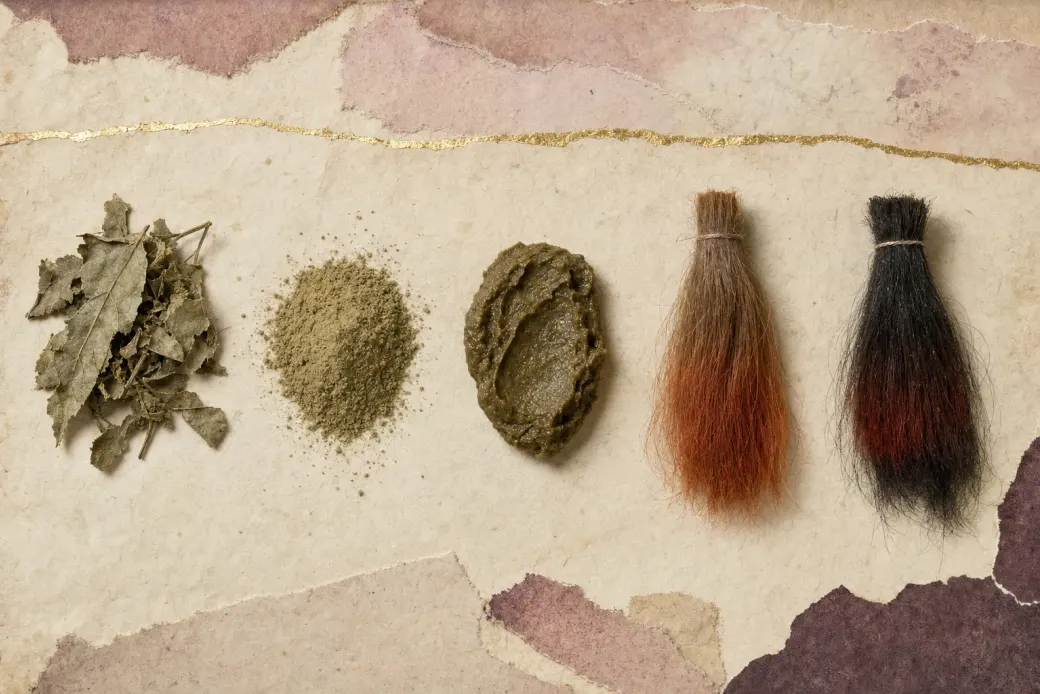
A red-orange stain for hair, skin and nails made from the milled leaf of Lawsonia inermis, whose colourant lawsone binds to keratin instead of coating it.
- 3min read
- 4chapters
- 6sources

Vivien
Your guide through time
Listen to this entry
5 min listenVivien reads our essays aloud, word for word — every date and every name in its place — so you can listen the way you would be walked through a gallery.
An AI voice, designed for History of Makeup
Henna is the dried, milled leaf of Lawsonia inermis, a thorny shrub of arid and semi-arid regions from North Africa through the Levant to South Asia. Mixed with an acidic liquid and left to stand, the paste releases a dye that stains keratin orange to deep red-brown.[1]
It is among the oldest cosmetics still in continuous use, and its colour is a stain rather than a coating. Henna does not sit on the hair or the skin; it binds to the protein, and it leaves when the protein does.[2]
What It Is
The colourant is lawsone, 2-hydroxy-1,4-naphthoquinone, present in the leaf at up to about two per cent and stored there in bound form.[3] Crushing and acidification release it; the freed lawsone then reacts with keratin, which is why the stain develops over hours and continues to darken for a day or two after the paste is removed.[4]
The leaf also carries tannins, gallic acid, flavonoids, sugars and an essential oil, so a henna paste is never a single-compound system, and two batches of leaf are not interchangeable.[3]
In History
Henna's Egyptian record is above all a record of hair. Mummified remains have been unearthed with hair dyed red with henna, probably at the time of embalmment; one such woman, from Thebes at Deir el-Bahri, is dated to around 1000 BCE.[5] Identifications of this kind rest on colour and archaeological context rather than on chemical analysis, and the confident claims that push henna back to the predynastic period should be read with that in mind.
What is not in doubt is the continuity. Henna has been applied to hands, nails, palms and soles for weddings, festivals, births and mourning across North Africa, the Arabian Peninsula, the Levant, Iran and South Asia for centuries, and that practice was never interrupted by the arrival of synthetic dyes.[6]
What It Does
In hair, henna works as a direct dye: it needs no oxidant and no developer.[8] Because lawsone builds with repeated application, henna-coloured hair darkens gradually rather than changing in one sitting.[7]
It cannot lighten. On hair it lays red-orange over whatever colour is already there rather than replacing it, so the result depends on the starting shade. The tannin content gives the paste a mild astringency, which underlies its traditional use on scalp and skin as well as for colour.[8]
One caution about the identifier block above. The INCI-registered ingredient, LAWSONIA INERMIS LEAF EXTRACT, is a solvent extract of the leaf, while the material this entry otherwise describes — the paste, the traditional practice, and the colour additive listed in the United States — is the milled leaf itself. The two are one processing step apart, as they are for madder.
Safety and Status
In the United States henna is a listed colour additive exempt from certification, defined in 21 CFR 73.2190 as the dried leaf and petiole of Lawsonia alba Lam. The permitted use is narrow: hair only, not eyelashes or eyebrows and not generally in the area of the eye, with label warnings to that effect.[9]
The European Union works the other way round. A cosmetic product is not authorised ingredient by ingredient; Regulation (EC) No 1223/2009 requires that every product placed on the market carry a safety assessment made by a qualified assessor, and that obligation is what governs a henna hair colour.[12] The Scientific Committee on Consumer Safety, which advises the Commission rather than licensing anything, adopted an opinion on henna on 19 September 2013. It found the preparation it tested — 100 g of henna powder in 300 ml of boiling water, made up from two specified batches of leaf — safe for the consumer as a hair dye, while recording that the assessment did not extend to other extracts or to body-paint use, and that the genotoxicity of lawsone would benefit from reassessment.[10]
Preparations sold as black henna are a different material. The Food and Drug Administration states that temporary tattoos marketed under that name contain p-phenylenediamine and may increase the risk of allergy to hair dyes, and that coal-tar hair dyes are not intended for staining skin.[11]
Sources
- [1, 5]The henna plant: transcending time, religion and culture Natural History Museum, London, 2026.View source (opens in a new tab) Accessed 2026-09-22.
- [2, 4, 6, 8]Natural Dyes: Sources, Tradition, Technology and Science Archetype Publications, 2007.
- [3, 10]Opinion on Lawsonia inermis (Henna), COLIPA no. C169, SCCS/1511/13 European Commission, Directorate-General for Health and Food Safety, 2013.View source (opens in a new tab) Accessed 2026-09-22.
- [7, 11]Hair Dyes United States Food and Drug Administration, Office of Cosmetics and Colors, 2026.View source (opens in a new tab) Accessed 2026-09-22.
- [9]21 CFR 73.2190: Henna Electronic Code of Federal Regulations, Title 21, Part 73, Subpart C, 2026.View source (opens in a new tab) Accessed 2026-09-22.
- [12]Regulation (EC) No 1223/2009 on cosmetic products 2009.View source (opens in a new tab) Accessed 2026-09-22.