Ultramarine
Identity
Restrictedas of 22 Sep 2026
- INCI name
- ULTRAMARINES
- CAS
- 57455-37-5
- Colour Index
- CI 77007
- Origin
- Synthetic
- First attested
- 1828 CE
- Also known as
- ultramarine blue · lazurite · Pigment Blue 29 · French ultramarine
How it is dated
This field records the first industrial synthesis of the pigment, not a dated cosmetic use: the Societe d'Encouragement pour l'Industrie Nationale awarded its prize to Jean-Baptiste Guimet in February 1828, and 1828 is the earliest date at which the material a modern eyeshadow contains could have existed. No dated attestation of ultramarine in a cosmetic is established here, for the synthetic or for the natural pigment ground from lapis lazuli, which is far older as a painter's material.
No regulatory dataset is loaded. The status above is this archive's editorial summary of the documented record, not a statement of any substance's legal position in your jurisdiction, and nothing here is advice on whether to use it.
In short
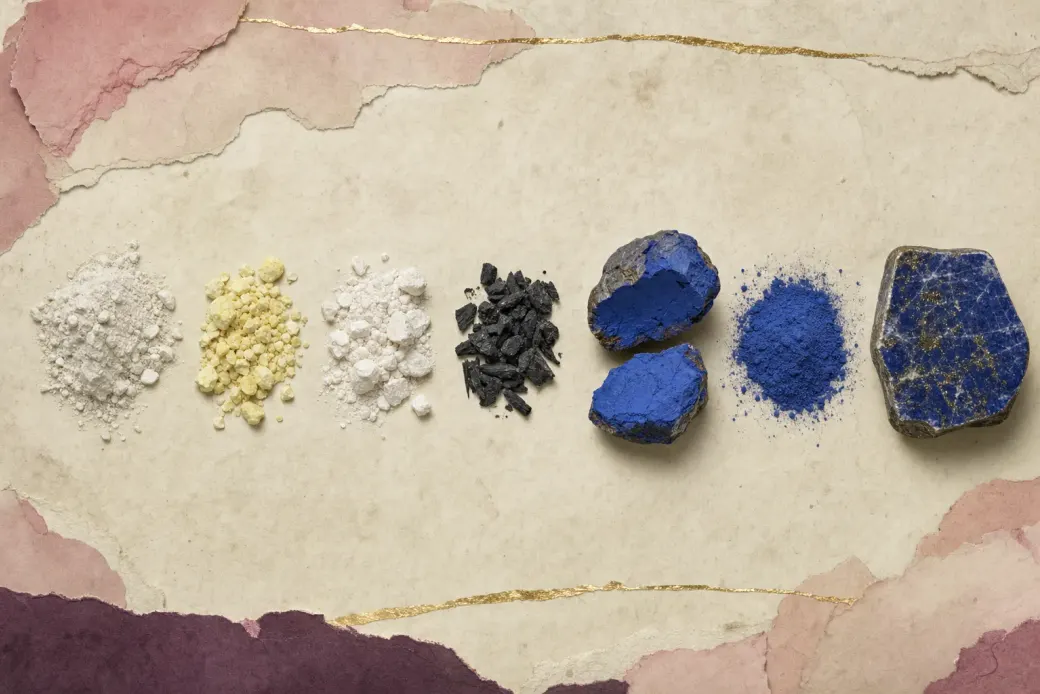
The blue of lapis lazuli, reproduced industrially from china clay, soda, sulphur and charcoal since 1828, and permitted in the United States only in externally applied cosmetics: nothing for the lips or any mucous membrane.
- 3min read
- 4chapters
- 6sources

Vivien
Your guide through time
Listen to this entry
6 min listenVivien reads our essays aloud, word for word — every date and every name in its place — so you can listen the way you would be walked through a gallery.
An AI voice, designed for History of Makeup
Ultramarine is the blue of lapis lazuli. For most of its history it was made by crushing that stone, which came from a small number of workings in Badakhshan, in what is now Afghanistan, and it was the costliest pigment in the European painter's cupboard. Since 1828 it has been manufactured from cheap industrial minerals, and the synthetic material is chemically the same thing.[1]
The colour additive listed for cosmetics in the United States is the calcined synthetic, defined by its process rather than by a mineral source.[2] Natural ultramarine ground from lapis is not that listed material, and is not what a modern eyeshadow contains.
What It Is
Ultramarine is a sodium aluminium sulfosilicate: a cage-like aluminosilicate framework with sulphur trapped inside it. The colour does not come from a metal ion, as it does in most inorganic pigments, but from the unpaired electron of a sulphur radical anion held in those cages.[3] That is unusual, and it explains the pigment's one real vulnerability. It is unstable even in dilute acid, and decomposes to yield hydrogen sulphide, which destroys the colour.[3]
The American colour additive listing defines the manufactured pigment by its process: pigments obtained by calcining at temperatures above 700 degrees Celsius a mixture of kaolin, sulphur, sodium carbonate, silicious matter, sodium sulfate and carbonaceous matter, but not necessarily all of these substances, to produce a single colour.[4]
In History
Lapis lazuli reached Europe by long trade routes and was priced accordingly, which is why replacing it was worth a public prize. In 1824 the Societe d'Encouragement pour l'Industrie Nationale offered 6,000 francs for a process that would make the pigment artificially and sell it below 300 francs a kilogramme.[5]
Jean-Baptiste Guimet was awarded the prize in February 1828. The following month Christian Gmelin, at Tuebingen, contested it, claiming he had reached the result a year earlier and had chosen not to publish. Guimet replied that he had held his own formula back for two years. Mertens describes a third independent route as well, found by Koettig at the Meissen porcelain works, so the contest was not simply between two men; both of the priority claims are self-reported, and the secrecy that made the industry profitable is what leaves the question unresolved.[5]
One claim should be set aside, and set aside carefully. That the ancient Egyptians wore powdered lapis as eyeshadow is repeated constantly and is not established. The 2022 study of kohl containers in the Petrie Museum found lead-based, manganese-based, silicon-based and carbon-based recipes, with copper minerals in two of the samples, and no lapis or lazurite among the minerals it reports.[6] That study does not set out to test the claim, and absence in eleven vessels from a single collection is not evidence that the practice did not exist. The honest position is that the claim is unevidenced, not that it has been disproved.
What It Does
Ultramarine is the practical route to a clean blue or violet in a powder product. Very few inorganic pigments give that hue at all, and the alternatives are organic lakes, which behave differently and carry restrictions of their own. The colour additive listing treats blue, green, pink, red and violet ultramarines as one family, describing them as complex sodium aluminum sulfosilicates whose proportions of each element vary with each colour.[7]
It is opaque, stable to heat and light, and untroubled by alkali. Its incompatibility with acid is the constraint that matters in formulation, and it is why ultramarine is uncommon in products held at low pH.
Safety and Status
The American listing, at 21 CFR 73.2725, permits ultramarines in externally applied cosmetics, including cosmetics intended for use in the area of the eye.[8] That phrase is defined narrowly. Under 21 CFR 70.3, externally applied cosmetics are those applied only to external parts of the body and not to the lips or to any body surface covered by mucous membrane.[9] A blue lipstick sold in the United States is therefore not coloured with ultramarine, though a blue eyeshadow may be.
The same listing sets purity limits of lead not more than 20 parts per million, arsenic not more than 3, and mercury not more than 1.[8] In the European Union, ultramarines are a permitted colourant under Annex IV of Regulation (EC) No 1223/2009.[10] The two regimes do not condition colourants in the same way, and a product lawful in one may not be lawful in the other.
Sources
- [1, 5]The History of Artificial Ultramarine (1787-1844): Science, Industry and Secrecy Ambix, volume 51, 2004.View source (opens in a new tab)
- [2, 4, 7, 8]21 CFR 73.2725 - Ultramarines Code of Federal Regulations, title 21, part 73, subpart C, 2026.View source (opens in a new tab) Accessed 2026-09-22.
- [3]Ultramarine Natural ColourLex.View source (opens in a new tab) Accessed 2026-09-22.
- [6]Recipes of Ancient Egyptian kohls more diverse than previously thought Scientific Reports, volume 12, 2022.View source (opens in a new tab)
- [9]21 CFR 70.3 - Definitions Code of Federal Regulations, title 21, part 70, subpart A, 2026.View source (opens in a new tab) Accessed 2026-09-22.
- [10]Regulation (EC) No 1223/2009 on cosmetic products 2009.View source (opens in a new tab) Accessed 2026-09-22.