Titanium Dioxide
Identity
Restrictedas of 22 Sep 2026
- INCI name
- TITANIUM DIOXIDE
- CAS
- 13463-67-7
- EC
- 236-675-5
- Colour Index
- CI 77891
- Origin
- Synthetic
- First attested
- 1916 CE
- Also known as
- titanium white · titania · TiO2 · rutile · anatase · CI 77891
How it is dated
Commercial production of titanium dioxide pigment for world markets began in 1916 at the Titania mine in Sokndal and the Titan Co. works at Fredrikstad, both in Norway.
No regulatory dataset is loaded. The status above is this archive's editorial summary of the documented record, not a statement of any substance's legal position in your jurisdiction, and nothing here is advice on whether to use it.
In short
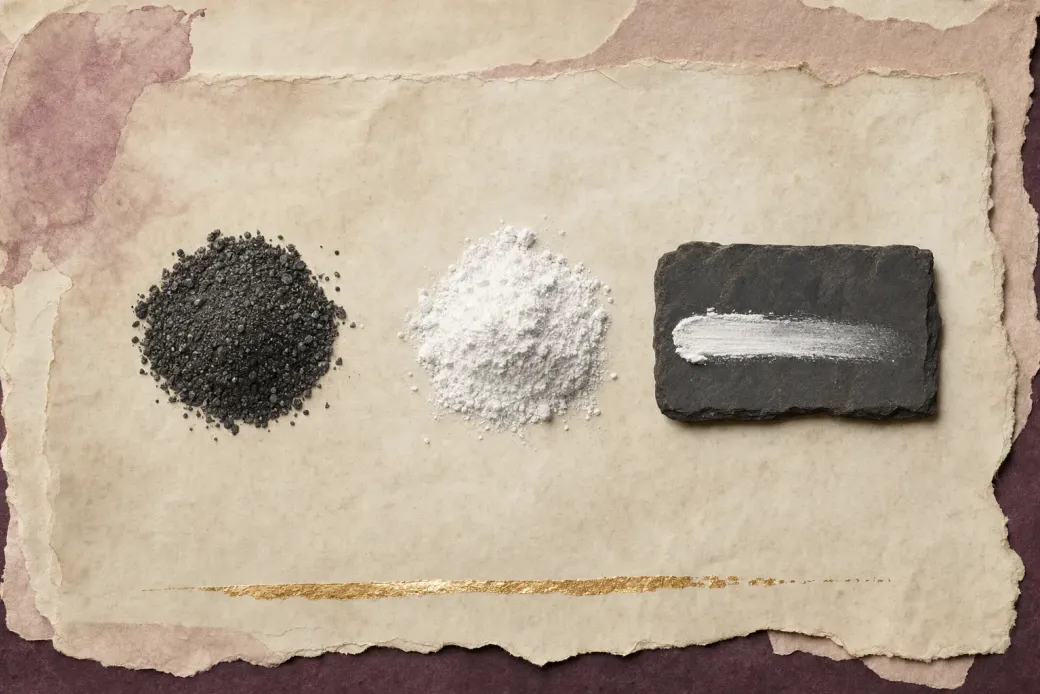
The manufactured white that replaced lead: a titanium oxide with a refractive index high enough to make it the most opaque white a cosmetic chemist can use, and a permitted mineral ultraviolet filter.
- 3min read
- 4chapters
- 7sources

Vivien
Your guide through time
Listen to this entry
6 min listenVivien reads our essays aloud, word for word — every date and every name in its place — so you can listen the way you would be walked through a gallery.
An AI voice, designed for History of Makeup
Titanium dioxide is the whitest white in ordinary use, and the reason is optical rather than chemical. Its particles have a refractive index higher than almost any other solid a cosmetic chemist can reach for, so light entering a film of it is scattered back out before it reaches the skin underneath.
That property made it the successor to white lead in paint, where it displaced the older pigment over the first half of the twentieth century.[1] The same substitution followed in cosmetics, and for the same reason: it covered as well without the metal.[2] A modern complexion product is opaque because of titanium dioxide more often than because of anything else in the jar.
What It Is
The compound is titanium(IV) oxide, TiO₂, obtained from titanium-bearing ores such as ilmenite and rutile and then purified. Pigment-grade material is manufactured, not simply mined and ground. It exists in several crystal forms; rutile and anatase are the two that matter commercially, and rutile is the more opaque and the more stable of them.
As a cosmetic ingredient it is TITANIUM DIOXIDE, CAS 13463-67-7, EC 236-675-5, and as a colourant it is CI 77891.[3] Those identifiers cover both the pigment grade, whose particles are sized to scatter visible light, and the much smaller nano grade used in sunscreens, which scatters ultraviolet while leaving visible light largely alone.
In History
On Ingrid Halland's account, titanium dioxide's career as a commercial pigment begins in Norway: the chemists Peder Farup and Gustav Jebsen developed both the compound as a white and the sulphate process for making it during the 1910s, and production began in 1916 at the Titania mine in Sokndal and the Fredrikstad works later known as Kronos Titan.[4] The priority is not uncontested — the Titanium Pigment Corporation at Niagara Falls was producing from the same year — and "first mass-produced in 1916" is the safer formulation than any national claim.
It reached cosmetics the way it reached everything else: by being whiter, cheaper and less hazardous than what it displaced. Zinc white had already taken much of white lead's ground during the nineteenth century, and titanium took the rest.[5]
What It Does
In a powder or a foundation, titanium dioxide supplies opacity and lightens the shade. It is rarely the whole colour: iron oxides supply the warmth, and the titanium supplies the coverage they are suspended in. Too much of it produces the pale flat cast that photographs badly under a flash, because the pigment reflects the burst straight back at the lens.
It is also a physical ultraviolet filter, and a mattifying agent almost by default, since a heavily loaded film scatters light in every direction rather than returning it in one. Coated grades — silica, alumina, dimethicone — exist to stop the raw oxide acting as a photocatalyst on the other ingredients around it.
Safety and Status
In the European Union, titanium dioxide is listed in Annex IV to Regulation (EC) No 1223/2009 as the permitted colourant CI 77891, and the nano form is listed in Annex VI as a permitted ultraviolet filter at up to 25 per cent, excluding applications that could expose the user's lungs by inhalation.[6] It is also restricted: Commission Regulation (EU) 2021/850 of 26 May 2021, applicable from 1 October 2021, added titanium dioxide in powder form containing 1 per cent or more of particles with an aerodynamic diameter of 10 µm or less at entry 321 of Annex III, permitting it in loose face powders at up to 25 per cent and in hair aerosol sprays at 1.4 per cent for general consumers and 1.1 per cent for professional use, and not in other products.[7] In the United States it is listed at 21 CFR 73.2575 for use in cosmetics, including in the area of the eye, at levels consistent with good manufacturing practice.[8]
The United States position sits inside a framework that changed after that listing. Section 505G of the Federal Food, Drug, and Cosmetic Act, added by the CARES Act in March 2020, made the over-the-counter sunscreen monograph a deemed final order. Titanium dioxide and zinc oxide are the two active ingredients the Food and Drug Administration has proposed to classify as generally recognised as safe and effective — in the proposed rule of 26 February 2019, and again in the proposed order issued under the new process in September 2021.[9] Both remain proposals rather than final determinations. Readers most often meet titanium dioxide in arguments about food additives. Food law and cosmetics law are separate regimes, and a determination made under one does not settle the position under the other.
Sources
- [1, 5]Lead whiteView source (opens in a new tab) Accessed 2026-09-22.
- [2]Beauty Imagined: A History of the Global Beauty Industry Oxford University Press, 2010.
- [3, 6]Regulation (EC) No 1223/2009 on cosmetic products 2009.View source (opens in a new tab) Accessed 2026-09-22.
- [4]TiO2: How Norway Made the World Whiter University of Bergen (research project record), 2023.View source (opens in a new tab) Accessed 2026-09-22.
- [7]Commission Regulation (EU) 2021/850 amending Annexes II, III, IV and VI to Regulation (EC) No 1223/2009 2021.View source (opens in a new tab) Accessed 2026-09-22.
- [8]Color Additives Permitted for Use in Cosmetics, 21 CFR Parts 73 and 74View source (opens in a new tab) Accessed 2026-09-22.
- [9]Over-the-Counter Monograph M020: Sunscreen Drug Products for Over-the-Counter Human Use; Proposed Order (86 FR 53024) 2021.View source (opens in a new tab) Accessed 2026-09-22.