Carmine (Cochineal)
Identity
In current useas of 22 Sep 2026
- INCI name
- CARMINE
- CAS
- 1390-65-4
- EC
- 215-724-4
- Colour Index
- CI 75470
- Origin
- Animal
- First attested
- 300 BCE
- Also known as
- cochineal · crimson lake · carmine lake · Natural Red 4 · E120 · Dactylopius coccus
How it is dated
Chromatographic work on pre-Columbian textiles reports that American cochineal was not used by the earliest Andean cultures before the third century BCE, and that it becomes frequent only in the Wari and Tiwanaku period of about 700 to 1100 CE. The year given is that terminus rather than the date of an analysed find.
No regulatory dataset is loaded. The status above is this archive's editorial summary of the documented record, not a statement of any substance's legal position in your jurisdiction, and nothing here is advice on whether to use it.
In short
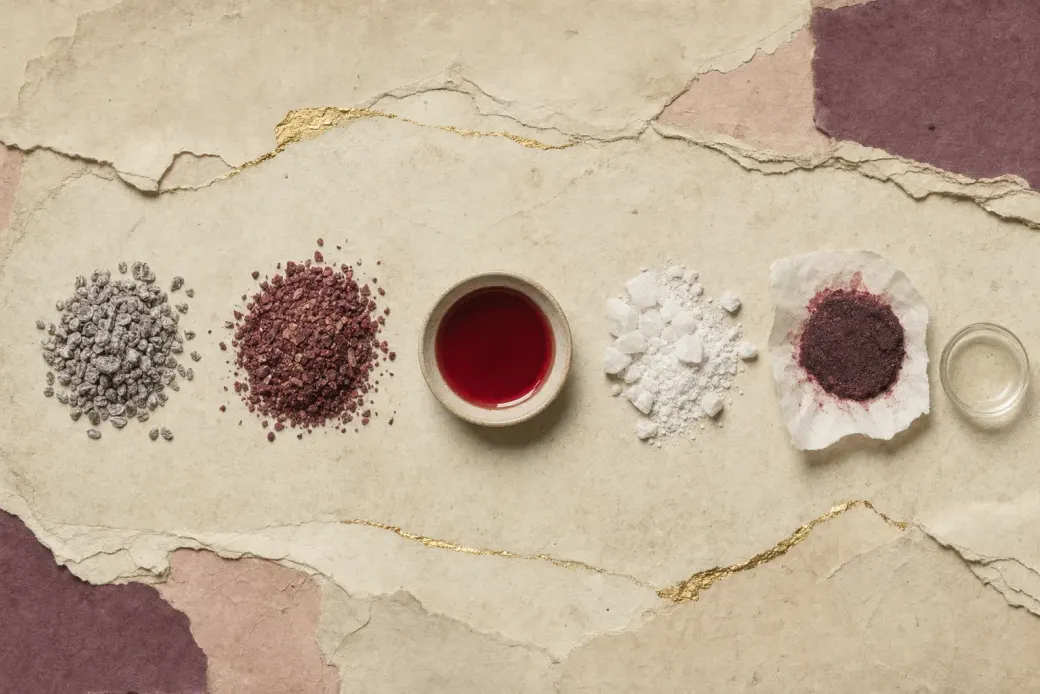
A deep crimson lake pigment made from the dried bodies of the female cochineal insect, and the only red of animal origin still in routine industrial use in cosmetics.
- 3min read
- 4chapters
- 8sources

Vivien
Your guide through time
Listen to this entry
5 min listenVivien reads our essays aloud, word for word — every date and every name in its place — so you can listen the way you would be walked through a gallery.
An AI voice, designed for History of Makeup
Carmine is the aluminium lake of carminic acid, the red compound that the scale insect Dactylopius coccus manufactures in its own body. The insects are farmed on prickly pear, brushed from the cactus pads, killed and dried; the colour is drawn out in hot water and then fixed onto an aluminium substrate, which turns a soluble dye into an insoluble pigment.[1]
It survives in modern formulation because nothing else quite matches it. Something like seventy thousand dried insects are needed for a pound of dye, a ratio that made cochineal one of the most valuable cargoes leaving the Americas for three centuries.[2]
What It Is
The colouring principle is carminic acid, an anthraquinone carrying a sugar group. That sugar is the whole difference between it and the kermesic acid of European kermes: it makes the molecule more water-soluble and, in practice, a much stronger dye.[3]
Commercial carmine is not carminic acid alone. It is a complex of the acid with aluminium, often with calcium as well, and it carries insect protein through from the extraction. Nor is it the same listed material as cochineal extract, the weaker aqueous preparation that United States regulation treats as a colour additive in its own right and requires to be declared under its own name.[3]
Chromatographic work on pre-Columbian Peruvian textiles has identified a set of minor carminic acid derivatives that appear to fingerprint that region.[4] Telling cochineal apart from the other insect reds is a coarser business, done on which main anthraquinone is present — carminic, kermesic or laccaic acid.[3]
In History
Cochineal was cultivated in Mesoamerica before the Spanish arrival and rendered as tribute in bagged form. After 1521 it became a controlled colonial export, concentrated in Oaxaca and shipped through Seville, and it is commonly described as the most valuable American export after silver.[5]
Europe did not know what it was buying. The material arrived as hard dried grains, and whether those grains were seeds, berries or animals was argued over until eighteenth-century microscopy settled the question in favour of the insect.[6]
In cosmetics the dye moved from the dyehouse to the dressing table as carmine lake, and by the time American cosmetics became an industry it was the standard red for rouge and lip colour.[7]
What It Does
As a lake, carmine behaves as a pigment rather than a dye. It is ground and dispersed rather than dissolved, and it sits on the surface instead of staining it.[8] That is precisely why it works in a lipstick bullet, where a soluble dye would migrate into the skin and bleed at the lip line.
The shade shifts with pH and with the metal it is laked onto, running from orange-red through true crimson to a bluish purple. A single raw material can therefore support a wide range of finished colours, which is part of why it outlasted its competitors.[9]
Safety and Status
Carmine is permitted in cosmetics in both major jurisdictions. In the European Union it appears as CI 75470 in Annex IV to Regulation (EC) No 1223/2009, the positive list of colourants allowed in cosmetic products.[10]
In the United States the Food and Drug Administration issued a final rule on 5 January 2009 in response to reports of severe allergic reactions including anaphylaxis. It requires foods to declare cochineal extract or carmine by name in the ingredient statement, and cosmetics to declare carmine prominently and conspicuously at least once in the labelling.[11] The distinction matters: cochineal extract is not a listed cosmetic colour additive in the United States at all, so the cosmetic half of the rule speaks only to carmine. The agency confirmed the effective date of 5 January 2011 in a notice of 11 March 2009.[12] The requirement is a labelling one: it exists so that people who react to the material can identify it, not because the colourant was withdrawn.
Sources
- [1, 6, 9]Cochineal Red: The Art History of a Color The Metropolitan Museum of Art Bulletin, vol. 67, no. 3, 2010.
- [2, 5]A Perfect Red: Empire, Espionage, and the Quest for the Color of Desire HarperCollins, 2005.
- [3, 8]Natural Dyes: Sources, Tradition, Technology and Science Archetype Publications, 2007.
- [4]Identification of unknown colorants in pre-Columbian textiles dyed with American cochineal (Dactylopius coccus Costa) using high-performance liquid chromatography and tandem mass spectrometry Analytical and Bioanalytical Chemistry, vol. 407, no. 3, pp. 855-867; published online 12 September 2014, 2015.
- [7]Hope in a Jar: The Making of America’s Beauty Culture Metropolitan Books, 1998.
- [10]Regulation (EC) No 1223/2009 on cosmetic products 2009.View source (opens in a new tab) Accessed 2026-09-22.
- [11]Listing of Color Additives Exempt From Certification; Food, Drug, and Cosmetic Labeling: Cochineal Extract and Carmine Declaration (final rule) Federal Register, 5 January 2009, 2009.View source (opens in a new tab) Accessed 2026-09-22.
- [12]Listing of Color Additives Exempt From Certification; Food, Drug, and Cosmetic Labeling: Cochineal Extract and Carmine Declaration; Confirmation of Effective Date Federal Register, 11 March 2009, 2009.View source (opens in a new tab) Accessed 2026-09-22.