Carnauba Wax
Identity
In current useas of 22 Sep 2026
- INCI name
- COPERNICIA CERIFERA (CARNAUBA) WAX
- CAS
- 8015-86-9
- EC
- 232-399-4
- Origin
- Plant
- Also known as
- Brazil wax · Ceará wax · Copernicia cerifera cera · palm wax · E 903
What it does
No regulatory dataset is loaded. The status above is this archive's editorial summary of the documented record, not a statement of any substance's legal position in your jurisdiction, and nothing here is advice on whether to use it.
In short
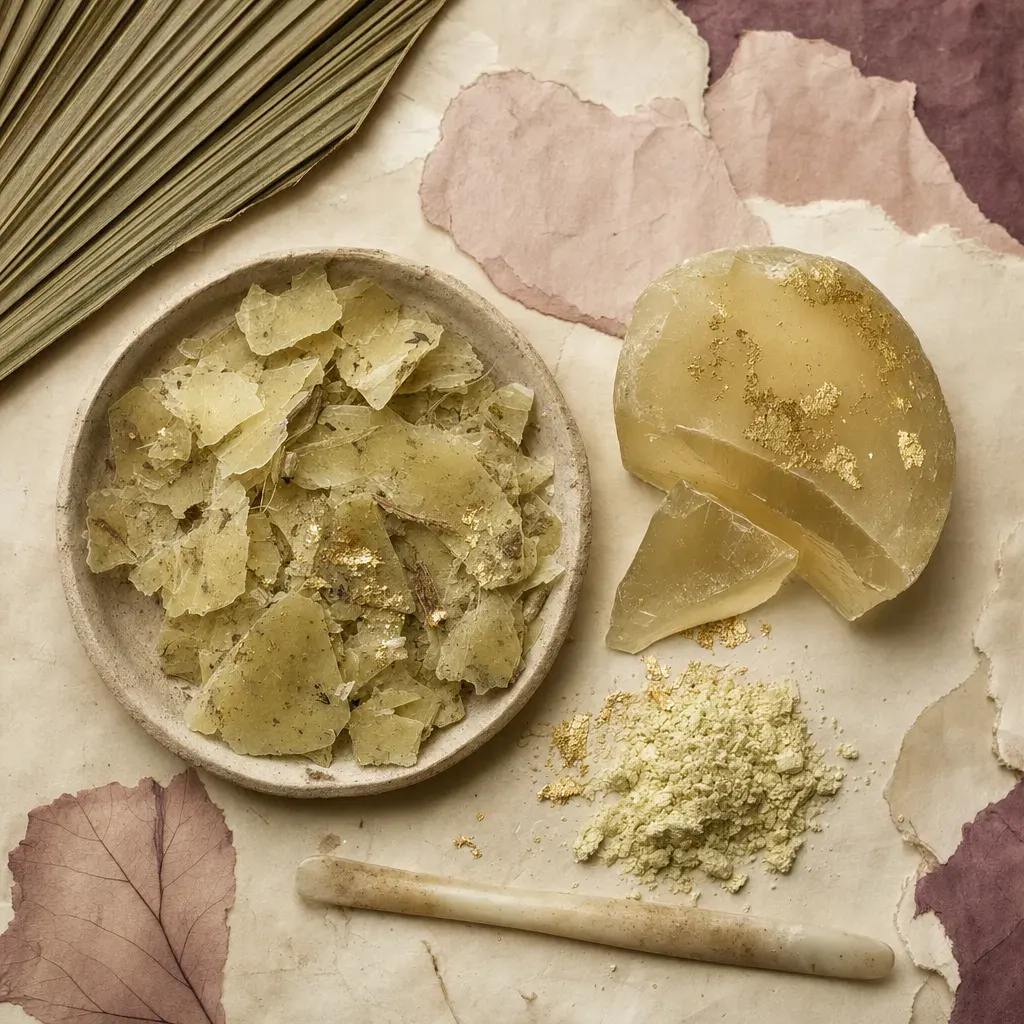
Carnauba is the hard, high-melting wax a Brazilian fan palm secretes onto its fronds to survive the dry season, and in cosmetics it is the ingredient that stops a lipstick going soft in a warm room.
- 2min read
- 4chapters
- 6sources

Vivien
Your guide through time
Listen to this entry
4 min listenVivien reads our essays aloud, word for word — every date and every name in its place — so you can listen the way you would be walked through a gallery.
An AI voice, designed for History of Makeup
Carnauba wax comes from the leaves of a fan palm that grows in the dry north-east of Brazil. The tree coats its fronds to survive months without rain. The leaves are cut, dried until the coating flakes away, and the flakes are melted and filtered.
It is the hardest and among the highest-melting waxes in ordinary cosmetic use, and it is valued for precisely that. A small proportion added to a softer base raises the melting point of the whole blend and lifts the gloss of the finished surface.[1]
What It Is
The wax is dominated by esters of very long-chain acids and alcohols, mostly in the range of twenty-six to thirty carbons, together with a substantial fraction of diesters built on hydroxycinnamic acid. Those aromatic diesters are unusual among commercial waxes and are part of the reason carnauba sets so hard.
The nomenclature is a small trap. The palm's accepted botanical name is Copernicia prunifera, but the cosmetic ingredient is still listed under the older synonym Copernicia cerifera. An ingredient list and a botanical reference can therefore disagree while describing the same tree.[2]
In History
Carnauba was a Brazilian export commodity long before it was a cosmetic ingredient. European chemists examined it during the nineteenth century, first with candles in mind and later as the working component of floor and furniture polishes, and an economy grew around the palm groves of the north-eastern states.[3]
Its cosmetic career followed the moulded lipstick. Once colour had to be cast into a stick that would be carried in a handbag and used in the street, the formulator needed a wax that held its shape in a warm room, and carnauba was already being produced in quantity for other trades.[4]
What It Does
Carnauba is a hardener, used at low percentages. It raises the melting point of a wax blend, increases the force needed to break a stick, and gives a smoother, glossier cast surface. It also acts as a film former: part of the thin layer left behind on lip or lash is carnauba.
Used alone it is unworkable. It sets brittle and drags rather than glides, so it is almost always carried in a softer matrix of beeswax, candelilla or a mineral wax.[5]
Safety and Status
The Cosmetic Ingredient Review panel assessed carnauba alongside beeswax, candelilla and Japan wax, concluding in 1984 that they were safe in the practices of concentration and use then current, and allowing that conclusion to stand on re-review.[6] Carnauba is not listed in the prohibited or restricted annexes of Regulation (EC) No 1223/2009 of 30 November 2009.[7]
In food it is E 903 under Regulation (EC) No 1333/2008 of 16 December 2008,[8] and Commission Regulation (EU) No 1147/2012 of 4 December 2012 set out its use as a glazing agent on certain fruits.[9] Supply is a separate question from toxicology. Carnauba is cut and beaten by hand from wild and semi-managed groves, and the labour and land economics of that harvest have been examined in their own right.[10]
Sources
- [1, 4, 5]Lipstick Formulation Cosmetics and Skin.View source (opens in a new tab) Accessed 2026-09-22.
- [2, 3, 10]From Candle Wax to E 903: Commodity Geographies of the Carnaúba Wax Palm (Copernicia cerifera) from Northeastern Brazil Paper presented at the Ninth International Congress of the Brazilian Studies Association, 2008.View source (opens in a new tab) Accessed 2026-09-22.
- [6]Final Report on the Safety Assessment of Candelilla Wax, Carnauba Wax, Japan Wax, and Beeswax Journal of the American College of Toxicology, volume 3, issue 3, 1984.View source (opens in a new tab)
- [7]Regulation (EC) No 1223/2009 of the European Parliament and of the Council of 30 November 2009 on cosmetic products Official Journal of the European Union, 2009.View source (opens in a new tab) Accessed 2026-09-22.
- [8]Regulation (EC) No 1333/2008 of the European Parliament and of the Council of 16 December 2008 on food additives Official Journal of the European Union, 2008.View source (opens in a new tab) Accessed 2026-09-22.
- [9]Commission Regulation (EU) No 1147/2012 of 4 December 2012 amending Annex II to Regulation (EC) No 1333/2008 as regards the use of beeswax (E 901), carnauba wax (E 903), shellac (E 904) and microcrystalline wax (E 905) on certain fruits Official Journal of the European Union, 2012.View source (opens in a new tab) Accessed 2026-09-22.