Iron Oxides
Identity
In current useas of 22 Sep 2026
- INCI name
- IRON OXIDES
- CAS
- 1309-37-151274-00-11317-61-9
- EC
- 215-168-2257-098-5215-277-5
- Colour Index
- CI 77491CI 77492CI 77499
- Origin
- Mineral
- First attested
- 100,000 BCE
- Also known as
- red iron oxide · yellow iron oxide · black iron oxide · magnetite · Pigment Red 101
How it is dated
This field records the first attested production and storage of the pigment, not its first attested use on skin. An ochre-processing toolkit was recovered from deposits at Blombos Cave, South Africa, dated to roughly 100,000 years ago; the excavators state that the application of the mixture is unknown, and this entry does not assert a cosmetic use at that date.
No regulatory dataset is loaded. The status above is this archive's editorial summary of the documented record, not a statement of any substance's legal position in your jurisdiction, and nothing here is advice on whether to use it.
In short
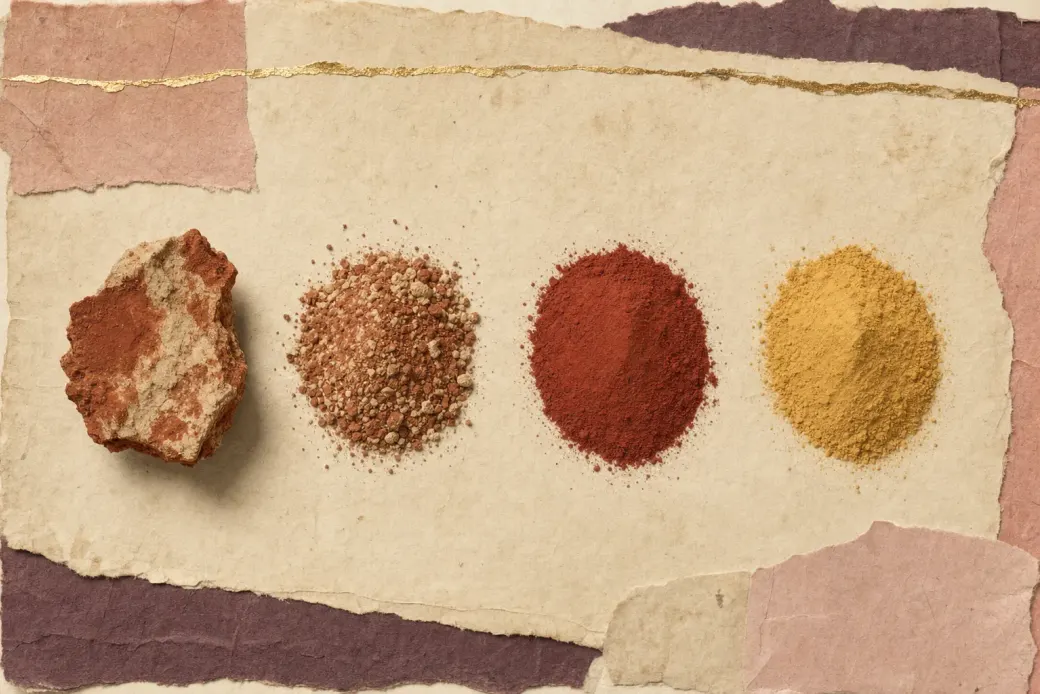
Three iron compounds, a red, a yellow and a black, which between them mix almost every shade of human skin and carry most of the colour in foundation, concealer and pressed powder.
- 3min read
- 4chapters
- 4sources

Vivien
Your guide through time
Listen to this entry
5 min listenVivien reads our essays aloud, word for word — every date and every name in its place — so you can listen the way you would be walked through a gallery.
An AI voice, designed for History of Makeup
Iron oxides are the workhorse pigments of modern colour cosmetics. Three of them, a red, a yellow and a black, are blended in varying ratios to build nearly every foundation, concealer and pressed powder shade on the market. In the United States all three are listed as a single colour additive.[1]
They are also among the oldest colouring materials people have used. The red is chemically the same compound as the colouring matter in ochre, the earth pigment ground and stored in southern African caves roughly a hundred millennia ago.[2]
What It Is
Three distinct compounds share the name. Red is iron(III) oxide. Yellow is a hydrated iron oxide, chemically an iron oxide-hydroxide. Black is iron(II,III) oxide, the compound that occurs in nature as magnetite and is weakly magnetic. The trade designation Pigment Red 101 names the red member only; the yellow and the black carry designations of their own.
Cosmetic grades are not dug out of the ground. The American colour additive listing describes them as synthetically prepared iron oxides, including the hydrated forms, free from admixture with other substances, and sets limits on the trace metals they may carry.[3] How that material is made is not something the listing describes: in practice it is precipitated from solution, which is what gives a maker control over particle size and shade. Ochre from a hillside carries clay, silica and whatever else the deposit held. A synthetic iron oxide is made to a specification, which is why this entry and the separate entry for red ochre are not about the same material.
In History
Red ochre has one of the longest archaeological records of any colouring material, though it is not the earliest claimed and no cited source here ranks it against the others. At Blombos Cave in South Africa, excavators recovered grindstones, hammerstones and two abalone shells holding a liquefied ochre-rich mixture, in deposits dated to about 100,000 years ago.[4]
The find demonstrates deliberate sourcing, processing and storage. It does not demonstrate what the mixture was for. Accounts that describe it as body paint go past the evidence, and the excavators did not claim it.[4]
Iron oxides also appear in the analysed residues of ancient Egyptian eye cosmetics, but more sparsely than the familiar account suggests. In one of the eleven Petrie Museum kohl containers analysed in 2022, haematite was identified by X-ray diffraction alongside lead minerals, and the authors note that no iron was detected in that sample by electron microscopy, which they attribute to heterogeneity within the sample. The same study found manganese-based, silicon-based and carbon-based recipes as well as the familiar lead-based ones, so the range of kohl is wider than the standard account allows.[5]
What It Does
Iron oxides are opaque, insoluble and lightfast. They do not dissolve in the oil or water phase of a formulation. They sit in it as dispersed solid particles, which is why a foundation has to be milled rather than simply stirred.
Their practical virtue is mixing behaviour. Red, yellow and black in different proportions cover the range of human skin tone, and titanium dioxide lightens the result without shifting its hue very much. A fourth colourant is rarely needed. The American listing reflects this by treating any one or any combination of the synthetic iron oxides as the same additive, whatever the shade.[6]
Safety and Status
In the United States, iron oxides are listed at 21 CFR 73.2250 for colouring cosmetics generally, including cosmetics intended for use in the area of the eye, and batches are exempt from certification.[7] In the European Union they appear in Annex IV of Regulation (EC) No 1223/2009, the positive list of colourants permitted in cosmetic products.[8]
The American listing constrains purity rather than concentration: arsenic not more than 3 parts per million, lead not more than 10, mercury not more than 3.[7] Those figures describe the pigment as supplied to a manufacturer, not the finished product a customer buys.
Sources
- [1, 3, 6, 7]21 CFR 73.2250 - Iron oxides Code of Federal Regulations, title 21, part 73, subpart C, 2026.View source (opens in a new tab) Accessed 2026-09-22.
- [2, 4]A 100,000-Year-Old Ochre-Processing Workshop at Blombos Cave, South Africa Science, volume 334, 2011.View source (opens in a new tab)
- [5]Recipes of Ancient Egyptian kohls more diverse than previously thought Scientific Reports, volume 12, 2022.View source (opens in a new tab)
- [8]Regulation (EC) No 1223/2009 on cosmetic products 2009.View source (opens in a new tab) Accessed 2026-09-22.