Kermes
Identity
Obsoleteas of 22 Sep 2026
- Colour Index
- CI 75460
- Origin
- Animal
- First attested
- 1,900 BCE
- Also known as
- Kermes vermilio · grain · scarlet grain · kermes lake · Natural Red 3 · al-qirmiz
No INCI name: this material predates the nomenclature and is not a listed cosmetic ingredient.
How it is dated
A wool textile from the Cave of Skulls in the Judean Desert, radiocarbon-dated to between 1954 and 1767 BCE, is the oldest kermes-dyed cloth confirmed by chemical analysis.
No regulatory dataset is loaded. The status above is this archive's editorial summary of the documented record, not a statement of any substance's legal position in your jurisdiction, and nothing here is advice on whether to use it.
In short
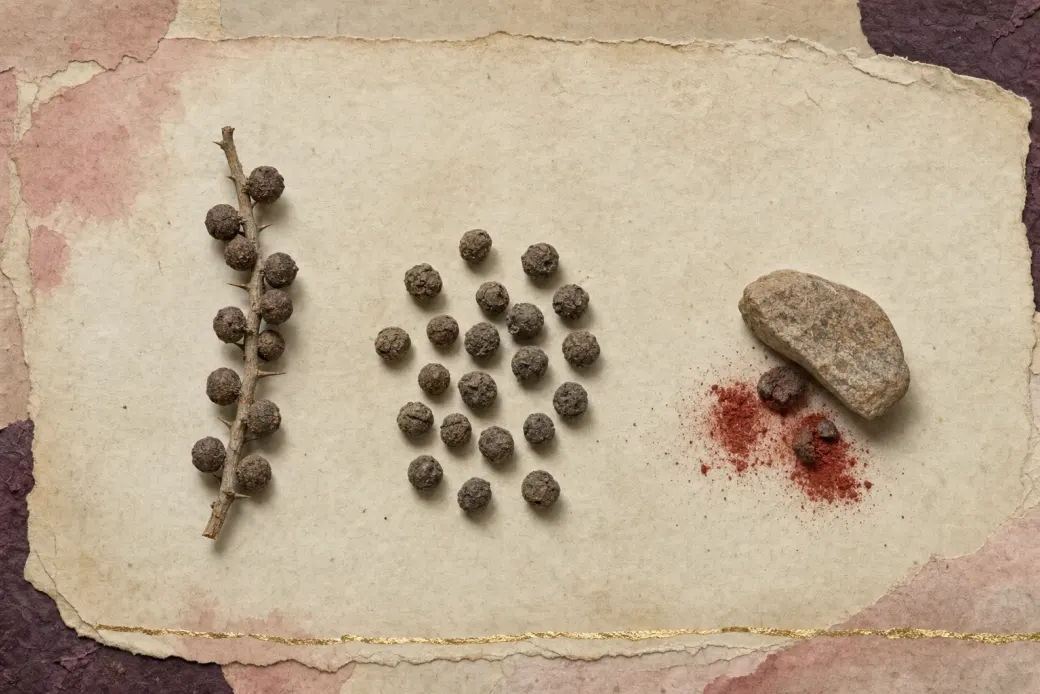
The scarlet of the Mediterranean world before American cochineal: a red dye taken from the dried females of a scale insect that lives on the kermes oak.
- 2min read
- 4chapters
- 8sources

Vivien
Your guide through time
Listen to this entry
4 min listenVivien reads our essays aloud, word for word — every date and every name in its place — so you can listen the way you would be walked through a gallery.
An AI voice, designed for History of Makeup
Kermes is a red taken from the dried, gravid females of scale insects of the genus Kermes, chiefly Kermes vermilio, which feed on the kermes oak, Quercus coccifera, around the Mediterranean.[1]
For most of its history nobody was certain what it was. The insect fixes itself to a twig, swells into a hard rounded body and looks exactly like a berry, so the material was collected, traded and taxed as a grain for centuries before naturalists resolved the question.[2]
What It Is
The colourant is kermesic acid, an anthraquinone. Structurally it is carminic acid without the sugar group, and that absence is the chemical reason kermes yields less colour per unit weight than cochineal and lost its market as soon as cochineal arrived.[3]
Like the other anthraquinone reds it needs a mordant, usually an aluminium salt, to bind to wool or silk. Extracted with alkali and precipitated onto alumina it gives a lake that was for a long period one of the principal red lakes of European painting.[4] The name crimson lake belonged to that kermes product first. It followed the trade to cochineal once carmine took the market in the sixteenth century, and in modern glossaries it is the cochineal lake that carries it.[4]
In History
The oldest textile dyed with Kermes vermilio yet confirmed by chemical analysis comes from the Cave of Skulls in the Judean Desert and is radiocarbon-dated to between 1954 and 1767 BCE.[7] Jars of dried kermes reported from a Neolithic burial at Adaouste in Provence would be considerably older, but that identification has not been confirmed analytically.[8]
Pliny describes the coccum of Galatia and of Spain at Naturalis Historia 9.141, and the scarlet grain gathered from the low-growing holm-oak at 16.32.[5] Roman writers treat red as both a dyestuff and a face colour, though the surviving Latin rarely specifies which red is meant.[6]
Medieval Europe knew the material as grain, and cloth coloured with it was dyed in grain, which is where the word ingrained comes from. Kermes declined through the sixteenth century as Spanish cochineal reached European markets.[8]
In Cosmetics
Kermes has a thinner cosmetic record than its fame suggests. It is documented above all as a textile dye and a painter's lake.[9] The surviving European recipes for rouge more often name safflower, brazilwood and, after the sixteenth century, cochineal.[10][11]
Its clearest mark on cosmetics is linguistic. The Arabic al-qirmiz, the kermes, gives English crimson, and also alkermes, a spiced confection coloured with the insect and quietly recoloured with cochineal once kermes grew scarce.[9]
Safety and Status
Kermes is obsolete as a cosmetic material. It fell out of commercial use long before the modern ingredient nomenclature existed, so it carries no INCI name of its own; the insect red the European Union lists for cosmetics is carmine, which stands as CI 75470 in Annex IV to Regulation (EC) No 1223/2009, the positive list of colourants permitted in cosmetic products.[13]
It survives in two narrow places. In conservation science, kermesic acid found in a textile or a paint layer helps date and locate the object and tell it apart from a cochineal-dyed one.[12][14] Among hand dyers, small quantities of the dried insect are still bought and used.[12]
Sources
- [1, 4, 14]Kermes, CAMEO: Conservation and Art Materials Encyclopedia Online Museum of Fine Arts, Boston, 2026.View source (opens in a new tab) Accessed 2026-09-22.
- [2, 3, 8, 9, 12]Natural Dyes: Sources, Tradition, Technology and Science Archetype Publications, 2007.
- [5]Naturalis Historia, Books IX, XVI and XXII 77.
- [6]Cosmetics in Roman Antiquity: Substance, Remedy, Poison The Classical World 102.3, 2009.
- [7]Early evidence of an archaeological dyed textile using scale-insects: The Cave of Skulls, Israel Journal of Archaeological Science: Reports, vol. 57, article 104673, 2024.
- [10]The Artificial Face: A History of Cosmetics David & Charles, 1973.
- [11]Fashions in Makeup: From Ancient to Modern Times Peter Owen, 1972.
- [13]Regulation (EC) No 1223/2009 on cosmetic products 2009.View source (opens in a new tab) Accessed 2026-09-22.