Dimethicone
Identity
In current useas of 22 Sep 2026
- INCI name
- DIMETHICONE
- CAS
- 9006-65-963148-62-99016-00-6
- Origin
- Synthetic
- First attested
- 1946 CE
- Also known as
- polydimethylsiloxane · PDMS · dimeticone · dimethylpolysiloxane
What it does
How it is dated
The polymer was made before it was described. Eugene Rochow's direct-process experiment at General Electric on 10 May 1940 dates the monomer route rather than the material, and organosilicon work at Corning Glass Works in the 1930s is earlier still without being precisely dated in the sources used here. The securely dated record for the linear methylpolysiloxanes themselves is Winton Patnode and Donald Wilcock's characterisation of 1946.
No regulatory dataset is loaded. The status above is this archive's editorial summary of the documented record, not a statement of any substance's legal position in your jurisdiction, and nothing here is advice on whether to use it.
In short
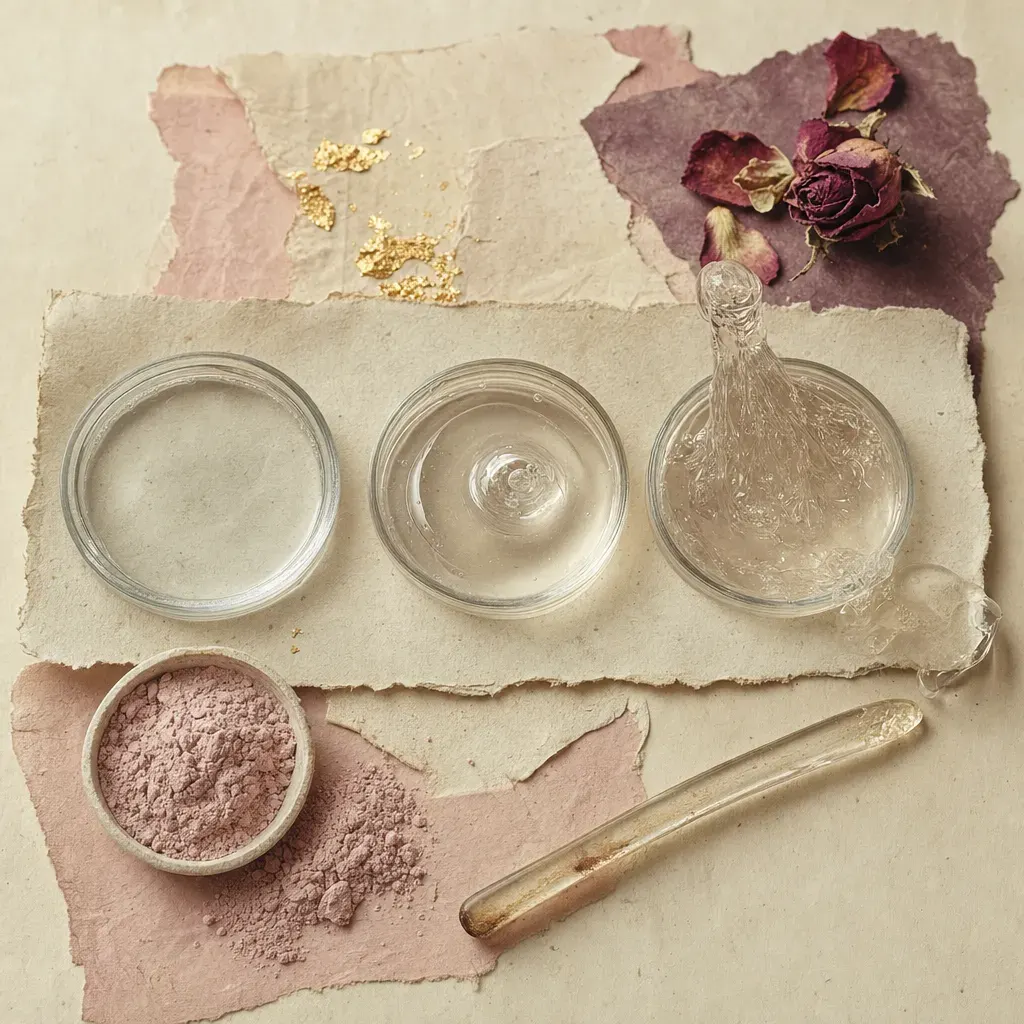
A synthetic silicone fluid sold in every viscosity from thinner than water to a cuttable gum, valued in cosmetics for spreading further than an oil of the same thickness and for leaving a dry rather than a greasy surface.
- 3min read
- 4chapters
- 6sources

Vivien
Your guide through time
Listen to this entry
5 min listenVivien reads our essays aloud, word for word — every date and every name in its place — so you can listen the way you would be walked through a gallery.
An AI voice, designed for History of Makeup
Dimethicone is the plainest member of the silicone family and the one most widely used in cosmetics. It is a chain of alternating silicon and oxygen atoms, with two methyl groups on every silicon.[1] It is supplied in viscosities ranging from thinner than water to a gum that must be cut with a solvent before it can be poured.
Its usefulness is almost entirely physical. It spreads further than a vegetable or mineral oil of the same thickness, it does not oxidise into rancidity, and it leaves a surface that feels dry rather than greasy. Most modern foundations, primers and hair conditioners contain some.
What It Is
The backbone is a siloxane: silicon and oxygen repeating in alternation, with a methyl group on either side of each silicon. The silicon to oxygen bond is longer and more freely rotating than a carbon to carbon bond, which is why silicone fluids stay pourable across a wide temperature range and why a very long chain can still behave as a liquid.
Dimethicone is made by hydrolysing dimethyldichlorosilane. That reaction became industrially practical after Eugene Rochow passed methyl chloride over a heated copper and silicon mixture at General Electric in May 1940, a route since known as the direct process.[2] Hydrolysis yields both rings and chains; Winton Patnode and Donald Wilcock separated and described the two families in 1946.[3] The chains, capped at each end and sorted by length, are dimethicone. The rings are the cyclic siloxanes.
In History
Silicones reached the market as war materials. Corning Glass Works and Dow Chemical formed the Dow Corning joint venture in 1943 to manufacture them.[4] The early demand was industrial - greases, insulators, hydraulic fluids - rather than for anything applied to a face. The move into skin and hair products came later, as part of the wider post-war turn of the beauty industry towards synthetic raw materials.[5]
Hair care did most to spread it. A conditioner that deposits a thin silicone layer alters how hair feels immediately, and the change can be judged in the hand rather than argued for. That immediacy mattered as much to dimethicone's adoption as any technical case made for it.
What It Does
In a formulation dimethicone does three separable jobs. It thins the feel of heavy oils and waxes, so a cream can carry pigment without dragging. It slows water loss from the surface of the skin by sitting on it as a continuous layer. And in hair products it coats the cuticle, reducing friction between strands and making combing easier.
Low-viscosity grades act mainly as spreading agents. High-viscosity gums act as film formers and are usually supplied already dispersed in a volatile carrier, because they cannot easily be handled otherwise. In the United States dimethicone is also a listed over-the-counter skin protectant active ingredient, permitted at one to thirty per cent under 21 CFR 347.10, as in force on 22 September 2026.[6]
Safety and Status
Dimethicone is in ordinary cosmetic use. It is a chain rather than a ring, and it is not itself named in the European restrictions on cyclic siloxanes: Commission Regulation (EU) 2018/35 of 10 January 2018 restricted the rings D4 and D5 in wash-off cosmetic products,[7] and Commission Regulation (EU) 2024/1328 of 16 May 2024 extended entry 70 of Annex XVII to the REACH Regulation to D6 and to leave-on products.[8] All three of those substances are rings.
Entry 70 nevertheless reaches dimethicone indirectly. As amended, the restriction bites on D4, D5 and D6 at or above one tenth of one per cent by weight whether they are present as substances on their own, as constituents of other substances, or in mixtures.[8] Commercial dimethicone can carry a residue of cyclic siloxane left over from manufacture, so a grade carrying residual cyclics above that threshold is within the scope of the instrument - which is why cosmetic grades are bought against a specification rather than as a generic fluid. European regulatory attention to silicones over the past decade has been directed at their persistence in the environment rather than at their behaviour on skin.
Sources
- [1, 2, 4]Dimethyldichlorosilane and the Direct Synthesis of Methylchlorosilanes. The Key to the Silicones Industry Organometallics, volume 20, 2001.View source (opens in a new tab)
- [3]Methylpolysiloxanes Journal of the American Chemical Society, volume 68, issue 3, pages 358-363, 1946.View source (opens in a new tab)
- [5]Beauty Imagined: A History of the Global Beauty Industry Oxford University Press, 2010.
- [6]Code of Federal Regulations, Title 21, Part 347: Skin Protectant Drug Products for Over-the-Counter Human Use, section 347.10, Skin protectant active ingredients United States Government Publishing Office, electronic Code of Federal Regulations, 2026.View source (opens in a new tab)
- [7]Commission Regulation (EU) 2018/35 of 10 January 2018 amending Annex XVII to Regulation (EC) No 1907/2006 concerning the Registration, Evaluation, Authorisation and Restriction of Chemicals (REACH) as regards octamethylcyclotetrasiloxane (D4) and decamethylcyclopentasiloxane (D5) Official Journal of the European Union, 2018.View source (opens in a new tab)
- [8]Commission Regulation (EU) 2024/1328 of 16 May 2024 amending Annex XVII to Regulation (EC) No 1907/2006 as regards octamethylcyclotetrasiloxane (D4), decamethylcyclopentasiloxane (D5) and dodecamethylcyclohexasiloxane (D6) Official Journal of the European Union, 2024.View source (opens in a new tab)